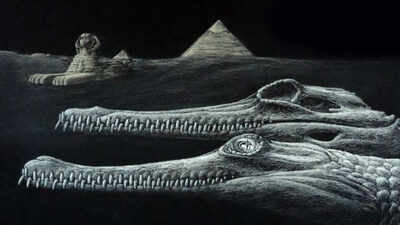
Long before the Great Sphinx became one of Egypt’s most recognisable monuments, the landscape around Cairo was home to a very different kind of long-snouted creature. Now, a fossil discovered from the same ancient rocks used to construct the Sphinx has revealed a new species of extinct crocodile and it comes with an extraordinary coincidence. The fossil is missing the tip of its snout, creating an uncanny parallel with the monument’s famously absent nose. The species, named Herugavialis cairensis, has been identified through a fresh examination of fossils recovered nearly a century ago. The findings, published in Royal Society Open Science, offer a glimpse into a time when crocodiles thrived in the ancient Mediterranean.
A crocodile lost to time
According to a report published by Phys Org, the fossils were originally recovered during the 1920s from Egypt’s roughly 45-million-year-old Mokattam Formation. Among them was a remarkably well-preserved skull that had been classified as belonging to Tomistoma, the group commonly associated with the modern false gharial. That identification, however, was based largely on the fossil’s outward resemblance to the living species. Modern paleontological techniques have now allowed researchers to take a much closer look.CT scanning, in particular, enabled scientists to examine the internal structure of the skull without damaging the fossil. Combined with new analytical methods, the investigation revealed a series of anatomical differences significant enough to establish the crocodile as a previously unrecognised species, adds the report.The skull of Herugavialis cairensis remains relatively complete, although its missing snout tip became one of the most intriguing details of the discovery, claims the findings.
The gharial connection
According to the findings, gavials are distinguished by their unusually long, slender snouts, a feature adapted to their specialised feeding habits. Today, only two living species remain: the critically endangered gharial, Gavialis gangeticus, found on the Indian subcontinent, and Tomistoma schlegelii, the false gharial of Southeast Asia.Their evolutionary history, however, is considerably more expansive. Fossil gavials have been found across much of the world and represent a lineage that stretches back more than 100 million years. Unlike their modern descendants, many ancient species inhabited shallow marine environments, adds the findings. Also, Herugavialis adds another piece to this complex evolutionary story, showing that ancient Egypt once supported a surprisingly rich assemblage of long-snouted crocodilians.
Egypt’s ancient crocodile coast
As per Phys Org, around 45 million years ago, the landscape of what is now Egypt looked dramatically different. Shallow marine environments covered parts of the region, creating habitats capable of supporting several crocodile species.Herugavialis was far from alone. At least two other gavial species inhabited the region during the same broad period, pointing to a Mediterranean ecosystem with considerably greater crocodile diversity than exists today.The findings suggest that diversity appears to have shifted alongside major changes in Earth’s climate and sea levels. Over millions of years, the Mediterranean environment underwent profound transformations, eventually becoming inhospitable to crocodilians.
A strange echo of the Sphinx
According to Royal Society Open Science, the discovery carries an almost poetic connection to one of Egypt’s most famous monuments. The Mokattam rocks that preserved the fossil also contributed to the geological material from which the Great Sphinx was carved. Even more striking is the missing anatomy, as the Sphinx is renowned for its damaged and absent nose, while the fossil crocodile is missing the end of its own snout. The coincidence inspired the name Herugavialis, drawing on Heru, the ancient Egyptian deity associated with the falcon-headed god Horus and thought by the researchers to have potentially influenced the imagery of the Sphinx, the findings conclude.Image Courtesy: Phys Org