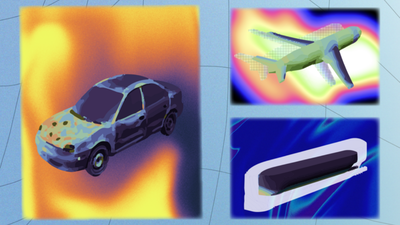
Artificial intelligence can already generate texts, create images and generate 3D objects, but getting AI to understand how those objects behave in the real world is much harder. Researchers at MIT and Tsinghua University have now developed a new AI approach called GeoPT that could help bridge that gap. The system is designed to learn basic physical behaviour and predict how cars, planes, boats and other objects respond to wind, water, collisions and other forces. The researchers say it can learn up to twice as fast while using up to 60% less data than existing models. The approach could eventually help engineers test vehicle designs virtually, allowing them to explore more possibilities while reducing the need for costly physical experiments.
MIT researchers give AI a feel for physics
GeoPT is designed to help AI understand how physical interactions happen around 3D objects. Instead of relying entirely on expensive physics simulations, the researchers created millions of synthetic examples involving tiny particles interacting with different shapes. The particles move towards objects at different speeds and angles before stopping when they reach the object’s surface. By learning from these simple interactions, GeoPT develops a basic understanding of how an object’s shape relates to physical movement before it is trained for more complicated tasks.AI models are extremely good at recognising patterns in text, images and other digital information, but physical behaviour is much harder to learn. To teach an AI how a car responds to airflow or how a boat behaves in waves, researchers normally need large amounts of detailed simulation data. Producing that data can take considerable computing power because specialised programs have to calculate what is happening across thousands or even millions of points on a 3D object. This makes it difficult and expensive to create enough examples for an AI model to learn from.\
GeoPT uses less training data
The researchers found that GeoPT could substantially reduce the amount of labelled data needed for several physics simulation tasks. Across their tests, the system used between 20% and 60% less labelled data than comparison models while maintaining strong performance. MIT says the model also reached peak performance roughly twice as fast overall. The results varied depending on the task, so the 60% figure should not be interpreted as a universal reduction. Instead, it represents the upper end of the savings reported in the researchers’ experiments.
Testing cars, planes and boats
The team tested GeoPT on a range of engineering problems to see whether the approach could work beyond its initial training examples. The model was used to simulate how complex 3D shapes respond to airflow and surface pressure, including aircraft-related scenarios. Researchers also tested how vehicle bodies deform during collisions and how boat hulls respond to forces from both air and water. According to MIT, GeoPT performed better than leading comparison models on several of these benchmarks, particularly in terms of speed, accuracy and the amount of labelled data required.One of the strongest results came from simulations involving a boat hull exposed to both air and waves. The researchers reported that GeoPT needed 60% fewer labelled training examples than leading baseline models while reaching peak accuracy four times faster. This matters because fluid simulations can be computationally demanding, particularly when an object interacts with more than one physical environment. A system that can produce useful predictions with less training could potentially allow engineers to explore more designs without having to run every expensive simulation from scratch.
It can also simulate crash damage
GeoPT was also tested on the kind of physical changes that happen when objects collide. Researchers used the system to predict how different 3D vehicle models would deform after a crash. The model was able to reproduce the deformation patterns while using less labelled data than the comparison systems. This could eventually be useful for industries where engineers need to test many possible designs and collision scenarios. However, the research is still at the experimental stage, so the system should not be viewed as a replacement for certified crash testing or established engineering simulation methods.
Researchers tested it beyond traditional mechanics
The team also carried out a surprising test involving light interacting with a 3D model of a toy rabbit. GeoPT produced accurate results even though the particular 3D model and light-related physics had not been part of its previous training. The researchers see this as evidence that the system can transfer some of what it learned about geometry and physical interactions to situations it has not encountered directly. However, this does not mean GeoPT has mastered optics or every type of physics. It was a specific demonstration of the model’s ability to generalise.
It could reduce the need for physical experiments
The potential practical benefit is straightforward. Engineers often have to test designs repeatedly before settling on a final version. Building physical prototypes or running detailed computer simulations for every variation can take considerable time and money. A fast AI-based simulator could allow engineers to explore many more possibilities during the early stages of design. MIT researcher Haixu Wu said GeoPT produced high-fidelity simulations involving more than 100 million mesh points in seconds, suggesting that the approach could eventually become useful for testing complex vehicle designs before physical experiments are carried out.
The bigger goal is a physics AI
The researchers see GeoPT as more than a tool for individual engineering problems. They believe the approach could eventually contribute to a broader AI system that understands physical behaviour across many different situations. Such a system could potentially help simulate weather, study how materials behave under stress and generate more physically realistic videos. The idea is similar to the way modern AI models can learn from huge amounts of text and images, but with physical behaviour becoming another source of information that helps AI understand the world.
GeoPT is still an early step
Despite the impressive results, GeoPT is not a universal physics simulator and it does not mean AI has suddenly developed a human-like understanding of physics. The current research focuses on specific simulation benchmarks and still relies on additional training for particular tasks. The researchers themselves describe the work as a step towards a more general physics world model. Much more testing would be needed before such systems could reliably replace established engineering tools or physical experiments in safety-critical situations.The significance of GeoPT lies in its attempt to make physics simulation more efficient. Instead of teaching an AI entirely through expensive, task-specific simulations, researchers have found a way to give it useful physical knowledge beforehand using large amounts of synthetic data. If the approach continues to scale, engineers could eventually use AI to test a much wider range of designs and physical scenarios at a fraction of the computational cost of some existing methods. For now, GeoPT represents an early but notable attempt to give AI something it has traditionally lacked: a better understanding of how the physical world actually behaves.