
A fossil that had sat inside London’s Natural History Museum since the 19th century appeared to have little left to reveal. Then palaeontology student Jack L. Norton took a closer look. While studying for his Master’s degree at the University of Portsmouth, Norton and his former supervisor, Dr Samuel Cooper, re-examined the 150-year-old specimen with modern imaging technology. What they uncovered was a previously unrecognised species of coelacanth, an ancient lineage whose living relatives are often described as “living fossils”. The fossil, from southern England’s Lower Cretaceous Gault Formation, helps fill a remarkable 50-million-year gap in the fossil record of the family Latimeriidae, which includes modern coelacanths. The discovery, announced by the University of Portsmouth on 21 April 2026, is also a striking reminder that museum collections can contain scientific discoveries waiting for new generations of researchers to recognise them.
Jack L. Norton found a 150-year-old museum fossil hiding in plain sight
The fossil that changed Norton’s research story was not newly excavated from a remote location. It had already been collected and preserved at the Natural History Museum in London during the 19th century. Its importance only became apparent when Norton, then a Master’s student, and Dr Samuel Cooper returned to the specimen with questions that earlier researchers could not answer. Rather than relying solely on its visible features, the researchers used X-ray computed tomography, or XCT, to examine the fossil internally and reconstruct aspects of it in three dimensions. The technology allowed them to investigate anatomical details that could not be properly studied from the outside. Norton described the experience of manipulating such an old and important specimen in 3D as “truly fantastic”. The finding demonstrates how modern technology can give scientists new ways to interrogate collections that have been preserved for generations.
The museum fossil revealed a missing link in coelacanth evolution
The 150-year-old specimen turned out to be Macropoma gombessae, a previously unknown species and the first diagnostic latimeriid coelacanth identified from the Lower Cretaceous. In the research paper ‘Oldest Cretaceous latimeriid elucidates cranial evolution in derived and extant coelacanths (Actinistia, Latimeriidae),’ published in Papers in Palaeontology, Jack L. Norton, Charles Wood, David M. Martill and Samuel L. A. Cooper used X-ray computed tomography to examine the fossil’s skull in detail. The specimen was collected from the Albian Gault Formation at Folkestone, Kent, and had been purchased by the British Museum in 1885. Its discovery addresses a major gap in the fossil record of Latimeriidae: until now, no diagnostic members of the family were known from the Lower Cretaceous, leaving around 50 million years of their Mesozoic evolutionary history poorly understood. The researchers’ analysis places M. gombessae as the oldest species of Macropoma and as a close relative of later Macropoma species, Swenzia and the living genus Latimeria. Rather than simply representing an intermediate species, the fossil provides evidence for how important features of the coelacanth skull changed through time. Its anatomy retains several more primitive characteristics while showing evolutionary changes in the sensory canals, skull ornamentation and lower jaw. The researchers found that these features help establish the sequence in which major cranial modifications appeared among latimeriids, offering a clearer view of the transition towards the anatomy seen in living coelacanths.
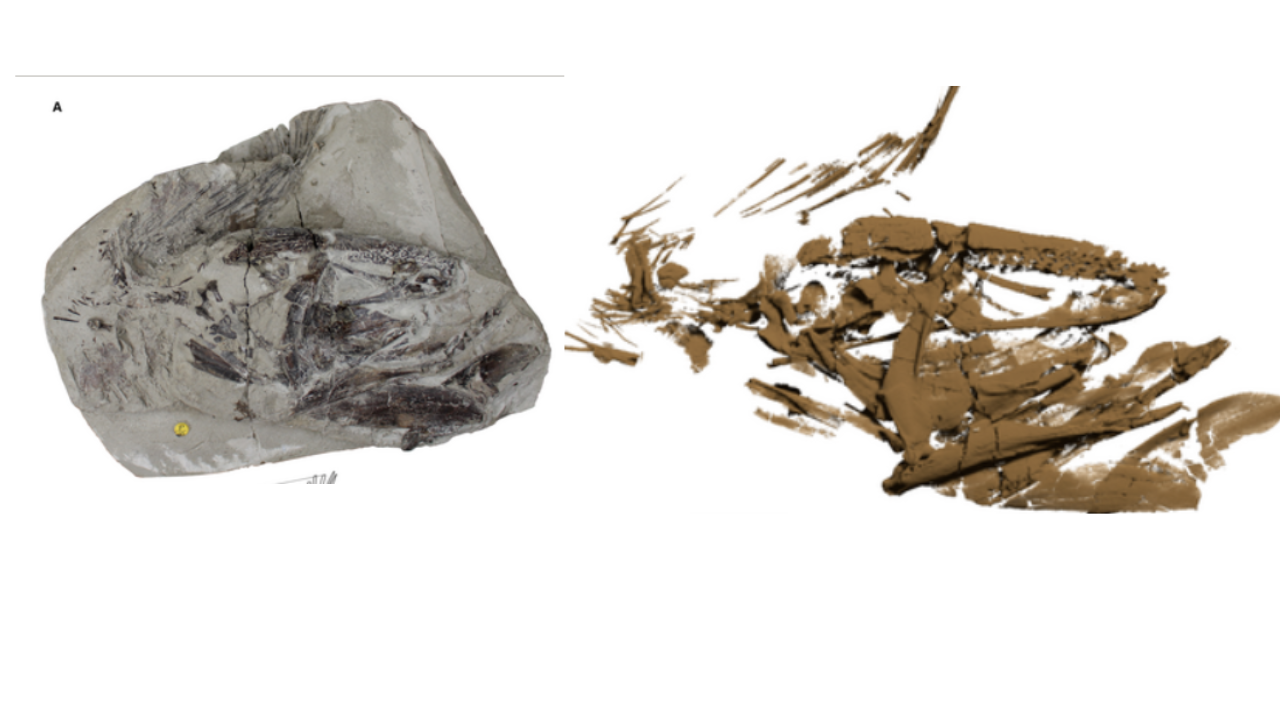
1) Macropoma gombessae sp. nov. NHMUK PV P 36, holotype, from the Early Cretaceous (Albian) Gault Formation of Folkestone, England/2) reconstruction from XCT scan of Macropoma gombessae sp. nov./Images (University of Zurich)
Why Jack L. Norton’s palaeontology discovery matters
Norton’s discovery is significant not simply because it adds another species to the fossil record, but because it illustrates how much information can remain hidden inside established museum collections. Professor David Martill highlighted the fact that it was a curious student who recognised the specimen’s importance, pointing to the value of the next generation of scientists. Emma Bernard, a fossil fish curator at the Natural History Museum, similarly noted that Norton and Cooper were both early in their careers when they identified the specimen as a new species. Their work demonstrates the continuing scientific value of collections assembled long before today’s imaging technology existed. A fossil can remain unchanged for more than a century while the tools used to understand it evolve dramatically. In this case, XCT scanning transformed an old museum specimen into evidence capable of reshaping part of the evolutionary story of one of the world’s most unusual fish lineages.
Macropoma gombessae adds a new chapter to ancient fish evolution
The new species was given the name Macropoma gombessae, with the species name honouring “Gombessa”, a traditional name associated with the living coelacanth among Malagasy communities and fishers in the Comoros. The term roughly refers to an “inedible” or “worthless” fish, reflecting how the animal was perceived before its extraordinary scientific significance became understood. Norton is now pursuing a PhD in Zurich, continuing a career that has already produced an unexpected contribution to palaeontology. The research was published in Papers in Palaeontology, while the University of Portsmouth and the Natural History Museum both emphasised what the discovery says about the potential of historic collections. A specimen that had spent around 150 years quietly sitting in a museum has now become a key piece of evidence for understanding how the ancient lineage leading towards modern coelacanths evolved.