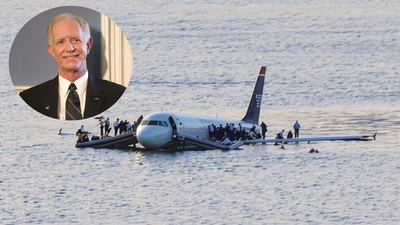
Captain Chesley “Sully” Sullenberger, the pilot who safely landed US Airways Flight 1549 on New York’s Hudson River after a bird strike caused an almost complete loss of thrust in both engines, has been inducted into the National Aviation Hall of Fame. The September 24, 2026, induction came 17 years after the emergency landing that became known as the “Miracle on the Hudson”. All 155 people aboard the Airbus A320 survived the ditching. Sullenberger’s Hall of Fame recognition also reflects a career spanning more than four decades, including military service, commercial aviation, pilot training and advocacy for aviation safety.
How Captain Sully Sullenberger landed the plane on the Hudson River
On January 15, 2009, US Airways Flight 1549 departed New York’s LaGuardia Airport for Charlotte Douglas International Airport in North Carolina. Captain Sullenberger was in command, with First Officer Jeffrey Skiles alongside him. Shortly after take-off, the Airbus A320 encountered a flock of Canada geese. The birds struck the aircraft at low altitude, causing severe damage to both engines and an almost complete loss of thrust. Sullenberger and Skiles immediately began assessing their options while communicating with air traffic controllers.The crew initially considered returning to LaGuardia. Air traffic controllers also suggested Teterboro Airport in New Jersey. However, the aircraft was losing altitude rapidly, and the crew determined that neither airport could be reached safely. Sullenberger then chose the Hudson River as the landing site. The aircraft touched down on the river approximately three and a half minutes after take-off. The successful ditching allowed all 150 passengers and five crew members to escape the aircraft alive. Nearby ferries and other vessels quickly moved towards the stranded Airbus, helping evacuate passengers from the aircraft’s wings and exits. The incident became known internationally as the “Miracle on the Hudson”.
What caused the emergency on Flight 1549
The National Transportation Safety Board investigated the accident and concluded that the aircraft had encountered a flock of large birds shortly after departure. Both engines ingested birds and suffered substantial damage, resulting in an almost total loss of thrust. The investigation found that the crew had only a very short period to respond to the emergency. The aircraft was at a relatively low altitude, leaving little time to select an alternative airport or otherwise recover from the loss of engine power. The NTSB identified the bird strike and resulting dual-engine thrust loss as the probable cause of the accident. The investigation also examined the evacuation, rescue response and other factors surrounding the ditching. The aircraft itself remained sufficiently intact after hitting the river for passengers and crew to evacuate. The incident became an important case study in emergency decision-making, crew coordination and aviation safety.

Capt. Sully Sullenberger stands beside the US Airways Flight 1549 fuselage at the Carolinas Aviation Museum in June 2011.
Who is Captain Sully Sullenberger
The Hudson River landing was the most famous moment of Sullenberger’s career, but he had already spent decades working in aviation. Born in Denison, Texas, Sullenberger learned to fly as a teenager. He attended the US Air Force Academy and graduated in 1973 before becoming a fighter pilot in the US Air Force. During his military career, he served as a flight leader and training officer and participated in multinational military exercises. His experience included flying the F-4 Phantom II. After leaving the Air Force, Sullenberger joined Pacific Southwest Airlines in 1980. The airline was subsequently acquired by US Airways, where he continued his commercial flying career. By the time he retired from commercial aviation in March 2010, Sullenberger had accumulated more than four decades of aviation experience and thousands of hours of flight time.
What did Sully Sullenberger do after the Hudson landing
The 2009 emergency landing made Sullenberger an internationally recognised figure, but he continued working on aviation safety after retiring from airline flying. He became an advocate for improvements in aviation safety, pilot training and crew resource management. He also wrote and spoke extensively about leadership, teamwork and decision-making in high-pressure situations. Sullenberger later entered public service. In 2021, President Joe Biden nominated him to serve as US ambassador and representative to the International Civil Aviation Organization. He assumed the position in 2022 and worked on international aviation issues. His story was also brought to the big screen in Sully, the 2016 film directed by Clint Eastwood and starring Tom Hanks. The film focused on the Hudson River landing and the investigation that followed.
Why was Sully Sullenberger inducted into the Hall of Fame
The National Aviation Hall of Fame selected Sullenberger as part of its Class of 2026. He was formally inducted during a ceremony in Washington, DC, on September 24, 2026. The organisation recognised his actions during Flight 1549 as well as his broader contributions to aviation. His career included military flying, commercial aviation, safety advocacy, pilot training and public service. Sullenberger participated in the induction ceremony remotely. During his remarks, he acknowledged the importance of Flight 1549 while also emphasising that his professional life extended well beyond the dramatic events of January 15, 2009. The 2026 Hall of Fame class also includes astronaut Peggy Whitson and several other figures associated with aviation and aerospace.
Sullenberger’s early-stage Alzheimer’s diagnosis
The Hall of Fame induction comes after Sullenberger publicly revealed in July 2026 that he had been diagnosed with early-stage Alzheimer’s disease. Sullenberger said he had received the diagnosis in August 2025. He later spoke publicly about experiencing some memory difficulties and explained that he wanted to discuss his condition openly rather than keep it private. In interviews, he and his wife, Lorrie, have discussed how they are approaching the diagnosis and treatment. Sullenberger has also said he hopes sharing his experience can help other people and families dealing with Alzheimer’s disease. His diagnosis came more than a decade after the Hudson River landing and does not form the basis of his Hall of Fame recognition, which honours his aviation career and contributions.
What happened to the plane that landed on the Hudson
The Airbus A320 involved in Flight 1549 was recovered from the Hudson River after the accident. The aircraft was eventually preserved and became part of an aviation museum collection. It is now displayed at the Sullenberger Aviation Museum in Charlotte, North Carolina, alongside exhibits connected to the history of commercial and military aviation. The aircraft remains one of the most recognisable physical reminders of the 2009 emergency. The museum’s collection allows visitors to see the aircraft associated with the event that brought worldwide attention to Sullenberger and the crew of Flight 1549.
17 years after the ‘Miracle on the Hudson ’
Sullenberger retired from commercial airline flying shortly after the Hudson River landing, but the event continued to shape his public career. He went on to advocate for aviation safety, participate in public-service work and speak about leadership and emergency decision-making. On September 24, 2026, 17 years after Flight 1549 came down on the Hudson River, Sullenberger was inducted into the National Aviation Hall of Fame.The honour placed the 2009 emergency landing within the context of a much longer aviation career, recognising not only the decision that saved all 155 people aboard Flight 1549 but also Sullenberger’s decades of work in aviation, safety and public service.