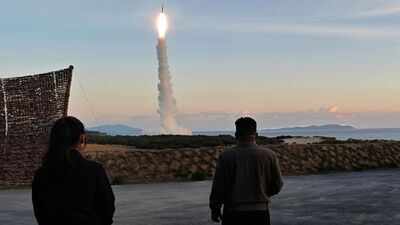
North Korea has claimed it has added artificial intelligence technology to a missile to make the weapon capable of changing its flight path and extremely difficult to intercept, escalating concerns over Pyongyang’s efforts to develop more sophisticated missile systems.North Korean leader Kim Jong Un oversaw the missile launch, with state media claiming the weapon demonstrated advanced manoeuvring capabilities, including flight at low altitude.Pyongyang claimed the weapon was fitted with an AI based guidance system that can make real time adjustments to its flight path, including low altitude manoeuvres, making it harder for enemy missile defence systems to predict and intercept.Kim’s sister and senior North Korean official Kim Yo Jong said the missile demonstrated a “wave like” flight trajectory, which she claimed could complicate enemy tracking and interception.North Korea has presented the test as evidence of progress in developing weapons capable of penetrating advanced missile defence networks.North Korea described the weapon as an intermediate range strategic ballistic missile linked to its hypersonic strategic weapon system.According to South Korea, the missile was launched from the Wonsan area and travelled more than 700 km towards the East Sea. North Korean state media, however, claimed that it struck a target around 1,000 km away.South Korea’s defence ministry said the missile was within the detection and interception capabilities of South Korean and US defence assets. It said the two allies maintain a strong combined defence posture and assessed that the weapon could be detected and intercepted.Why AI in missiles mattersThe significance of artificial intelligence in a missile lies less in simply making the weapon “smarter” and more in its potential to help the weapon process information and adjust its behaviour during flight.The Centre for Strategic and International Studies (CSIS) notes that hypersonic weapons combine high speed with manoeuvrability and relatively low-altitude flight, creating major challenges for conventional missile-defence systems. Unlike a traditional ballistic trajectory, a manoeuvring weapon can follow a less predictable path.That matters because missile defence depends heavily on detecting, tracking and predicting an incoming weapon’s trajectory.CSIS says newer missile threats are increasingly flying lower, faster and on unpredictable trajectories, making them harder to detect and track and increasing the importance of advanced sensor networks.AI could potentially add another layer to this problem.The importance of AI in missiles is therefore not that it makes a weapon automatically “unstoppable”, but that AI-assisted guidance could potentially make a manoeuvring missile more adaptive and its trajectory harder for missile-defence systems to predict.