
When Albert Camus wrote that one must imagine Sisyphus happy, he was not, one would assume, thinking of India’s content creator economy. And yet, there is something Sisyphean about the business of being a creator: the endless filming, editing, posting and chasing of engagement, only to start all over again the next day.One must imagine the creator successful. But is success really within reach of everyone who has been promised a shot at it? In a world where almost everyone has some form of digital access to social media, is the creator economy truly sustainable or even democratised?For a country as young, populous and linguistically diverse as India, the proposition of a platform like social media has always been transformative, for the common man and the common company. Talent could emerge from anywhere, audiences could be found beyond geographical boundaries, and businesses could reach consumers through hyperlocal advertising at a fraction of the cost of traditional campaigns.According to a 2025 report by Boston Consulting Group (BCG), India has between 2 million and 2.5 million active digital creators, whose content influences an estimated $350–400 billion (Rs 33.24 lakh crore to Rs 38 lakh crore) in annual consumer spending. That figure is projected to exceed $1 trillion (Rs 94.97 lakh crore) by 2030.A 2024 YouTube Culture and Trends survey, conducted with research firm SmithGeiger, also found that 83% of surveyed Indians aged 14–24 identified themselves as creators. But identifying as a creator is not the same as earning a living from it.And within this framework the most pertinent question comes up, has just the ability to become a creator been democratised far more than the ability to make a living as one. And who is it that gets to make a living out of it?
A booming economy, a crowded marketplace
The numbers suggest an industry expanding on almost every front. But the growth of the creator economy has also brought more people into competition for brand partnerships, audience attention and a share of the same advertising budgets. The money flowing in the market is not able to keep pace with the number of people wanting to profit off of it.Speaking on the basis of anonymity to a marketing manager from a small digital marketing agency based out of Gurgaon, TOI learnt that in a lot of cases almost 70% upwards of a brand’s marketing budget is allocated for influencer marketing.Micro- and nano-influencers are particularly attractive to brands and agencies because they can offer targeted audience engagement at lower rates than larger creators. But the economics of these collaborations do not always work in creators’ favour. Agencies, acting as middlemen, can negotiate deals that leave creators with little or no monetary compensation. In many cases, instead of being paid for their work, creators are offered barter collaborations, receiving products or services in exchange for promotional content. Others face such long delays in receiving their remuneration that they eventually give up on being paid altogether. The result is a growing market in which brands can benefit from creators’ reach and labour without necessarily paying for either.
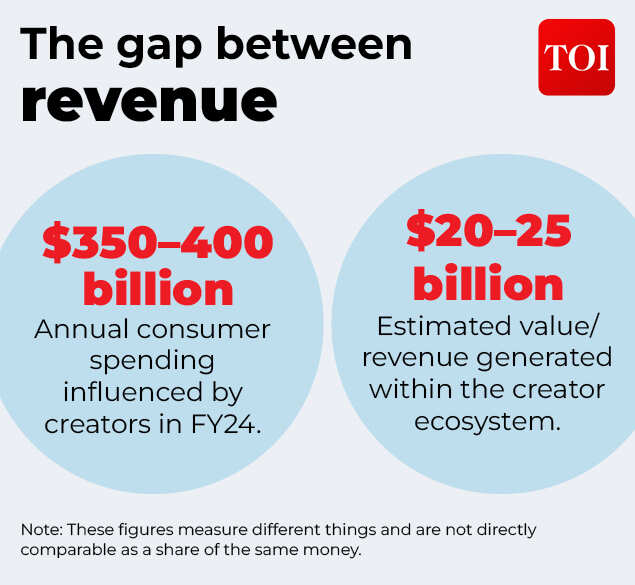
The gap between influence and monetisation is apparent in BCG’s estimates. In FY24, creators influenced $350–400 billion (Rs 33.24 lakh crore to Rs 38 lakh crore) in consumer spending in India, while the creator economy generated $20–25 billion (Rs 1.90 lakh crore to Rs 2.38 lakh crore) for participants, including platforms and creators. The figures are not directly comparable measures of money flowing between parties, but they underline the distinction between the spending creators’ influence and the revenue generated within the ecosystem.The broader data suggests that this gap exists alongside a rapidly expanding market. A 2024 report by EY projected that India’s influencer marketing industry would reach Rs 3,375 crore by 2026, up from an estimated Rs 1,275 crore in 2022. The industry, then, is attracting greater marketing investment, but that does not automatically translate into more paid opportunities for individual creators.A 2026 study by the Indian School of Business, in collaboration with creator marketing platform Hashfame, found that India’s creator base grew from 9.6 lakh in 2020 to 41.2 lakh in 2025.But the supply of creators appears to be growing faster than campaign opportunities. Among non-metro creators, the campaign-to-creator ratio fell from approximately 0.37 in 2020 to 0.10 in 2025. Brand collaborations are not expanding in proportion to the growing creator base.
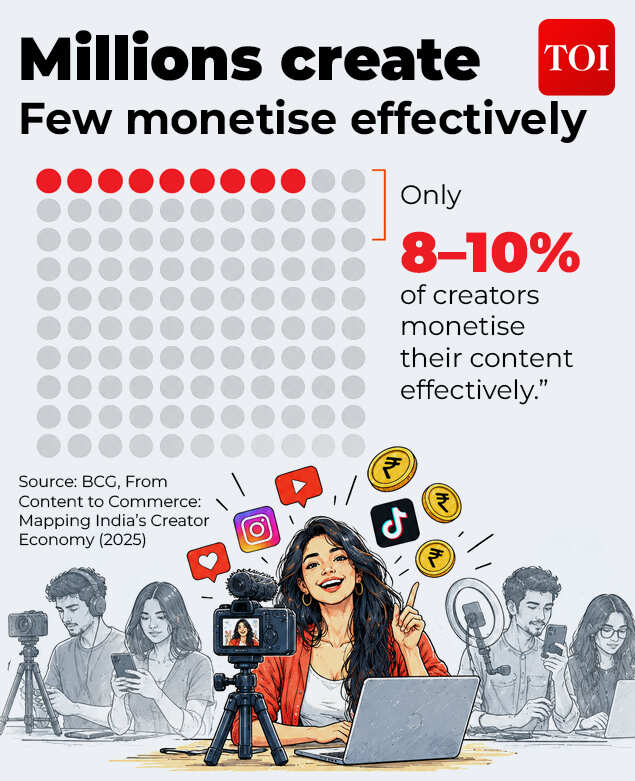
BCG data suggests that out of the entire influencer pool in India, 8-10 per cent of creators are able to monetise their content effectively, and an average income they generate is close to only Rs 18,000 a month.
The business model
A creator’s job is to be seen by the people for the work they produce. In the current digital climate there are upwards of 200 million creators and the number is constantly growing. This is why visibility is such a core tenet in this economy, but visibility does not guarantee a salary.Platforms like Instagram do not have a universal, fixed payment for every view available to every Indian creator. So one may suggest that the platform is democratised, everyone can generate views, but not everyone can monetise those views. A small elitist per cent of creators usually dominate when it comes to earnings.Building an audience and viewership is also a daily job. Talking to 13 different people who tried their hand at becoming a creator and then ended up discarding that effort, TOI found out that a lot of them spent money in the hopes of future returns. But when the returns never came, they had to discard their efforts before it became even more expensive for them to sustain it. One of the people questioned even spent Rs 1.8 lakhs on getting a new phone because she felt like it could boost how her content looked. Till date she has not made any money through her social media.Her experience points to a less visible cost of the creator economy: the money, time and labour people invest before they have any assurance that their work will pay off. For those who never manage to monetise their audience, the pursuit of visibility can become an expense rather than a livelihood.The uncertainty does not necessarily disappear once a creator builds an audience. Macro-influencer Ved Maddison, who has 324,000 followers, argues that even at this level, content creation may not generate a sustainable income, particularly in an expensive city such as Mumbai. Maddison has carved out a niche as a mixed creator who is white-passing while retaining other cultural markers of his Indian identity. But his experience also draws attention to a less visible advantage: he had a financial safety net when he began his career.That cushion matters in an industry where building an audience can take time, returns are uncertain and creators may have to keep investing before they earn anything back. A platform may allow anyone to publish content, but not everyone can afford to keep doing so until it becomes profitable.Having a niche is itself becoming more complicated as the creator economy expands. With more people entering the market and people increasingly identifying with the creator label, the competition is no longer just for audience attention, but for the distinctiveness that makes a creator worth following in the first place. How long can a niche remain a niche before someone else finds a way to replicate it, repackage it or do it better? This leaves creators under constant pressure to put themselves out there, keep their audiences engaged and remain attractive to brands.This has implications for the content itself. When posting becomes a daily requirement, creators have less room to experiment, develop ideas or let a piece of work take shape at its own pace. Over time, the demand for constant output can risk diminishing the very creativity that made a creator worth following in the first place.
Scrutinising the language of democratisation
It would be misleading to conclude that the creator economy is simply a market in which everyone loses. Its growth has created new ways for people to find audiences, build businesses and reach consumers.The problem is that these outcomes are not distributed evenly. A platform can make publishing accessible to millions without providing them with a dependable source of income.This is also why the language of democratisation needs closer scrutiny. Social media has lowered some of the barriers that once separated creators from audiences. But access to a platform is not the same as access to the resources, networks and commercial opportunities that make the platform profitable. Nor does the ability to publish content mean that everyone has an equal chance of turning it into a livelihood.The distinction is between democratising participation and democratising returns. The former is visible in the growing number of creators and the expansion of content beyond India’s largest cities. The latter is harder to establish, particularly when only a small proportion of active creators monetise effectively and many depend on irregular brand deals.That does not make the creator economy a failed experiment. It makes the promise of the creator economy more complicated than its most optimistic projections suggest. Its success cannot be measured only by the amount of consumer spending influenced by creators, the number of people posting videos or the money brands allocate to campaigns. It must also be measured by whether creators can earn enough, consistently enough, to sustain the work they do.When Camus asked us to imagine Sisyphus happy, he was writing about the absurdity of a task that must be repeated without end. The creator, too, returns to the same cycle: filming, editing, posting, learning what resonates and beginning again. Sisyphus pushed his rock for eternity. Unlike him, the creator’s burden is not simply the endless work, but the belief that somewhere along the climb lies a payoff that remains elusive for most.