Dinosaur fossils are like treasure troves that give a peek into the past, millions of years ago when these most deadly beasts roamed the Earth.And while many of them are surrounded by purely scientific names, some get their names beyond the lab. A newly named dinosaur from southern England is one of the second kind, and its story starts with a hardworking dad from Surrey rather than a famous scientist.Its name, Paludohadros proudlovii, honours Will Proudlove, the man who managed the quarry where it was found. He never got to see the discovery. He died at just 35, leaving behind his wife and two young children.So how did a brickworks manager end up with a dinosaur named after him?Let’s dig in to find out
A Surrey Dad now has a dinosaur named after him
A newly identified dinosaur genus and species, Paludohadros proudlovii, has been named in honour of the late Will Proudlove, a Surrey dad. According to the BBC, he managed the Ewhurst brick and roof tile works in Surrey, where the dinosaur’s fossil was found. He died at 35, shortly before the fossil was found in 2001 and donated to the Natural History Museum.His wife, Rachel, told BBC Radio Surrey that dinosaur remains had been found before at the site where her husband worked. She said he was fascinated by this. Whenever a layer of clay was removed from the quarry, Will would check whether anything looked like a fossil. Rachel also described the naming as a “huge” honour for the family. “It’s a great legacy for my husband to be remembered by,” she told the BBC.
His name recognises his long service of work
Will had worked his way up through the ranks to become manager. The Natural History Museum says the species name, proudlovii, recognises that long service at Ewhurst Works. According to the museum’s statement, Rachel added that the dinosaur was only discovered after Will had died, but that its story has since become part of the family’s lives.
What does the dinosaur look like?
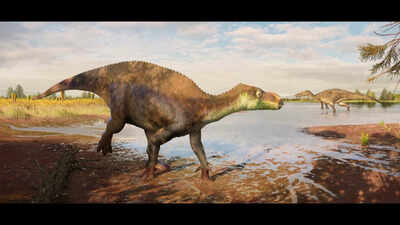
The remains are part of the iguanodontians, a group of dinosaurs known for their thumb spikes. The museum explains that iguanodontians found in southern England were long assumed to be either Iguanodon or its smaller relative, Mantellisaurus. That changed in 2023, when museum scientists published a detailed redescription of Mantellisaurus. It made key differences easier to spot, and several new iguanodontians have since been named, including Brighstoneus, Comptonatus, the sail-backed Istiorachis, and now Paludohadros.This four-legged plant-eater lived around 125 million years ago, in the Early Cretaceous period. Southern England was then covered in muddy wetlands, which inspired the genus name, since palus means “swamp” in Latin. The animal was about five metres long and weighed nearly 1.5 to two tonnes, similar to a rhino. However, its bones were still developing, so the museum believes this individual was a juvenile that could have grown to about twice that size.