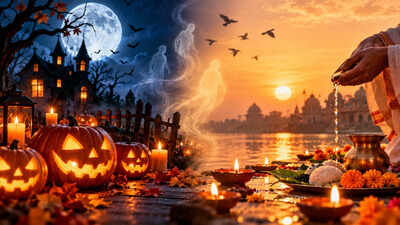
Three weeks ago, many Indian families sat on the floor with sesame seeds, kusha grass, and a brass vessel of water, offering tarpan to parents and grandparents no longer here. This Saturday, families in America and Europe will hang paper skeletons on their doors and send children out in costumes to collect sweets. Both customs are, at their heart, about the dead. Yet one is quiet and solemn, and the other is noisy and playful. Side by side, they show how differently two cultures make peace with the people they’ve lost.
Two Calendars, One Season
Pitru Paksha follows the lunar calendar. It’s the dark fortnight of Bhadrapada or Ashwin, depending on the regional calendar. In 2026, it ran from late September and ended on October 10 with Mahalaya Amavasya, the new moon.Halloween falls on October 31 on the solar calendar, followed by All Saints’ Day and All Souls’ Day on November 1 and 2.Even so, both fall in early autumn in the northern hemisphere. The harvest is done. Days are shortening. Across many cultures, this time of year has been linked with the dead returning, perhaps because nature itself seems to be dying back.
Pitru Paksha: Feeding and Thanking
The core belief behind Pitru Paksha is that ancestors live in Pitru Loka, the realm of the forefathers, and depend on their descendants for nourishment and peace. During this fortnight, they’re believed to come close to the earth.Families perform shraddh on the tithi of a particular ancestor’s passing. Tarpan involves offering water mixed with black sesame, often while standing in a river or facing south. Pinda, rice balls mixed with sesame and ghee, are offered as food for the departed.Crows are fed, since they’re seen as messengers of the ancestors. Brahmins, cows and the poor are also given food. The mood is serious and grateful. Many families avoid buying new things, starting ventures or holding celebrations during the fortnight, since it’s a time devoted to the past rather than to new beginnings.A sense of debt drives this. Hindu thought speaks of pitru rin, the debt owed to ancestors for life itself. Shraddh is one way to repay it.
Halloween: Remembering and Playing With Fear
Halloween comes from a different view. Its oldest roots lie in beliefs that the dead and other spirits wandered freely at this time of year, and that not all of them were friendly. Disguises, lanterns and offerings were partly protective.Christian observances layered remembrance on top. All Souls’ Day, on November 2, remains a day for prayers and candles on graves in many Catholic countries.But modern Halloween, especially in North America, has turned fear into fun. Children dress as ghosts and witches. Haunted houses sell tickets. The dead become characters in a playful show, rather than relatives to be fed.That doesn’t mean the Western approach is shallow. Laughing at death can be a way of facing it. And many families still visit cemeteries or light candles for loved ones around this time.
Where the Two Traditions Meet
Despite the differences, the overlap is striking. Both believe the dead come close at this time of year. Both involve offering food, whether pinda and kheer or, in older European custom, soul cakes and plates left out overnight.Both use light. In India, Diwali lamps, which follow Pitru Paksha within a few weeks, are traditionally said to light the way for ancestors returning to their realm. Some families hang an akash deep, a high lantern, through the month of Kartik for this purpose. In the West, candles in windows and on graves serve a similar role.And both, in the end, are about not forgetting. Whether through a solemn tarpan at a riverbank or a child in a sheet asking for sweets, the dead are kept in the conversation.This year, Halloween falls during Scorpio season, with the Sun and a retrograde Mercury both in that sign. Astrologically, Scorpio rules endings, inheritance and the bonds that survive death, a fitting backdrop for any tradition that honours the departed.