In June 2009, a 12-year-old girl who could barely swim found herself alone in the dark waters of the Indian Ocean after a passenger aircraft plunged into the sea near the Comoros Islands. Bahia Bakari clung to a piece of floating wreckage as rescuers searched for survivors. She was eventually pulled from the water by a sailor who jumped into the rough sea to reach her. According to an Associated Press report published at the time, French officials said she had been afloat for about 13 hours. She was the only survivor of the crash that killed 152 people, including her mother.The aircraft was Yemenia Airways Flight IY626, an Airbus A310-324 travelling from Sana’a in Yemen to Moroni, the capital of the Comoros. The flight was part of a longer journey that had originated in Paris, with stops in Marseille and Sana’a. It was carrying 142 passengers and 11 crew members, according to France’s Bureau of Enquiry and Analysis for Civil Aviation Safety (BEA).The aircraft crashed into the sea during its approach to Moroni in the early hours of June 30, 2009. The BEA said air traffic controllers lost radio contact with the crew shortly before the aircraft struck the water, about 18 km from the airport. The accident occurred during a night-time approach in difficult weather conditions.
A child thrown into the sea
Bahia had been travelling with her mother, Aziza Aboudou, to visit relatives in the Comoros. Her father, Kassim Bakari, was waiting in France with their other children. In the hours after the crash, he spoke to reporters about his daughter’s limited swimming ability and the shock of learning that she had survived.In an interview with French radio, he recounted what Bahia had told him after she found herself in the water. Recalling what his daughter told him, her father, told The Guardian: “I asked her what happened and she said: ‘We saw the plane fall in the water. I found myself in the water. I was hearing people speak but I couldn’t see anyone. I was in the dark. I couldn’t see anything. Daddy, I couldn’t swim very well. I grabbed on to something but I don’t know what.’” Her father described her as a timid and fragile child who could barely swim. The fact that she had managed to remain afloat for hours made her survival even more extraordinary.Bahia later recalled that the aircraft had begun shaking shortly before the crash. In an interview published by the London Evening Standard in April 2012, she described sitting beside her mother, who was tired, as other passengers prepared for the landing. She remembered seeing the plane shake and being told to fasten her seat belt.After the impact, she found herself in the ocean, separated from her mother. She heard women crying and pleading for help nearby but could not see them or reach them. She tried to move towards the voices but struggled against the waves and exhaustion.
The rescue at sea
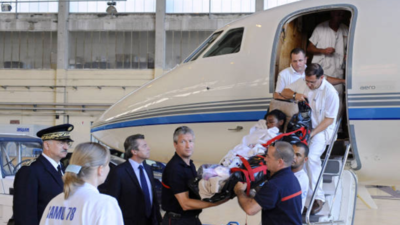
The search for survivors was complicated by rough weather. According to an Associated Press account, the crew of a vessel searching the area encountered winds and waves reportedly reaching 16 feet. They eventually spotted Bahia clinging to a piece of debris. A member of the rescue team threw a life preserver towards her, but she was too exhausted and the sea was too rough for her to catch it. One of the sailors, Libouna Maturaffe Soulemane, then jumped into the water carrying a flotation device and reached her. The two were pulled aboard the rescue vessel, the Sima Com 2.The crew wrapped Bahia in blankets and gave her a warm drink. She was suffering from hypothermia and had sustained a fractured collarbone, along with bruises and other injuries. Despite the ordeal, she was conscious when rescuers brought her to safety.The rescue was followed by an emotional reunion with her father. Bahia was flown back to France on a government aircraft accompanied by officials, arriving at Le Bourget airport near Paris on July 2.
The moment she learnt she was the only survivor
For a time, Bahia did not fully understand the scale of the disaster. She had heard other people in the water and continued to hope that her mother would be found. In her 2012 interview, she recalled that a hospital psychologist eventually told her that her mother was not coming back and that she was the sole survivor. It was only then that she understood what had happened to the people travelling with her.The crash prompted an international investigation involving authorities from the Comoros, France, Yemen and the United States. The BEA’s investigation records the aircraft’s registration, passenger and crew numbers, the loss of contact with air traffic control and the circumstances of the approach. Its documentation also identifies Bahia as the sole surviving passenger.