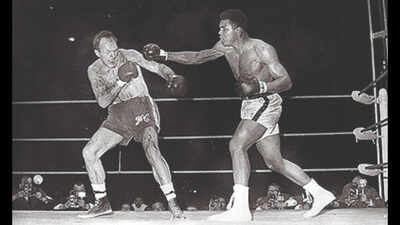
NEW DELHI: Sonia and the ’60s is also a tale of a young girl swept in the tide of civil rights blowing across the globe.In her memoir ‘Belonging’, mentioning Martin Luther King, “free speech movement” in Berkeley and students movements in Europe as the influences on her generation, the Congress matriarch has fleetingly, but noticeably, referred to an indelible episode from the timeless story of boxing great Muhammad Ali. This was among the “memorable moments” in Cambridge after Sonia met Rajiv Gandhi. On a May 1966 evening, Sonia and friends gathered at a friend’s place glued to the radio to listen to “the blow-by-blow boxing match between Ali and British boxer Henry Cooper.“She adds, “when Clay beat Cooper in the sixth round of the match, we roared in triumph. It was for us not just a victory in a sport but a moral one as well. We had been roused by Martin Luther King Jr’s massive demonstration in Washington and his ‘I have a dream’ speech.”It was a momentous evening – not just for the prize fight – but for the times it represented. Two years ago, Ali had not only become the world heavyweight champion, acquired a reputation as a blabbermouth, but also a flaming rebel and a political lightening rod who shook the white establishment of Jim Crow America with his black pride assertion.A rebellion that would take him to oppose the draft to fight in the Vietnam War with that stinging barb – “I ain’t got no quarrel with ’em VietCong”. It led to his exile from boxing, before his return four years later shook the world more than his initial avatar, interspersed with gladiatorial battles like ‘Rumble in the Jungle’ and ‘Thrilla in Manila’. But prior to Ali’s exile were his two fights with Cooper, the British champion. The first was in 1963 as Cassius Clay, then still a braggard who backed his claims with heavy punches and floored opponents with blinding speed. Clay went to London in the hope of mopping up points to force the reigning heavyweight champion, the scary Sonny Liston to give him a chance at the title.This was the fight that is remembered for trainer Angelo Dundee’s gamesmanship that saved the day for Clay and kept him in business for future. Who knows if it had turned out differently.Clay had mocked Cooper like he did to all – predicting to end it in five rounds. But ‘Enry’s ‘Ammer’, that dreaded left hook (hammer) that Cooper was famous for, put Clay on his backside in the fourth round. Ali later said, “it made me feel as if I had gone back and visited all my ancestors in Africa”. It was enough, almost. But a small split in the seam of one glove, that trainer Angelo Dundee had seen before the fight but retained presciently for an emergency, was now put to good use .As Ali “slumped on his stool like a sack of potatoes”, Dundee stuck his finger in the split and made it bigger and then asked the referee for a change of gloves. That earned Clay enough seconds to return to his senses. He recovered to batter Cooper. A year later, Clay shocked the world by defeating Liston twice, embraced Islam and became the most famous man on earth.