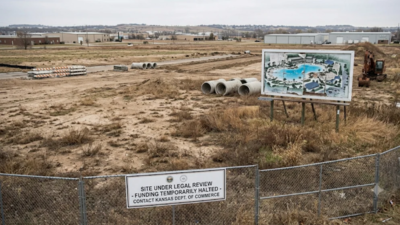
State officials in Kansas have filed a lawsuit to stop more public bond money from going to Derby Shores, a planned $160 million lagoon resort. The project still has no buildings above ground, four years after it was approved. The Kansas Department of Commerce filed the lawsuit this month in Sedgwick County District Court. It is asking the court to block any more bond payments and require a full account of the $35,285,000 in bonds already sold for the project. “More than four years after the project was approved and bonds were sold, it has not been built,” the state said in its court filing. “Announced opening dates have come and gone.”The lawsuit names Derby Destination Development, a partnership made up of Dave Murfin, Rick Worner, and Rodney Steven II. Project trustee Security Bank of Kansas City and the city of Derby are also named as defendants, according to The Wichita Eagle. Derby city manager Kiel Mangus said local officials are still reviewing the lawsuit and waiting for the private developers to take action. “It is going to take action by the developer to move things forward,” Mangus told The Wichita Eagle. “We haven’t fully been able to evaluate all the things in the suit, so that’s what we’re going through right now,” he added. He also said: “We’re hopeful that we can find a resolution and move forward in an acceptable manner to all parties.” None of the developers, a Department of Commerce spokesperson, or the agency’s two lawyers from Morris Laing returned calls for comment on Wednesday, The Wichita Eagle reported.
Grand resort plans and rising costs
Derby Shores was first presented as a major tourist attraction for the region. Its main feature would be a 4 1/2-acre lagoon with water activities. The plans also include a hotel, apartments, housing for older people, restaurants along the water, a tiki bar, a climbing wall, a zipline, an aerial ropes park, a BMX course, a camping area, a picnic lawn, and an outdoor space for events. The entire development would cover about 40 acres. The original project budget was $130 million. Murfin and Worner later brought in Steven, the founder of the Genesis Health Clubs chain, which has nearly 90 locations across the country, to develop one part of the project. Steven took charge of building and operating the lagoon and increased its planned size from 2 acres.Steven also operates the Genesis Sports Complex and Blast Off Bay water park in Goddard. Speaking to The Wichita Eagle in 2024, he explained why he wanted a larger lagoon. “I didn’t think it would be enough of a draw,” Steven said. “I just wanted to do it right. I didn’t want to do something little.” The resort is part of a larger $100 million sales tax and revenue (STAR) bond district created by Derby in 2018. The district was originally established to support Worner’s Field Station: Dinosaurs attraction. That dinosaur park has already paid off its bond debt. However, The Wichita Eagle reported that it now faces possible closure because of financial problems that began during the pandemic.
Dispute over construction deadlines and taxpayer risk
Under Kansas’s STAR bond programme, future sales tax money collected inside a special district is used to repay project bonds instead of going into the State General Fund. State lawmakers require construction to begin within two years after a project plan is approved because public tax money is used to support the debt. “Kansas taxpayers carry most of that cost,” the Department of Commerce argued in its lawsuit. “The sales tax that repays STAR bonds would otherwise go to the State General Fund. Because the State takes that risk, the Legislature attached conditions to STAR bond projects.” The lawsuit also quotes the law, which states that if construction does not begin within two years, “funding for such project shall cease.” According to the lawsuit, Derby approved the project plan on May 10, 2022. A total of $35,285,000.00 in bonds were sold in July 2022. Lawyers representing the developers argued that construction began in January 2023, when workers demolished a barn and farmhouse on the property. State officials disagreed with this claim. They pointed out that “The City’s own 2026 report to the State says construction began in 2026.”
Site conditions and scope of the state injunction
Mangus said that infrastructure work, including roads, drainage systems, land grading, and sewers, is “nearly complete.” However, the lawsuit states that no buildings have been constructed above ground and that “ground cleared in the past has gone back to weeds.” Although the state wants a temporary and possibly permanent stop to further bond payments, officials said they are not trying to shut down the wider development district or prevent work paid for with private money. According to the court filing, “Commerce is not seeking to end the Derby STAR Bond District, cancel Derby’s agreements, or stop the developer or anyone else from building with private funds.”The department is also not asking for the return of bond money that has already been properly spent on approved project costs. It is not trying to stop the developer from applying for fresh project approval under the STAR Bond Act either. Instead, the lawsuit states that if the legal requirements are not met, “Commerce asks that the unexpended proceeds be applied to retiring the bonds that were issued to fund it.” Derby has asked the state to remove its order stopping further bond payments. The developers have also urged the city to restart the payments. The state warned that “and the public will suffer irreparable injury” if spending continues without proper checks. In its filing, the department defended its request, stating: “The injunction serves the public interest. It enforces the Act as the Legislature wrote it. It preserves public funds that are repaid primarily with state sales tax revenue. . . . It preserves, rather than forecloses, the ability of the Secretary to approve the project again if the Act’s requirements are met.”