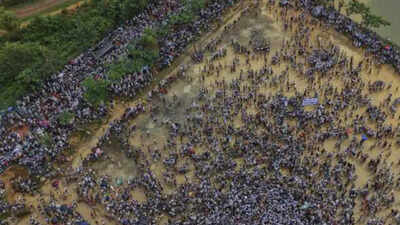
Nearly eight decades after the world adopted the genocide convention in the aftermath of the Holocaust, the International Court of Justice (ICJ) is approaching a historic moment.On November 19, the world’s highest court will deliver a landmark ruling on whether Myanmar committed genocide against its Rohingya Muslim minority. The verdict could shape the future interpretation of international law and have significant implications for South Africa’s separate genocide case against Israel over the war in Gaza.According to The Guardian, the ruling could establish an important legal benchmark for determining how states are held responsible for genocide, particularly how courts assess the intent to destroy an ethnic, religious, racial or national group.The case was brought by The Gambia against Myanmar in November 2019 under the 1948 Convention on the Prevention and Punishment of the Crime of Genocide. The Gambia accused Myanmar’s military of carrying out a campaign of violence against the Rohingya population in Rakhine state, particularly during the 2017 crackdown.According to the UN refugee agency UNHCR, around 700,000 Rohingya fled to neighbouring Bangladesh following the military operations that began on August 25, 2017.In January 2020, the ICJ ordered Myanmar to take all measures within its power to prevent acts prohibited under the Genocide Convention against the Rohingya and preserve evidence relating to the allegations.The court rejected Myanmar’s preliminary objections in July 2022, ruling that it had jurisdiction to hear the case. Public hearings on the merits took place from January 12 to 29, 2026, with the court now preparing to deliver its final judgment.The November 19 judgment could mark a first in the history of the ICJ. Although the court has previously recognised that genocide occurred in the 1995 Srebrenica massacre, it has never directly held a state responsible for committing genocide. A ruling against Myanmar would therefore be a landmark in the enforcement of the Genocide Convention and the international legal accountability of states.Why the Myanmar ruling matters for Israel’s Gaza caseThe judgment will also be closely watched for its potential implications for South Africa’s genocide case against Israel over its military campaign in Gaza.South Africa filed the case at the ICJ in December 2023, accusing Israel of violating the 1948 Genocide Convention through its military operations in the Palestinian territory. Israel has rejected the allegations, maintaining that its war is directed against Hamas and not the Palestinian population.The two cases are legally separate, but both require the ICJ to examine whether the evidence establishes the specific intent to destroy, in whole or in part, a protected national, ethnic, racial or religious group.The Myanmar judgment could provide important guidance on how the court assesses genocidal intent, particularly when examining patterns of military conduct, civilian killings, destruction of settlements and statements by political and military leaders.The timing is also important. The Gaza case remains at the written pleadings stage. In May 2026, the ICJ set November 22, 2027, as the deadline for South Africa to submit its reply to Israel’s counter-memorial.Israel will then have until May 22, 2029, to file its rejoinder. This means the Myanmar judgment could offer legal guidance while the proceedings against Israel are still underway.The Guardian also highlighted the political implications of the ruling, particularly for the United States, which has strongly backed Israel.US ambassador to the UN Mike Waltz warned that the ICJ must not establish a genocide standard that could be applied against allied soldiers. The concern reflects the wider international debate over how the Genocide Convention should be interpreted and applied to military operations.