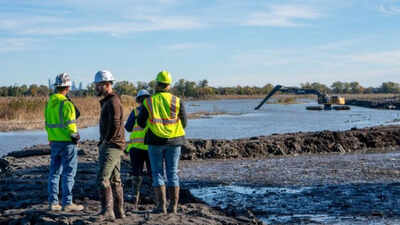
In Philadelphia, conservationists are working to address a problem that has been building for decades at a freshwater tidal marsh, where years of dredging, land filling and the construction of dikes have interfered with the natural movement of water. Therefore, in an effort to bring the wetlands back to life, a major restoration project has begun to reconnect the marsh with a nearby creek through the excavation of thousands of feet of channels.According to Ducks Unlimited, in a report published on November 10, 2026, the restoration is taking place at Henderson Marsh, within the John Heinz National Wildlife Refuge at Tinicum in Philadelphia, Pennsylvania. With the objective of restoring nearly 150 acres of freshwater tidal marsh and excavating close to 13,000 linear feet of tidal channels, the idea is ultimately to allow water to move through the wetlands more naturally.
Bringing a wetland back to life
The John Heinz National Wildlife Refuge is no ordinary patch of greenery surrounded by a city. Established in 1972, it is recognised as the first urban national wildlife refuge in the United States and protects the largest remaining freshwater tidal marsh in Pennsylvania. Located close to Philadelphia International Airport, the refuge provides an important natural space in a landscape that has otherwise experienced considerable development.However, like several wetlands situated near expanding urban areas, the marsh has undergone significant changes over the years. Historic land filling, dredging and the construction of dikes restricted the natural movement of tidal water through the wetland.The Henderson Marsh project is therefore in place to reverse some of these changes. Instead of simply adding new vegetation or creating artificial habitats, the conservation effort focuses on reopening the channels through which water can enter and move across the marsh. The newly excavated channels, along with additional connections to Darby Creek, are expected to improve tidal circulation overall.
The moving of water
A tidal wetland is closely connected to the natural rise and fall of water levels, with the changing tides helping shape the habitat and determine which plants and animals can thrive there. When these movements are restricted, the wetland can lose some of the natural processes that keep its ecosystem functioning.By restoring the tidal connections, conservationists hope to improve conditions for a variety of species. The project is expected to benefit American black ducks, mallards, shorebirds, wading birds, American shad and American eels, among other wildlife. The channels will provide fish with better opportunities to move between Darby Creek and the marsh, while the restored wetland can offer birds important feeding and resting grounds.The plans also include creating tidal pools and other habitat features that could support a wider variety of aquatic and wetland species.
Could this help homes facing floods?
While wildlife conservation is a major part of the project, the benefits are not expected to stop at the boundaries of the refuge. Communities around the Lower Darby Creek watershed, including Philadelphia’s Eastwick neighbourhood and nearby Tinicum Township, have experienced repeated flooding from Darby and Cobbs creeks. During major storms, rising water levels have damaged homes and forced residents to deal with the consequences of flooding.These floods have affected the Eastwick neighbourhood and surrounding communities. During Hurricane Isaias in August 2020, floodwaters also overtopped dikes and damaged sections of the refuge. The Henderson Marsh restoration forms part of a wider effort to explore nature-based approaches to flood resilience in the region. It is not being presented as a standalone solution to flooding, but restoring wetlands could be an important part of helping communities better manage the water that comes their way.
Partners and future of the project
The work is being carried out through a partnership involving Ducks Unlimited, the U.S. Fish and Wildlife Service, the National Oceanic and Atmospheric Administration (NOAA) and other federal, state and local conservation partners. Michels Construction is undertaking the excavation and dredging, with the work requiring specialised equipment and careful planning around changing tidal levels.According to the U.S. Fish and Wildlife Service, construction at Henderson Marsh began in September 2026 and is expected to take around 12 to 18 months. The project also includes plans for improved visitor facilities, including a new kayak and canoe launch, an observation tower overlooking the marsh and new signage along the trails.For the hundreds of thousands of people who visit the refuge to observe wildlife, fish or simply spend time outdoors, the restoration could perhaps also make the wetland far easier to explore.