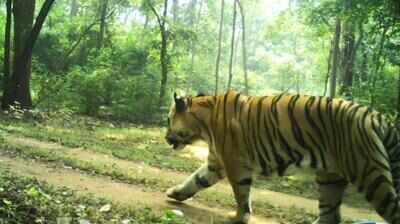
Bhubaneswar: The male Royal Bengal tiger that recently entered Debrigarh Wildlife Sanctuary had spent at least six months in Chhattisgarh’s Udanti-Sitanadi Tiger Reserve before continuing its remarkable dispersal journey and eventually reaching Debrigarh, Debrigarh authorities on Sunday revealed.The latest information emerged after the Chhattisgarh forest department matched the tiger’s stripe pattern with camera-trap photographs recorded in Udanti-Sitanadi in 2025. The finding provides the strongest evidence yet about the animal’s movement history, although its exact natal habitat is yet to be officially established.Divisional forest officer (Hirakud wildlife division) Anshu Pragyan Das confirmed on Sunday, “The same tiger had been documented in Udanti-Sitanadi Tiger Reserve through camera-trap images and other corroborative evidence.”Forest authorities are continuing a detailed analysis of camera-trap data to reconstruct the animal’s dispersal route across the central Indian landscape. Officials suspect the tiger may have originally dispersed from Maharashtra, possibly from Tadoba-Andhari Tiger Reserve, one of India’s most productive tiger habitats.However, no camera-trap evidence is currently available to conclusively establish its movement route before it appeared in Chhattisgarh. National Tiger Conservation Authority (NTCA) is yet to share its assessment regarding the tiger’s place of birth and dispersal history. Debrigarh authorities have sought additional inputs from NTCA to piece together the big cat’s long-distance journey.Wildlife experts point out that Debrigarh functions as a potential receiving habitat within the source-sink dynamics of the central Indian wildlife landscape. As tiger populations grow in established source habitats, young dispersing males often move across vast forested landscapes in search of territories, prey, water, mates and breeding opportunities.A wildlife officer said movements of transient tigers, leopards, wild dogs and herbivores into neighbouring forests are a positive indicator of improving habitat quality and successful conservation management across central India. The tiger’s arrival in Debrigarh is being viewed as part of this larger ecological process.With the tiger generating considerable public and conservation interest, forest authorities have intensified surveillance measures across the sanctuary. River patrol has been strengthened while additional monitoring is being undertaken along Debrigarh’s western boundary to ensure the animal’s safety and track its movements within the protected area.