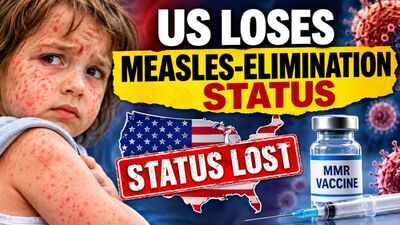
The United States has lost its measles-elimination status, reversing a major public health achievement after the highly contagious virus continued to spread within the country for more than a year.An independent commission of the Pan American Health Organization (PAHO), which operates under the World Health Organization, withdrew the designation following a vote, according to sources familiar with the decision. The panel concluded that measles transmission had continued uninterrupted for over 12 months, according to NBC news.The US was declared to have eliminated measles in 2000. However, the disease is now considered endemic in the country once again. PAHO is expected to formally announce the decision on Tuesday.“The United States has an extraordinary measles problem. We’ve had more measles cases in the last 18 months than we’ve had in the previous 25 years combined,” said Noel Brewer, a public health professor at the University of North Carolina at Chapel Hill.More than 5,400 measles cases have been reported in the US this year, over twice the previous year’s total and the highest annual figure since 1991. State health departments have also reported 10 deaths.PAHO is responsible for assessing whether countries in the Americas satisfy the criteria for measles elimination. Its commission met in Washington, DC, for four days last week to examine whether the virus had been circulating continuously in the US for at least a year.The eight-member panel of public health experts analysed genetic information from locally acquired infections — cases not associated with international travel — to establish whether outbreaks in different states were connected. It also considered vaccination coverage, the effectiveness of disease surveillance systems and the country’s preparedness to contain outbreaks.Measles vaccination rates have fallen across the US in recent years. Only 92% of kindergarten children had received the vaccine during the 2025-26 school year, compared with 95% in 2019-20. The 95% level is generally considered necessary to prevent outbreaks.An NBC News investigation found that vaccination coverage was below this benchmark in 75% of US counties and jurisdictions for which kindergarten measles vaccine data were available.The return of endemic measles puts unvaccinated people at considerable risk, said Walter Orenstein, former director of the US Immunization Program at the Centers for Disease Control and Prevention (CDC). Infants, who generally receive their first measles vaccine dose at 12 months, and people with weakened immune systems are particularly vulnerable.“People can go into a supermarket and get infected,” he said.At least four of the measles-related deaths reported this year involved infants who were too young to receive the routine vaccine. In some areas affected by outbreaks, health authorities are advising parents to consider an earlier dose for babies as young as six months.Measles is one of the most infectious diseases known. A single infected person can transmit the virus to as many as nine out of 10 susceptible people nearby. The virus can also remain airborne for up to two hours. Among unvaccinated individuals, infection can result in severe complications, including pneumonia and inflammation of the brain.Brewer said the country urgently needed a comprehensive plan to control the outbreak, describing the lack of action as “clear negligence”.In previous administrations, the CDC had responded to measles outbreaks through public briefings and vaccination drives. However, the agency has not undertaken similar measures this year, according to the report.A spokesperson for the department of health and human services said the CDC had taken extensive steps to tackle outbreaks. These included providing an additional $100 million in funding in October and sending specialists to assist state health authorities.The spokesperson added that health secretary Robert F Kennedy Jr and CDC Director Dr Erica Schwartz continued to recommend the measles, mumps and rubella (MMR) vaccine as the most effective protection against the disease.“We know where transmission is occurring and we’re working with state and local health departments to reach those communities,” Schwartz said in a separate statement. “Losing a designation doesn’t mean we abandon an evidence-based approach. It means we remain focused on stopping outbreaks.”Since assuming office, Kennedy has questioned the safety and effectiveness of measles vaccines and promoted unproven treatments, including inhaled steroids. President Donald Trump also raised concerns about the combined measles vaccine in August, falsely suggesting that it could be “quite lethal”, despite decades of evidence supporting its safety.Brewer said repeated public statements questioning vaccination had undermined parental confidence in immunisation.The decline in vaccination coverage has been widespread. Since 2019, 82% of counties and jurisdictions across the US have recorded lower measles vaccination rates. In three rural counties — Catron County in New Mexico and Adams and Custer counties in Idaho — coverage among kindergarteners has fallen below 50%.The Covid-19 pandemic contributed to the downward trend, as some parents postponed routine medical visits and childhood vaccinations. Misinformation surrounding Covid vaccines also fuelled the revival of debunked claims, including the false suggestion that measles vaccination is linked to autism.Even before the pandemic, the WHO had warned that vaccine hesitancy was contributing to a worldwide resurgence of measles.“This is not just a US problem, and it’s not just this administration,” Brewer said.The US is not the first country in the Americas to lose its measles-elimination status in recent years. Canada had its designation withdrawn last year after an outbreak resulted in more than 5,000 infections.Jon Andrus, a global health professor at george washington university and chair of the PAHO commission responsible for assessing measles elimination, said Canada had made significant efforts to contain the outbreak and maintain its status.“It wasn’t for a lack of effort in Canada. There was a political commitment at the highest level to sustain measles elimination and to stop that outbreak. That was for me the sad part of the story, because they really did try,” he said.Public health experts believe restoring the US measles-elimination designation could take several years.