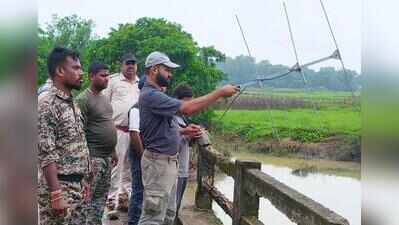
Bhubaneswar: With Hirakud dam opening 17 more sluice gates leading to swelling of the Mahanadi, one more gharial dispersed from Satkosia gorge. The GPS-tagged dispersed gharial has been traced to Athgarh forest division, where monitoring teams are deployed to track its movement.“In past few days we observed displacement of one more gharial from the gorge inside Satkosia Tiger Reserve. GPS tracking helped ascertain its exact location. Nandankanan officials will take a call on further course of action,” said a personnel from the tracking squad.Forest authorities confirmed that this was the third gharial, originally released in the Mahanadi gorge within Satkosia Tiger Reserve under a species recovery programme by Nandankanan Zoo, has been displaced. Since Aug 2, the city forest division has launched a marathon tracking operation to save two endangered gharials swept downstream by the swelling waters of the Mahanadi. Out of those two, one remains untraceable.“Of the 12 geo-tagged gharials released in March, so far three have dispersed. While one gharial’s location has been tracked to the Daya river and the third one to Athgarh forest division. The second one that was found near Jobra barrage in Cuttack is missing,” said a senior forest officer.“We receive satellite inputs about their movement. During flood-like situations, gharials are often swept downstream. Out of three dispersed, we are able to locate two and they are safe now,” said Amaresh Pradhan, DFO (City Division).Officials fear the aquatic reptiles could become entangled in fishing nets or killed by locals mistaking them for dangerous predators such as muggers or crocodiles. The release programme had been executed jointly by Nandankanan Zoo, Satkosia, and Mahanadi wildlife divisions. Each gharial was fitted with a transmitter to monitor survival and dispersal.Forest officials said currently three postgraduate researchers are engaged in monitoring the reptiles’ movements. Satkosia remains the only site in Odisha where gharials breed in the wild, and it also houses a dedicated research and conservation unit. The Nandankanan Zoo continues to play a pivotal role in the gharial recovery programme, which has been extended for another four years (2023–2026) following its initial phase from 2019–2022.