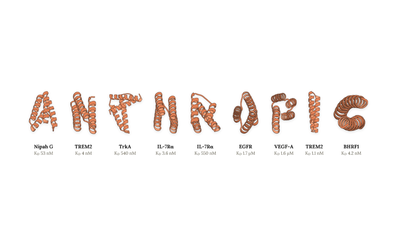
Anthropic says its Claude models designed working protein binders against 14 of 15 targets in a campaign that outside labs then physically built and tested, a result the company is framing as early proof that AI can absorb parts of biological research that normally eat months of a specialist’s time. The designs came out of sessions where Claude was left largely alone after the opening prompt, then handed to Adaptyv Bio and Twist Bioscience for validation.The numbers do most of the arguing. Claude produced 354 confirmed binders out of 1,320 designs. Hit rates came in at 26.7% for Mythos Preview and 22.6% for Opus 4.8 when the models attacked all targets at once, rising to 35.1% when Mythos Preview worked one target at a time. Anthropic pegs the current field average at 10% to 15%.
How Claude ran a protein design campaign with almost no human input
A binder, or minibinder, is a small protein built to latch onto a target protein, which is roughly how a large share of modern medicine works. Designing one from scratch has historically meant weeks of computation and screening.Claude got 48 hours of wall time, up to 12,500 NVIDIA H100 hours, a roughly 30,000-token prompt, internet access, and connectors for Google Drive, Slack, Gmail and BioRxiv. From there it picked where on each target to bind, orchestrated existing open-source design and folding models, ran optimisation cycles, and screened candidates. Human involvement came down to approving access requests, watching the infrastructure, and ordering the winning designs.
Where Claude beat published benchmarks, and where it flatly failed
Against RBX1, Mythos Preview hit 40% in single-target mode, against 3.7% for human entrants in Adaptyv Bio’s competition. Its best design outperformed the contest winner, which had come out of 245 entries.TNFα produced the odder result. Opus 4.8 designed binders that worked across human, cynomolgus monkey and mouse versions of the protein, which matters for animal testing. Mythos Preview, the more capable model, failed on it entirely. Anthropic admits it does not know why.Maltose-binding protein was a clean loss. None of the 90 designs bound. BBF-14, a synthetic beta-barrel used precisely because it is novel, yielded three binders with modest affinity.
Claude Opus 5 matched a contract lab’s purity reading in under 20 minutes
The second experiment used the publicly available Opus 5 on analytical chemistry. Given raw NMR and LC-MS files from a contract lab and a two-sentence prompt, with no vendor software, Claude returned finished results in 23 and 19 minutes. It measured purity at 96.4% against the lab’s 96.33%, and matched hydrogen counts within 0.08. The LC-MS file used an undocumented proprietary format, so Claude reverse-engineered the encoding and verified it by reproducing the instrument’s own totals across 2,664 scans. The lab’s own report arrived four days after the first spectrum.Anthropic acknowledges the dual-use risk here. Protein design remains blocked in Fable 5, its most capable generally available model, with a scientist access programme promised soon.