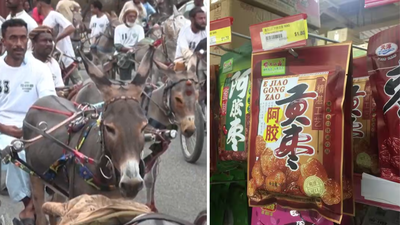
A donkey race in Karachi may look like an odd bit of local entertainment. But behind those small carts and cheering crowds is a story that stretches far beyond the streets of Pakistan. Donkeys have become increasingly valuable in Pakistan, partly because of growing Chinese demand for donkey hides. What was once largely a working animal for poor families and small businesses is now part of an international trade linked to ejiao, a traditional Chinese product made from donkey-hide gelatin.
Why are Pakistani donkeys attracting Chinese interest?
For decades, donkeys in Pakistan have largely been associated with hard labour. They pull carts, carry goods and help people earn a living in places where owning a vehicle is simply not an option.Pakistan has one of the world’s largest donkey populations. The country’s donkey population has been rising steadily, reaching nearly 6 million, according to livestock data cited in Pakistani media reports.But there is another reason the animal has caught international attention: its skin. China has a long-established market for ejiao, a gelatin made by processing donkey hides. It is used in traditional Chinese medicine and has also found a market in health and beauty products. The demand has become so large that China’s own donkey population has struggled to keep up.Research and industry estimates suggest that millions of donkey hides are needed every year for ejiao production. A 2026 analysis by the Hinrich Foundation put annual Chinese demand at roughly 4-6 million hides. That gap has pushed the industry to look abroad.
Pakistan has become an important part of that supply chain
Pakistan’s large donkey population has made it an obvious market for Chinese interest. The two countries finalized protocols for the export of donkey hides and meat in 2024. By 2025, Pakistan had moved further towards allowing the trade, including plans involving facilities in Gwadar.According to a Dainik Bhaskar Report, the Pakistani government has also openly promoted the donkey industry as a potential source of exports and employment. An official government statement said Chinese companies would be allowed to establish donkey farms, slaughterhouses and export facilities in the Gwadar Export Processing Zone.And the interest is not entirely theoretical anymore. In May 2026, Pakistan cleared exports of donkey meat and hides to China after regulatory delays had held up the trade.A 2025 report by The Economic Times described how donkey prices in Pakistan had risen sharply. One Karachi cart owner, Abdul Rasheed, reportedly found himself unable to replace his donkey after it died. The animal he had bought years earlier for around Rs 30,000 could now cost up to Rs 2 lakh.That is the central contradiction in the story.The rise in prices has also raised questions about what the growing export demand could mean for people who depend on donkeys for their livelihoods. A cart owner does not necessarily see a higher-priced donkey as an investment. He may simply see a machine he can no longer afford to replace.
Pakistan is also looking at the opportunity
For a country looking for new export markets, the numbers are difficult to ignore.Pakistan’s donkey population has continued to grow, reaching 6.2 million in 2025-26, up from 6 million the previous year, according to the Pakistan Economic Survey 2025-26. The country is now looking at increasing exports of donkey meat and other donkey-derived products to China.There is therefore a clear economic argument: develop organised farming, create jobs and turn an underappreciated animal into an export industry.But there are questions about how that growth is managed. Reuters has reported concerns in parts of Africa over donkey theft, illegal slaughter and the impact of the hide trade on communities that depend on the animals for transport and agriculture. The African Union moved towards a continent-wide moratorium on the slaughter of donkeys for their skins in 2024.
And then there is the donkey race
That brings the story back to Karachi. Donkey-cart racing has been a part of the city’s local culture for years. In August 2025, a donkey-cart race in Karachi’s Lyari area attracted attention after being organised with government support.The sight is unusual, even amusing at first glance. But the animals running those races belong to a much bigger economic story now.For one person, a donkey may be a racing animal. For another, it is the only way to transport goods. For an exporter, it can be part of a growing international business. And for China’s ejiao industry, its hide is the valuable commodity.That is what makes Pakistan’s donkey story so unusual.An animal that was once largely seen as a humble beast of burden has quietly found itself caught between local livelihoods, international demand and an emerging international export market.The concern is not simply about animal welfare. It is also about what happens when an animal that forms part of a family’s livelihood suddenly becomes a globally traded commodity.