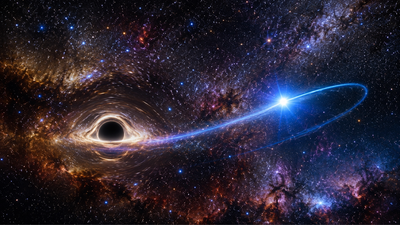
Astronomers have found what is currently the fastest known star in the Milky Way, a faint star racing through the extreme environment around Sagittarius A*, the supermassive black hole at the centre of our galaxy. Called S301, the star reaches a staggering speed of about 15,500 miles per second, or 25,000 kilometres per second, which is more than 8% of the speed of light. It completes an unusually tight orbit around the black hole in just 8.7 years and comes closer to Sagittarius A* than any other known star. The discovery could give scientists a rare opportunity to study the effects of a spinning black hole and potentially test one of the predictions of Albert Einstein’s general theory of relativity.
Scientists found a star travelling at 15,500 miles per second
S301 is a faint star orbiting Sagittarius A*, which has a mass roughly 4.3 million times that of the Sun. The star reaches its highest speed when it gets closest to the black hole, travelling at about 25,000 kilometres per second. That works out to roughly 56 million miles per hour and more than 8% of the speed of light. The star’s orbit is highly stretched rather than circular, meaning it spends much of its journey farther from the black hole before making a rapid close pass. At its closest approach, S301 comes to roughly 12 times the distance between Earth and the Sun, or about 1.8 billion kilometres.S301 takes only 8.7 years to complete one trip around Sagittarius A*. What makes its orbit particularly important is how close the star comes to the black hole. Its closest approach is unprecedented among the known stars orbiting Sagittarius A*. The enormous gravity of the 4.3-million-solar-mass black hole accelerates the star to its record speed as it approaches. Despite coming extremely close on astronomical scales, S301 does not simply fall into Sagittarius A*. Its speed carries it through the closest part of its orbit and back out again. Researchers believe the star’s highly elongated path could also provide clues about its past and how it ended up so close to the centre of the Milky Way.
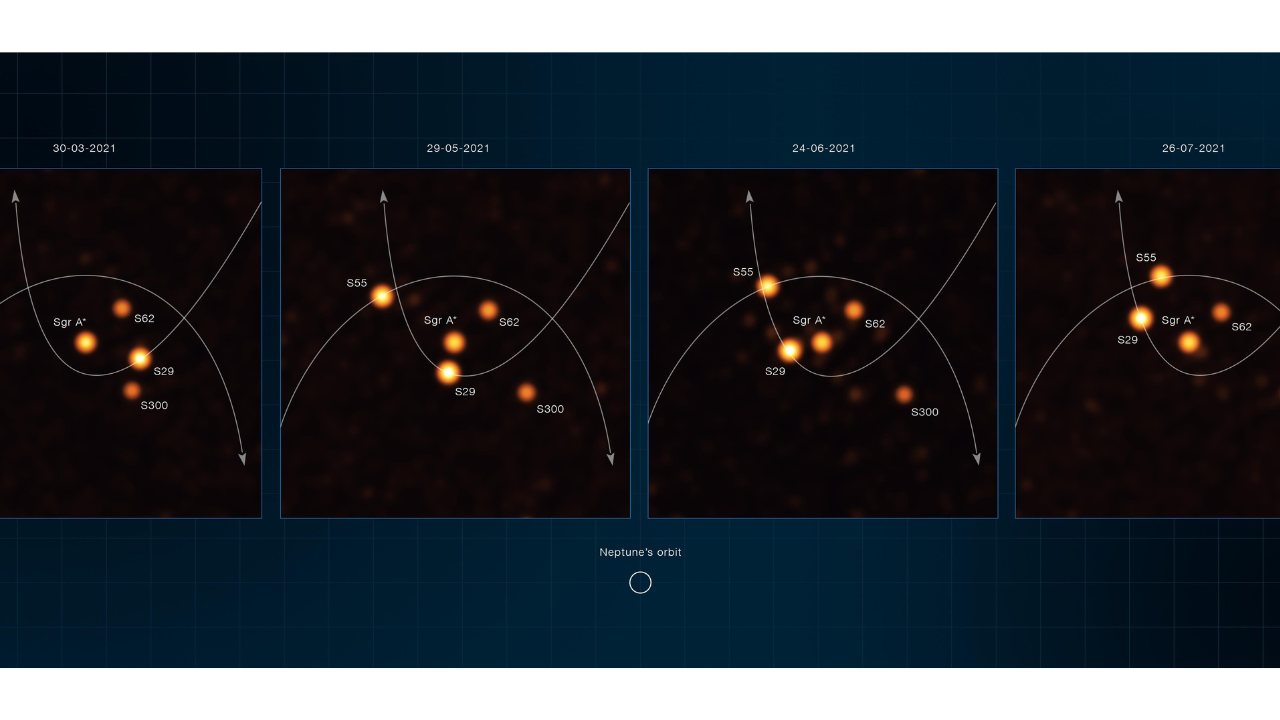
Images showing S301 and other stars orbiting Sagittarius A, the supermassive black hole at the centre of the Milky Way.
Scientists used observations dating back to 2017
Researchers identified S301 using the GRAVITY instrument on the European Southern Observatory’s Very Large Telescope Interferometer in Chile. The team first spotted the star in observations from 2023 and then searched older observations, finding it in data from 2021 and 2017. Combining these measurements allowed astronomers to work out the star’s path around Sagittarius A* and estimate its speed and closest approach. S301 is extremely faint, with the researchers describing it as a main-sequence star. They estimate it has around 1.5 times the mass of the Sun and is about five times as bright. Its unusual orbit may also have an unusual origin. Researchers suggest it could once have been part of a binary system that ventured too close to the black hole. Sagittarius A* may have disrupted the pair, capturing S301 while sending its former companion flying away at enormous speed.
The star could help test Einstein’s theory
The biggest scientific opportunity comes from S301’s proximity to Sagittarius A*. Einstein’s general theory of relativity predicts that a rotating black hole can drag the fabric of spacetime around with it. This effect is known as frame dragging or Lense-Thirring precession. The spinning black hole should gradually change the orientation of a nearby object’s orbit. Because S301 travels so close to Sagittarius A*, astronomers may be able to detect these subtle changes by carefully tracking its position over time. If successful, the measurements could provide a direct way to determine the spin of the Milky Way’s central black hole. That would offer an important test of general relativity in one of the most extreme environments accessible to astronomers. Scientists already know Sagittarius A*’s mass with considerable precision, but measuring its spin is much harder.
The next big opportunity comes in 2031
Astronomers plan to continue monitoring S301 with the upgraded GRAVITY+ instrument and eventually with the European Southern Observatory’s Extremely Large Telescope. The star’s next close pass around Sagittarius A* is expected in 2031, giving researchers another valuable opportunity to measure its motion. Comparing observations from multiple points in its orbit could reveal tiny changes that would otherwise be difficult to detect. The researchers published their findings in the journal Nature on August 19, 2026. The discovery is important not simply because S301 has broken a stellar speed record, but because its extreme orbit turns the star into a natural laboratory for studying a supermassive black hole. If scientists can detect the predicted orbital changes, S301 could help reveal how Sagittarius A* spins and provide a new test of Einstein’s description of gravity.