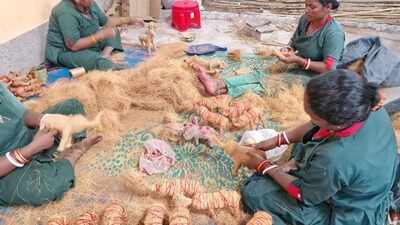
Bhubaneswar: In a unique initiative, Bhubaneswar Municipal Corporation (BMC) is taking care of both health and wealth of the city residents. Its drive to repurpose discarded coconut shells into making artefacts has not only taken care of the water accumulation issue during monsoon but also opened up livelihood opportunities for members of self-help groups (SHGs).The BMC officials said discarded coconuts, in which water often accumulates, become mosquito-breeding points, contributing to the spread of dengue. Their removal has significantly reduced the risk of vector-borne infections.Daily, 10,000 coconut shells are being collected in the city, which are processed for making coir and artefacts, BMC officials said, adding each member of SHGs gets Rs 15,400 a month for lending their labour.According to BMC deputy commissioner (sanitation) N Ganesh Babu, coconut shells in municipal waste posed a serious health hazard. “Coconut shells can carry stagnant water, which results in the creation of mosquito-breeding sources. So, such waste must be shifted from city’s markets and residential areas to avoid mosquito breeding,” he says.To streamline the process, three specialised vehicles — one for each zone — have been deployed. The collected coconut shells are transported to a dedicated unit where they are processed into coir and repurposed into artefacts such as bird nests. This waste-to-wonder initiative, officials say, reduces the segregation burden on sanitation workers while promoting a circular economy.The programme has also empowered women artisans from SHGs, who are turning discarded shells into creative products. “The creative pursuit of the SHG members is enhanced, and the initiative provides them with a sustainable source of income,” a BMC official says.City health officer Deepak Kumar Bisoyi says dengue cases have dropped sharply this year, with only 32 positive cases reported so far compared to nearly 400 during the same period last year. “Daily clearance of coconut piles has checked mosquito breeding sources, and this has significantly reduced infections,” Bisoyi says.Officials believe the dual benefits of the initiative — health protection and livelihood generation — make it a model for urban waste management.