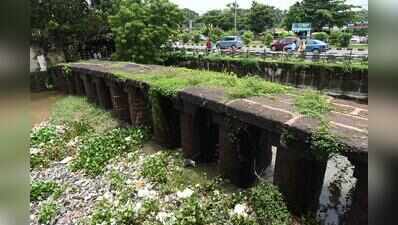
Rapid urbanisation might have closeted a 19th-century laterite bridge near Pandara in Bhubaneswar from public eye but the vintage structure, which once formed part of the historic Jagannath Sadak, is now fighting obscurity. Even locals are raising their voices to demand its conservation.Locally known as Satara Nala bridge on Gangua Nullah, earlier known as Gandhavati river, the structure is believed to have been built around 1850. It has stood as a mute spectator to several untold stories of pilgrims visiting Puri, floods affecting the capital and happy moments too.The bridge served as an important link on a branch route of the erstwhile Jagannath Sadak connecting Bhubanpur to Rasulgarh. Pilgrims to Puri Jagannath Temple and Bhubaneswar Lingaraj Temple would cross Gangua over this bridge while on their journey.Documentation by Indian National Trust for Art and Cultural Heritage (Intach) portrays the bridge as a rare surviving example of traditional laterite engineering and holds significant archaeological, architectural, and historical value.“The bridge stands around 40 metres off the Bhubaneswar-Puri national highway. Once a prominent landmark across Gangua stream, surrounding construction and encroachments have largely hid it from public view,” said Anil Dhir, a member of Intach’s Bhubaneswar chapter, who studied the monument a few years ago.Intach records describe it as a “bridge to nowhere”, with no approach road remaining at either end.“Built out of dressed laterite stone blocks and dry mortar, the bridge bears a slight curvature on the deck and rises nearly 18 feet above the riverbed. At approximately 120 feet long and 10 feet wide, it showcases craftsmanship that has withstood the test of time,” Dhir said.He, however, flagged growing threats to the monument. Intach’s survey cited encroachment by land mafia as a major concern, while vegetation undergrowth and unchecked urban expansion continue to exert pressure on the structure. Though the state archaeology department repaired the bridge in the 1980s, conservation efforts have remained limited, he added.Narayan Prusty, an activist and resident of Palasuni, said, “It has heritage value, but a portion of the monument has now been encroached upon. It had 17 pillars originally, but only 14 remain visible now. The rest are not visible due to encroachment,” he said.Prusty said locals had written to the Archaeological Survey of India (ASI) seeking protection of the monument. “If the govt does not take any step, we will stage a protest for conservation of this old bridge,” he added.Titu Kumar Behera, another Palasuni resident, said locals had been running from pillar to post to preserve the monument. “Recently, officers from the state archaeology department inspected the bridge. We have visited the Bhubaneswar Municipal Corporation (BMC) for help, but we are yet to get any response,” he said.Another local resident, Jitu Jagdev, urged the Odisha govt to preserve the bridge and prevent encroachment around Gangua Nullah. “We should treat our heritage with dignity so that our next generation appreciates the calibre of their forefathers,” he said.Last month, the state archaeology department sought details on the ownership and legal status of Satara Nala, as it was being considered for conservation and restoration work.In a letter to the BMC commissioner, the superintendent of the state archaeology department said a technical team recently inspected the ancient structure and found it to be of significant antiquity and heritage value.According to the letter, parts of the structure have been affected by adjoining development activities, while a small Devi temple occupies another portion of the site. The inspection raised concerns over the need to protect the heritage asset.“The monument is not protected either by the state archaeology department or by the Archaeological Survey of India. As a result, the ownership status and legal standing of the land must first be determined before any proposal for conservation or restoration can be taken up,” said Devjani Bhuyan, superintendent-in charge, Odisha State Archaeology (OSA).OSA has requested the BMC to furnish land ownership details, ownership records and any relevant documents available with the civic body or the revenue authorities. Officials said the information is required to assess the feasibility of undertaking conservation and protection measures for the heritage structure.