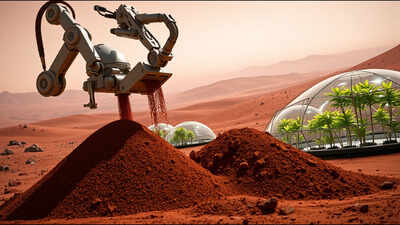
Three Texas students have designed a system they believe could help future astronauts grow food on Mars using material already sitting on the planet’s surface. Varshini Gandreddy, Dhiti Koyya and Raaga Bukkaraju developed the project, called Gaia’s Outpost, for the Conrad Challenge, focusing on one of the basic problems that would face any long-term human settlement on Mars: how to produce food without continually sending supplies from Earth. Martian regolith, the loose material covering the planet’s surface, contains perchlorates and lacks many of the properties needed for conventional agriculture. The students’ proposal is to process that material into a form that could support plant growth, creating an agricultural system that could operate on Mars rather than depending entirely on imported growing supplies. The team, coached by Sampath Bukkaraju, received the Simon Glinsky Expo Exhibit Award for Best Tabletop at the 2026 Conrad Challenge Innovation Summit at Space Centre Houston.
Why Martian soil is such a difficult problem for future astronauts
Mars has plenty of loose surface material, but simply planting crops in it would not work. Martian regolith contains perchlorates, chemical compounds that can be harmful to humans and plants, and it does not contain the organic matter and nutrient balance found in fertile soil on Earth. Future crews would therefore need either specially engineered growing systems or some way of processing local material before using it for agriculture. That challenge became the starting point for Gaia’s Outpost. Rather than treating Martian soil as something astronauts would have to import around, the students designed their project around the idea of making use of the resources already available on Mars.
How Gaia’s Outpost is designed to produce food on Mars
The team’s concept is intended to process Martian regolith and turn it into a growing medium suitable for agriculture. The aim is to allow astronauts to produce fresh food locally, reducing their dependence on supplies transported from Earth. The students also see the system as more than a food-production unit. Their project describes vegetation as potentially providing oxygen and creating a greener environment inside a Martian habitat. They argue that having living plants around astronauts could also provide a psychological benefit during missions in an environment that would otherwise be extremely barren and isolated. Those ideas remain part of the team’s proposed system rather than a demonstrated Mars-ready technology. Turning regolith into a reliable agricultural medium would require extensive testing under Martian conditions, including the effects of perchlorates, low pressure, radiation and limited water availability.
Why the students put an $800,000 price tag on the system
Gaia’s Outpost was presented as a commercial product rather than simply a classroom experiment. The team proposed selling each module for $800,000, targeting government space agencies and private aerospace companies that could eventually operate long-duration missions. Their argument is straightforward: if astronauts can produce at least some of their food using resources available on Mars, future missions could reduce the amount of agricultural material and food that has to be transported from Earth. The students also estimated a potential total addressable market of $24 billion for their technology. Those figures are the team’s own business estimates, rather than forecasts established by NASA or the broader space industry.
How Gaia’s Outpost performed at the Conrad Challenge
Gaia’s Outpost was among the student projects presented at the 2026 Conrad Challenge Innovation Summit at Space Centre Houston. The team received the Simon Glinsky Expo Exhibit Award for Best Tabletop, recognising its presentation at the event. The Conrad Challenge brings students together to develop projects around problems in areas including aerospace, energy, health, cybersecurity and water access. For the Gaia’s Outpost team, the competition provided a way to approach a problem normally associated with professional space research: how humans could produce food far from Earth. The project is still a student-designed concept, not a tested Mars agricultural system. But that is also what makes the idea interesting. Before astronauts can establish a long-term presence on Mars, they will need ways to make better use of the resources already there. These students are starting with one of the most basic requirements of all: finding a way to grow something in the dirt.