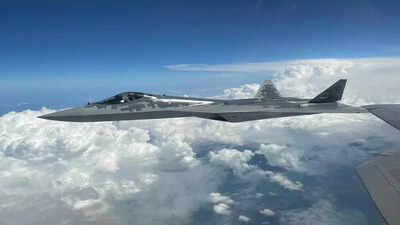
Prime Minister Narendra Modi‘s meeting with Russian President Vladimir Putin on the sidelines of the SCO Summit is shaping up to have centred on two big-ticket defence items, the S-500 missile defence system and the Su-57 stealth fighter, as New Delhi looks to deepen its military relationship with Moscow even as Washington watches uneasily. Discussions around both platforms were expected to formally begin during the meeting, part of what officials describe as the countries’ Special and Privileged Strategic Partnership.The push for the S-500 comes on the back of real battlefield validation of its predecessor. The S-400, deployed during Operation Sindoor, reportedly performed well in tracking and neutralising aerial threats and integrating into India’s broader air defence network, prompting New Delhi to look a generation ahead. Unlike the S-400, which offers theatre-level protection out to 400 kilometres against aircraft, drones and cruise missiles, the S-500 Prometheus is not designed to replace the S-400, but to supplement it. With the S-400 being more adept at taking down aircraft, drones and cruise missiles, this leaves open other threats such as ballistic missiles and hypersonic weapons.As per a US Department of War report, the Prometheus is designed to take down ballistic missiles and hypersonic weapons. The weapon is capable of intercepting targets at altitudes of 180 to 200 kilometres, reaching into the near-space layer, or just below the Karman Line, using its 77N6-N and 77N6-N1 hit-to-kill interceptors. Notably, unlike the straightforward purchase structure of the S-400 deal, the S-500 is reportedly being pitched as a co-production arrangement between an Indian partner and Russian industry, as per the New Delhi-based think tank India Foundation, which focuses on strategic affairs and international relations.The Russians have been pitching the S-500 to India since 2021, when their then Deputy Prime Minister Yury Borisov said that India could potentially become the first foreign recipient of this system.On the Su-57 front, Kremlin spokesperson Dmitry Peskov has publicly pushed the aircraft’s credentials, describing it as among the best in the world and confirming it was on the table during talks. Russian officials have also floated the possibility of licensed production and integration of Indian-origin weapons systems onto the platform, alongside continued cooperation on projects like BrahMos.The Indian Air Force is currently facing an aircraft shortfall, due to which the squadron strength of the air arm is at a six-decade low. At the same time, China is rapidly building a fleet of fifth-generation fighters and is testing sixth-generation aircraft, thus hampering the air force’s defensive posture. This comes at a time when India’s own fifth-generation fighter is not likely to enter service before 2035.The Indo-Russian Summit held in December last year made no mention of the S-500 or the Su-57 in the joint statement, largely because critical technical, logistical and financial discussions remained unresolved. Complicating matters further is Washington DC’s continued discomfort with India’s procurement of Russian arms, a factor that casts a shadow on either of the two deals. Russian President Putin is scheduled to come to India later this month for the BRICS summit.Beyond the marquee systems, broader defence cooperation is also learnt to have been discussed, including expanded logistics arrangements involving reciprocal access to military bases, and a potential upgrade programme for India’s Sukhoi-30 MKI fleet covering radars, avionics and weapons systems to extend the jets’ operational lifespan and lethality.