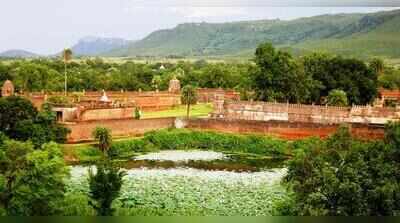
Perched at the foot of the rugged hills of Keonjhar’s Old Town, where legends flow as freely as the stream that gave the region its name, the Kendujhar Palace (popularly known as Kendujhar Rajabati) stands as a fading yet magnificent symbol of a bygone era.Its weathered walls, towering gateways and silent courtyards have witnessed centuries of royal grandeur, political intrigue and cultural traditions that shaped the former princely state. Though time and neglect have left their indelible mark, the palace continues to evoke memories of the Bhanja dynasty’s glory, offering visitors a rare glimpse into a rich historical legacy that still echoes through the heart of Keonjhar.Keonjhar was historically known as Kendujhar or Kendujhargarh. A popular local legend traces the origin of the name ‘Kendujhar‘ to a stream that emerged from the roots of a kendu tree. While kendu refers to the tree, ‘jhara’ means stream, lending the region its distinctive name.The palace is strategically located and fortified in Keonjhar. To the south lies the Indrachhatra Hudi mountain range, also known as Judia hill, which served as a natural defensive barrier. Large ponds, including Gopal Bandh and Mainsikata, surrounded the palace’s fort, providing additional protection. High walls with eight domes enclosed the palace complex, where soldiers kept watch over the kingdom.Built using a special type of lime-stone dust mortar, the structure has withstood the test of time. Two cannons placed in front of the palace continue to reflect the military strength of the erstwhile kingdom.Believed to have been originally built in the 12th century, the palace was extensively renovated and expanded by King Dhanurya Narayan Bhanjadeo during his reign from 1861 to 1905. “The condition of the palace has deteriorated due to lack of maintenance and protection. Yet, it continues to attract visitors because of its historical significance and architectural splendour,” said Nabakishor Sahu, a senior citizen and servitor of Baldevjew temple in Old Town which was constructed by Bhanja rulers.The palace can be viewed from Judia Ghat along NH-49, while the construction of the NH-20 bypass has made it even more accessible to tourists. Residents believe that opening the palace to the public would attract researchers and heritage enthusiasts from across the country.The surviving structure today stands as a silent witness to the legacy of the Bhanja dynasty that once ruled Keonjhar. Historians said nearly 49 rulers, including Maharaja Jyoti Bhanja, Raja Laxminarayan Bhanja, Dhanurya Narayan Bhanja, Gopinath Bhanja and Balabhadra Narayan Bhanja, spent time at the palace. Balabhadra Narayan Bhanja is said to have resided there during the Independence period.The palace’s main entrance remains one of its most striking features. “The architecture and decoration of Rajabati are distinct from those of other royal palaces. The massive wooden gate, adorned with brass kumbhas, is particularly impressive,” said Banabihari Mishra, a retired professor and resident of Old Town.Historical records suggest that the palace complex once housed the Maharaja Mahal, Rani Hanspur (the queens’ quarters), Kumar Mahal (the princes’ residence), a court of justice, a durbar hall, an armoury, a marriage hall, and bathing chambers. Temples dedicated to Gada Tarini, Raghunathjew and other deities within the fort continue to draw devotees.The palace had two prime gateways used by the royal family. The southern gate faces Matia Bandh, popularly known as Chandani pond. A temple situated at the centre of Hadibandha pond on the eastern side remains another attraction. During the annual Chandan Yatra, deities from the Baladevjew temple are brought to the pond, where traditional water rituals continue for 21 days.Several associated heritage structures now lie in neglect. Basuli Shala, where horses and elephants were worshipped during Ashva Panchami, is in a state of disrepair. Historical accounts also mention an elephant fair organised during Akshaya Tritiya, when elephants were ceremonially fed rice.Another palace, built by Gopinath Bhanja on Mining Road and completed during the reign of Balabhadra Bhanja, showcases exquisite artwork, a temple and horse stables. However, like Rajabati, it too is suffering from years of neglect and inadequate maintenance.