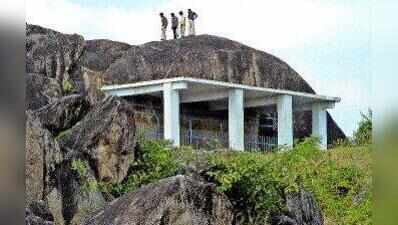
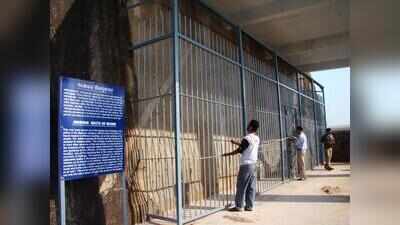
The tranquil banks of Rushikulya river near Purushottampur in Ganjam district cradle Jaugada, a historical monument significant for historians and enjoyable for its scenic view to visitors.Inside an iron cage, one can find a massive, elephantine boulder flank inscribed with the edicts of Asoka, king of Magadha, who once conquered Kalinga (then Odisha). His declaration of Dharma was written there more than 2,000 years ago in a unique manner.His famous declaration, “All men are my children”, is inscribed in the rock edict. Historians said it also contained the declaration that “conquest through love is greater than conquest by sword”, historians said.The edict has a 30x15x12 ft inscription installed on a mass of granite gneiss. The inscription at this site is one of the two Kalinga edicts, which supplement the series of 14 rock edicts of Asoka; the other is at Dhauli, near Bhubaneswar.“These two edicts laid down principles on which the newly conquered province of Kalinga was to be governed and directed to the officials by the king,” said Subash Chandra Padhy, former history professor, Berhampur University. Considering its size and content, Jaugada was counted as one among major Asokan rock edicts found in the subcontinent.The ravages of time, exposure to saline breeze, and prolonged neglect have inflicted considerable damage on this precious monument. James Prinsep noted the inscriptions in 1837. However, he abandoned it, historians say. “The site’s history took a dark turn in 1854 when Walter Eliot, an officer of East India Company, tried to copy the alphabets in the edicts by pouring hot tamarind juice over the surface to loosen the grime,” said Lalit Kumar Deb, former principal of Lingaraj Law College, here.“In 1858, James Minchin, a British merchant, saved the 3rd century BC monument from the brink of oblivion,” he said. In 1952, it was brought under the Ancient Monuments Protection Act-1951 and accordingly, Archaeological Survey of India (ASI) took over its protection.“The place can be made an important historical tourist place by creating gardens and some other attractions nearby,” said Shishir Kumar Panda, former president of the Indian History Congress (IHC). Lack of interest has led to neglect of the historical site though the place is very important from the archaeological point of view, he added.The main threat to the monument is the absence of periodical cleaning and proper protection. “If steps are not taken immediately, the country may lose one of its most prized monuments,” said Padhy.Ganjam collector Keerthi Vasan V said the govt has sought permission from the ASI for peripheral development and construction of some tourist amenities. State tourism secretary Balwant Singh visited the site recently.“The tourism department is likely to make a detailed project report (DPR) for peripheral development of Jaugada,” he said.For its propagation, the district administration has named its conference hall as Jaugada Kakshya at Chhatrapur, in the name of Jaugada.