Whenever a baby is born in the family, everyone begins deliberating and speculating about meaningful names for the newborn.But have you ever thought about what would have been the first baby name in the world, what it meant, and how it came to be?Babies have been named since the dawn of humanity, but written records are a much younger invention. So is there even a “first recorded baby name” waiting to be discovered in some ancient archive?For nearly 30,000 years, humans left their mark the only way they could, by pressing a hand against cave walls and blowing dust around it to leave a silhouette. They had stories, families, and presumably names, but without writing, none of that survived for us to read.So what did, or rather whose name did?Let’s dig in to find out.
Whom do we know to have the first recorded name in history?
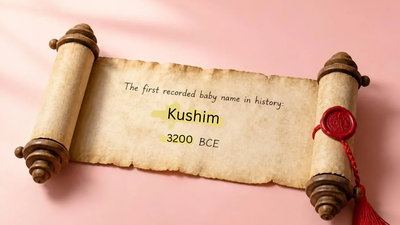
Around 3200 B.C. in Mesopotamia, writing was invented, and for the first time, a name could outlive the person who carried it. So who got that honour? Not a king. Not a warrior. Not a poet. The very first name we can read today belonged to someone whose job was counting barley.In his book Sapiens: A Brief History of Mankind, author Yuval Noah Harari mentions a 5,000-year-old clay tablet found in the ancient city of Uruk, in modern-day Iraq. The tablet isn’t a royal decree or a poem, but just a receipt. It simply reads: “29,086 measures barley, 37 months, Kushim.”Harari interprets this as a signed record, most likely meaning that nearly 29,000 measures of barley were received over three years, signed off by someone named Kushim. As Harari says, this tablet means “we are beginning to hear history through the ears of its protagonists.”
So, who exactly was Kushim?
According to Guinness World Records, Kushim was likely an accountant or administrator working at the Temple of Inanna in Uruk, and his name appears on at least 18 separate clay tablets recording barley transactions from around the 31st century B.C. One of those tablets is kept today in the Schøyen Collection in Oslo and translates roughly to a record of barley to be delivered over 37 months to “the government official kushim responsible for the brewery” at the temple.There is confusion about whether “Kushim” was a personal name or simply a job title. But according to Guinness World Records, that debate is mostly settled by the fact that in several tablets, the name appears with the word “Sanga,” which is a known title for a temple or palace administrator, suggesting Kushim was a specific individual, not just a role.
What’s most interesting isn’t who Kushim was, but who Kushim wasn’t
As Harari writes in his book, “it is telling that the first recorded name in history belongs to an accountant, rather than a prophet, a poet, or a great conqueror.” Five thousand years ago, most people were farmers, herders, and traders who simply needed a reliable way to track what they owned and what they owed. Writing wasn’t invented to glorify anyone; it was invented to keep the books straight and maintain records.