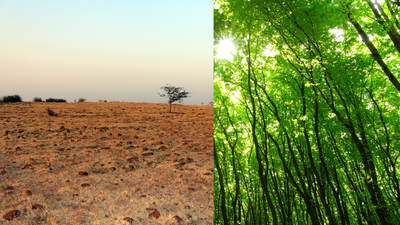
A rocky hillock near Mhow in Indore once looked like the kind of land most people would simply leave alone. There was little greenery, limited water and plenty of stone. In 2007, Dr Shankar Lal Garg bought 22 acres there with a very different plan: he wanted to build an educational institution. When that plan became financially difficult, he chose not to sell the land. Instead, he began turning it into a forest. Today, the site, known as Keshar Parvat, is reported to have around 40,000 trees representing more than 500 species.
The college that never happened
Garg was working as a college principal when he bought the land. The original idea was to develop a school or college, but the project required more money than he could arrange. That setback changed the purpose of the hillock.Rather than treating the property as a failed investment, Garg began seeing what it could become. Reports say he started systematic plantation work around 2015–16, beginning with trees such as neem, peepal and lemon.
Growing trees where even grass struggled
The difficult part was not planting a sapling. It was keeping one alive.The land was rocky, and Garg had to bring soil to places where there was little natural soil cover. He also carried out regular watering and maintenance. According to The Indian Express, his approach included acclimatising saplings before planting them and limiting watering so that roots would grow deeper.The result became unusually diverse. Reports list teak, banyan, sandalwood, bamboo, willow and deodar alongside fruit and flowering plants. NDTV also reported species including saffron, rudraksh, avocado, olive, dragon fruit and dates.
The fire did not end the experiment
In 2019, an accidental fire reportedly destroyed nearly 1,000 trees. Garg replanted and continued the work rather than abandoning the project.Creating green cover on difficult land is rarely about one plantation day. It depends on years of watering, protection and replacing plants that fail.India’s Green India Mission also recognises restoration of degraded landscapes, biodiversity, water-related ecosystem services and soil-moisture conservation as important parts of ecological restoration.
Why Keshar Parvat matters
The larger lesson is not simply that 40,000 trees can fit on 22 acres. It is that degraded land does not always have to remain degraded.Government programmes such as the Nagar Van Yojana promote tree cover, biodiversity and ecological benefits in urban and peri-urban areas.But Keshar Parvat should not be presented as proof that any barren plot can become a forest overnight. Its reported success came after years of labour, water management and maintenance. The exact tree count and species count are media-reported figures, not an independently published government inventory.
From failed construction plan to living landscape
Garg’s story has an appealing simplicity. A college did not happen. A forest did.The hillock that once appeared to offer little has become a long-term experiment in what patient restoration can achieve. It also carries a useful reminder for anyone interested in gardening or land restoration: sometimes the biggest change begins when a piece of land is given time, care and a chance to recover.Disclaimer: Tree numbers, species counts, survival rates and other details about Keshar Parvat are based mainly on media reports and statements attributed to Dr Garg. They should not be treated as independently verified government measurements.image.png