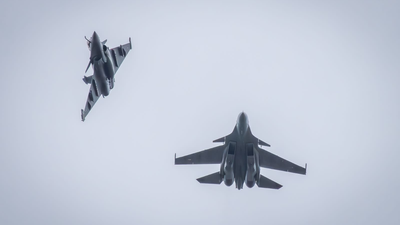
When China sent its J-16 ‘Hidden Dragon’ fighters to Egypt for Exercise Eagles of Civilisation, the headline takeaway was straightforward, Beijing’s pilots finally got a close look at the Rafale, the same jet that forms the backbone of India’s own fighter fleet. But a closer look at what actually happened suggests the exercise may have done India’s air force more favours than China’s.The Indian Air Force currently operates 36 Rafales, with 114 more in the pipeline, and until a fifth-generation stealth fighter enters service, this 4.5-generation aircraft remains India’s most potent platform. What sets the Rafale apart, beyond stealth shaping it lacks, is its advanced sensor fusion, network centricity and supercruise capability, features that put it firmly in fifth-generation territory in most respects but one. Its “omnirole” design philosophy lets a single aircraft strike, self-escort, designate targets with lasers, run electronic warfare through its SPECTRA suite, and conduct battle damage assessment, all within one mission, even though real-world operations typically split these roles across multiple aircraft.This is precisely where the Egypt exercise becomes useful for India rather than China. Every time a Rafale’s SPECTRA system encounters a hostile radar, in this case the J-16’s AESA radar, it logs that signature into its threat library, effectively building institutional knowledge across the entire global Rafale fleet, India included. In other words, China’s own jets unwittingly handed India’s defence planners fresh data on how to detect and counter the J-16 in a future conflict.That said, caution is warranted before drawing sweeping conclusions. Egypt’s Rafales differ meaningfully from India’s in weapons, sensors, software and operational doctrine, meaning this exercise cannot be read as a proxy for an actual India-China air battle. The most consequential gap is the missing Meteor missile, the Rafale’s signature long-range BVR weapon, which Egypt’s jets don’t carry. Without it, Egyptian pilots are unlikely to have developed genuine long-range BVR tactics against the Meteor’s engagement envelope, meaning the PLA Air Force’s exposure here offers limited insight into countering India’s actual Rafale loadout. China has had somewhat better exposure elsewhere, having exercised against Thailand’s Gripens, which do carry the Meteor, but that remains a different airframe altogether.