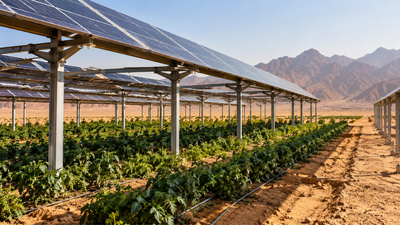
Egypt is testing a farming system that puts solar panels above crops instead of using separate land for agriculture and electricity generation. Known as agrivoltaics, the approach is being piloted at Habiba Farm in Nuweiba, South Sinai, where elevated panels provide partial shade while crops continue growing underneath. The project is designed for Egypt’s harsh desert conditions, where intense heat and limited water make agriculture difficult. Officials involved in the South Sinai project say the shade can reduce water evaporation from the soil by about 20% to 30%, while the panels generate renewable electricity. A second, larger installation is planned at Al Moghra in Marsa Matrouh, allowing researchers to examine whether the model can work beyond the initial demonstration site.
How solar panels are being combined with desert farming
Agrivoltaics uses the same piece of land for two purposes. Solar panels are installed above crops at a height that allows farming to continue underneath them. The panels capture sunlight to generate electricity, while the crops receive filtered sunlight and partial shade.Egypt’s South Sinai project is being tested at Habiba Farm in Nuweiba. The local government describes it as the first project of its kind in Africa and says it is intended to combine crop production with clean-energy generation on the same land.The concept is particularly relevant to desert agriculture because the panels can alter the microclimate around the plants. Instead of crops being exposed continuously to intense sunlight, the shade creates periods of reduced solar exposure.
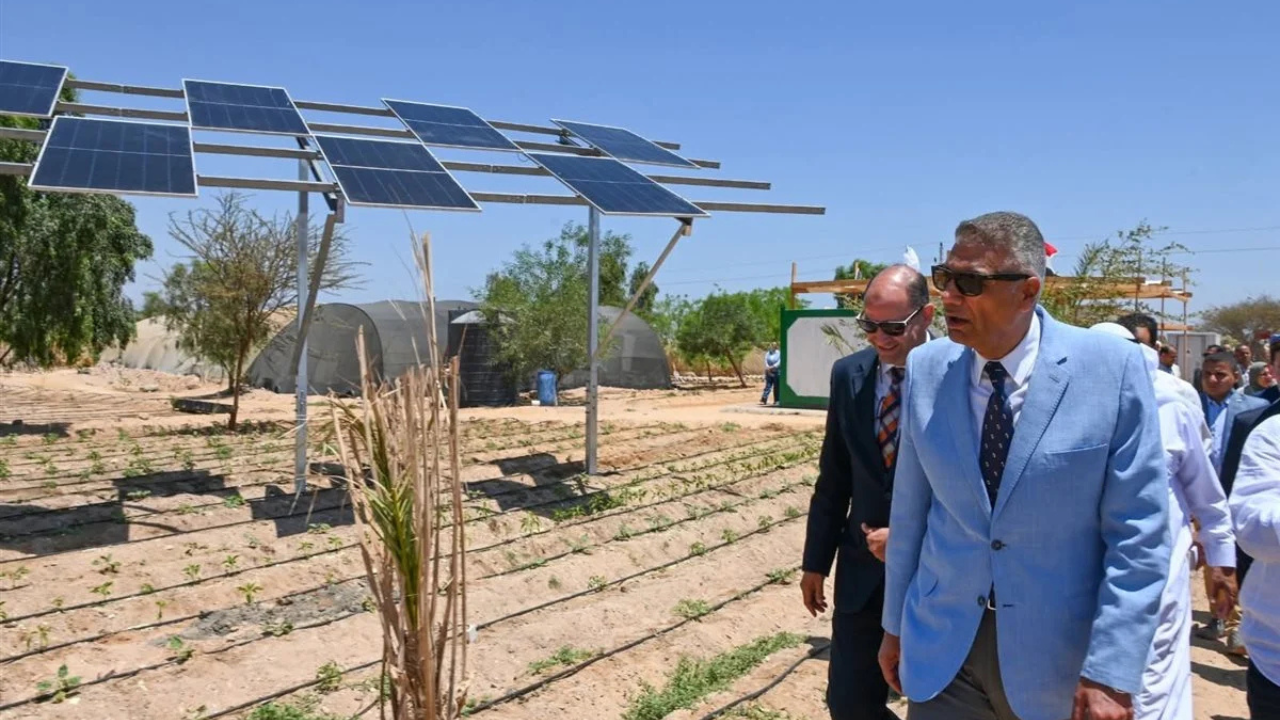
The shade could help reduce water loss
One of the main reasons Egypt is testing the system is water conservation. South Sinai officials say the panels can reduce evaporation from the soil by 20% to 30%, while also protecting crops from harsh climatic conditions.Independent research supports the broader idea that agrivoltaics can reduce water requirements, although results vary according to climate, crop and panel design. A March 2026 analysis published by the International Finance Corporation cited research showing water requirements could fall by 14% to 29% under some agrivoltaic systems.A separate 2026 peer-reviewed study in a hyper-arid environment recorded a 28.7% reduction in seasonal irrigation water use under an agrivoltaic system. Researchers also measured a 2.2°C reduction in mean air temperature and a 3°C reduction in soil temperature beneath the panels.These findings do not mean every crop grown under panels will automatically use 29% less water. Agrivoltaic results depend on factors including panel spacing, crop type, irrigation strategy and local weather.
Cooler conditions could benefit some crops
The panels can also provide protection from extreme heat. By reducing direct solar radiation, they can lower temperatures around the crop and soil while increasing humidity beneath the array.The 2026 hyper-arid study found that the cooler conditions improved water-use efficiency, although the crop used in that experiment, pepper, produced a lower marketable yield than the open-field control under the tested conditions.That finding highlights why Egypt’s projects are important as experiments rather than proof that solar shading will improve every crop. Too much shade can reduce the sunlight available for photosynthesis, so researchers need to find the right balance between electricity generation and crop growth. A 2026 review of agrivoltaic systems similarly found that crop responses differ considerably between species and system designs.
The panels also generate electricity for farming
The other half of the system is electricity. Solar panels produce power while the land remains available for agriculture, allowing one site to perform both functions.That electricity can potentially support farm operations such as irrigation and water treatment. South Sinai officials have also discussed expanding the concept to include solar-powered desalination systems, either for individual farms or groups of smaller agricultural communities.The approach could therefore reduce the need to choose between solar farms and agricultural land. Instead, the same area can produce food and renewable electricity.
Egypt is testing whether the model can work at larger scale
The Nuweiba project is not the only development. Plans include a larger agrivoltaic installation at Al Moghra in Marsa Matrouh, giving researchers another location in which to examine the technology under Egyptian conditions.The wider significance is linked to Egypt’s water and agricultural challenges. South Sinai agriculture already relies heavily on groundwater, while the region faces high temperatures and limited water availability.Agrivoltaics could potentially address several challenges at once by combining food production, renewable energy and more efficient water use. But the technology still faces practical questions, including installation costs, maintenance, crop-specific shading requirements and whether electricity and agricultural yields make the system economically worthwhile. IFC’s 2026 assessment also notes that technical, financial and regulatory barriers still need to be addressed before agrivoltaics can expand widely in emerging markets.For Egypt, the current projects offer a real-world test of whether solar panels can do more than generate electricity in the desert. They could also provide shade, reduce water loss and make limited agricultural land serve two purposes at the same time.