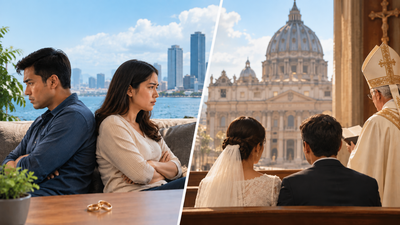
Divorce is a legal option in most parts of the world, allowing a married couple to formally end a marriage. But the Philippines and Vatican City are two places often cited as exceptions. The Philippines has no general divorce law for most marriages, while its Muslim Personal Law provides specific forms of divorce. In the Vatican’s Catholic canon-law framework, a valid and consummated sacramental marriage cannot be dissolved by human authority except by death, although canon law provides for separation, declarations of nullity and certain other forms of dissolution in specific circumstances. Here is what the official legal sources say.
Philippines: No general divorce law

The country has a separate Code of Muslim Personal Laws.
The Philippines does not have a general divorce law for most married couples. Instead, Philippine family law provides legal routes such as legal separation, annulment and declaration of nullity of marriage. Legal separation, however, does not end the marriage itself. A couple may be allowed to live separately, but the marriage bond remains. This distinction is important because legal separation is not the same as divorce. A person who is legally separated is still married and cannot simply marry someone else as a divorced person could.According to the Family Code of the Philippines, legal separation and the declaration of nullity or annulment of marriage are provided for under Philippine family law.
What happens when a marriage breaks down?
Philippine law provides grounds for legal separation. These include circumstances such as repeated physical violence, sexual infidelity, abandonment and certain criminal convictions. But even when a court grants legal separation, the marriage itself is not dissolved. Couples can also go to court seeking an annulment or a declaration of absolute nullity, depending on the legal circumstances of the marriage.These proceedings are different from divorce because they deal with the validity of the marriage rather than simply ending a valid marriage because the relationship has broken down. The Philippine legal system therefore gives couples certain ways to end their marital obligations or establish that a marriage was legally invalid, but it does not provide the ordinary divorce process available in many other countries.There is also an important qualification in cases involving a Filipino spouse and a foreign spouse. According to Article 26(2) of the Family Code, certain divorces validly obtained abroad can have legal effects in the Philippines, including allowing the Filipino spouse to acquire the capacity to remarry, subject to recognition under Philippine law.
There is an important exception for Muslim Filipinos
The description of the Philippines as a country where “divorce is illegal” has an important qualification. The country has a separate Code of Muslim Personal Laws. According to the Supreme Court E-Library, this code applies to certain Muslim marriages and specifically contains provisions dealing with marriage and divorce. Article 45 of the code defines divorce as the formal dissolution of the marriage bond and lists several forms, including talaq, khul’ and judicial divorce or faskh.The code also states that it applies to marriages where both parties are Muslims, or in specified circumstances where only the husband is Muslim and the marriage was solemnised according to Muslim law or the code.
Vatican City: Marriage is considered indissoluble
The Catholic Church’s Code of Canon Law states that the essential properties of Christian marriage are unity and indissolubility.
The situation in Vatican City is different. The Catholic Church’s Code of Canon Law states that the essential properties of Christian marriage are unity and indissolubility. It also says that a valid and consummated sacramental marriage cannot be dissolved by any human power or for any reason other than death, according to the Code of Canon Law. That is the central reason Vatican City is included in lists of places without divorce.A valid sacramental marriage is not treated as a marriage that can simply be terminated through a divorce proceeding under Catholic canon law. However, canon law provides for specific circumstances in which certain marriages can be dissolved. According to Canon 1142 of the Code of Canon Law, a non-consummated marriage can, for a just cause, be dissolved by the Roman Pontiff.This does not mean that every marriage involving Catholics is automatically considered valid and permanent regardless of circumstances. The Catholic Church has a formal process through which a marriage can be declared null. An annulment, in this context, is not the Catholic equivalent of a divorce. A declaration of nullity concerns whether a valid marriage existed according to the requirements of canon law. The Vatican’s Code of Canon Law contains specific procedures for cases concerning the declaration of nullity of marriage.
Can married couples live separately?
Yes. The Vatican’s canon law also contains provisions concerning the separation of spouses. According to the Code of Canon Law, spouses can have a legitimate reason to separate while maintaining the distinction between separation and dissolution of the marriage. So the absence of divorce does not mean that couples must necessarily continue living together in every circumstance. The key difference is that separation does not dissolve a valid marriage.
So is divorce actually ‘illegal’ in both countries?
In the Philippines, there is no general divorce law applicable to most marriages, but divorce is expressly provided for under the country’s Muslim Personal Law in cases covered by that code. Certain divorces obtained abroad can also have legal effects under Philippine law. In Vatican City, Catholic canon law does not provide for the divorce of a valid and consummated sacramental marriage. It does, however, provide procedures for separation and declarations of nullity, as well as limited forms of dissolution in specific circumstances.That makes the legal reality more nuanced than the commonly repeated two-country claim and also explains why the Philippines and Vatican City continue to appear on lists of places without a general divorce system.