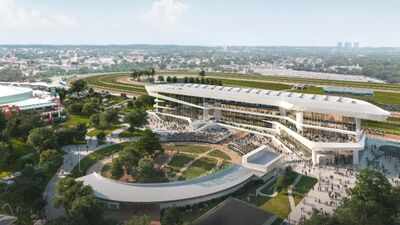
New York has reopened Belmont Park after a $555 million, three-year reconstruction that turned the historic Long Island racetrack into a modern sports and entertainment destination. The new five-story grandstand is about one-fifth the size of the old structure, freeing up space for green areas and public access to the infield, while four brand new racing surfaces will allow year-round racing at Belmont for the first time. Governor Kathy Hochul cut the ribbon on September 18, 2026, welcoming fans back to a venue that will host the return of the Belmont Stakes and the 2027 Breeders’ Cup, according to the governor’s office and local media coverage.
A smaller grandstand with a bigger experience
The most visible change at Belmont Park is the grandstand. The original building, which opened in the mid-20th century, had grown dated and inefficient, with vast interior spaces that were expensive to maintain and often underused. The new structure, designed by sports architecture firm Populous, covers roughly 300,000 square feet across five stories, down from about 1.25 million to 1.5 million square feet in the past. That reduction was intentional, aimed at creating a more intimate, fan-focused environment while unlocking land for parks, walking paths and gathering spaces.Inside, the design emphasises sightlines and connection to the action. Floor-to-ceiling windows give views of both the track and the paddock, and horses move to post through a glass-lined opening so spectators can see them up close. The first floor holds general-admission bars and concessions, while upper levels feature sit-down restaurants, clubs and a NYRA Bets room. Celebrity chef Marc Forgione is behind several dining concepts, including the Turf Club, with menus that range from chili lobster on Texas toast to steaks with bone marrow gremolata.Only the first two floors are open for the 2026 fall meet, with a capacity of around 6,000 for opening weekend. Floors three through five, including luxury suites and an event space with views toward the Manhattan skyline, are scheduled to be completed in early 2027, ahead of the Belmont Stakes return in June. When fully finished, the venue is expected to accommodate at least 50,000 spectators for major race days, matching the capacity of Saratoga Race Course.
Four new tracks and the promise of year-round racing
Beyond the grandstand, the racing surfaces themselves have been completely rebuilt. NYRA constructed four new tracks, including the traditional 1½-mile dirt oval that defines Belmont’s identity, two turf courses and a one-mile synthetic Tapeta oval. The synthetic track is a key innovation, allowing racing to continue during winter months when dirt and turf conditions can be unreliable in the Northeast. For the first time in Belmont Park’s history, this means the facility can host live racing year-round.These upgrades are not just about convenience. They are also about safety and consistency. Modern surfaces can be engineered to provide more uniform footing, reducing the risk of injuries to horses and jockeys. Multiple track options give race planners flexibility to match conditions to different types of races and to keep horses training and competing even when weather would previously have forced cancellations, as per reports.
Economic impact and jobs
A $455 million state loan secured by Governor Hochul in the fiscal year 2024 budget made the reconstruction possible, with total project costs reaching $555 million when track work and other improvements are included, reports share. During construction, the project created more than 3,700 union jobs and generated over $1 billion in economic activity, according to state officials. Once fully operational, Belmont Park is expected to produce about $155 million in annual economic output and roughly $10 million in new state and local tax revenue.Horse racing already supports an estimated $3 billion in annual economic activity across New York State and nearly 20,000 jobs. The return of Belmont, combined with the continued strength of Saratoga, gives New York both the oldest continuously operated thoroughbred racetrack in the country and one of the newest major racing venues built in the United States in more than four decades. For Long Island, the reopening is seen as a boost to hospitality, tourism and local businesses that depend on event-day traffic.
Life on the backstretch
The redevelopment also targeted the backstretch, where trainers, grooms, exercise riders and other workers live and work during the racing season. NYRA completed two new dormitories since 2023, with a third due in fall 2026, adding modern housing for the backstretch community. Other investments include upgrades to the on-site medical clinic, a new Blue Light security system, renovations to the Recreation Hall and Track Kitchen, a refreshed gymnasium, improved flood mitigation and reliable Wi-Fi access.These changes respond to long-standing concerns about quality of life for the people who care for the horses. State officials and racing leaders describe the backstretch improvements as a core part of the project, not an afterthought. By investing in housing, safety and amenities, they hope to make Belmont a more attractive place for trainers and workers to base their operations, which in turn supports the overall health of the racing ecosystem.
Major races return to Long Island
Belmont Park’s closure in 2023 meant the Belmont Stakes, one of American racing’s Triple Crown events, was temporarily moved to Saratoga Race Course. The new venue will welcome the Belmont Stakes back to its historic Long Island home in 2027, with the full grandstand expected to be ready in time. Last May, Governor Hochul also announced that Belmont would host the 2027 Breeders’ Cup World Championships, marking the first time the year-end mega event has returned to New York since 2005.The 2026 fall meet, which began with a sold-out opening card of nine races headlined by the Grade 1, $1 million Jockey Club Gold Cup, runs for 46 days through December 6, generally from Thursday to Sunday. Advance general admission for most dates is priced at $7, or $10 at the gate. The Long Island Rail Road serves the Elmont–UBS Arena station, with complimentary shuttles running to the track on race days, making it easier for fans from across the region to attend without driving.
A new chapter for an old icon
Belmont Park first opened in 1905 and has long been synonymous with American thoroughbred racing. Its 1½-mile dirt track is known as the “Test of the Champion” because of the Belmont Stakes, which challenges horses with the longest distance of the Triple Crown. Over more than a century, the venue has hosted countless memorable moments, from Secretariat’s record-setting performances to generations of champions who defined their eras on the big track.The 2026 reopening does not erase that history. A 200-year-old Japanese white pine that inspired Belmont’s logo was preserved during construction, standing as a living link between the old and new eras. What has changed is the way fans experience the sport. The compact grandstand, expanded paddock, accessible infield and multiple dining and entertainment options are designed to encourage wandering, socialising and closer interaction with the horses, rather than sitting passively in stadium-style seats all afternoon.For racing fans, the promise of year-round racing, a modernised backstretch and the return of marquee events signals a fresh start for Belmont Park. For New York State, the project is both an economic investment and a statement about the place of horse racing in the state’s cultural and tourism landscape. As the first new major racing venue built in the nation in more than 40 years, the new Belmont Park is positioned to shape how a new generation experiences the sport while honouring the legacy of one of its most iconic stages.