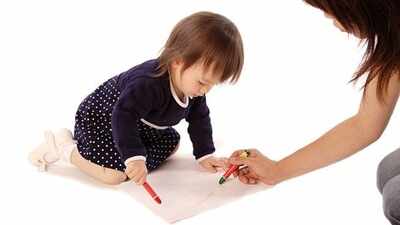
According to the American Academy of Pediatrics, with everything your one-year-old is figuring out on the walking-and-running front, it’s easy to completely miss the quieter stuff happening at the other end, her hands. Between twelve months and her second birthday, she’s picking up a level of control and precision with her fingers that genuinely changes how she explores everything around her, from a stray button on the floor to the pages of her favourite book. It’s less dramatic to watch than her first wobbly steps, sure, but honestly just as important, since these hand and finger skills are what let her examine objects, try new movements, and take in the world in a much more hands-on way.
Small objects are still a bit of a struggle at 12 months, and that’s normal
Right around her first birthday, picking up something tiny between her thumb and forefinger is genuinely hard work for her; that pincer grip is still very much a work in progress. Give it a few months though, and by the middle of her second year, she’ll be doing it without even thinking about it. You’ll start noticing her fiddling with small objects just for the sake of it, turning them over, banging them together, and seeing what happens when she puts two things next to each other. Some of the games she’ll gravitate toward naturally include stacking up to four blocks and then, almost immediately, knocking them right back down, opening and closing boxes or containers over and over, chasing after a rolling ball, turning knobs and flipping pages, fitting round pegs into matching holes, and scribbling or finger-painting with whatever she can get her hands on.
22 Sept 2026 | 14:56
Does your child tell you everything about school? What helps them open up?
These “games” are doing more than they look like
Here’s the thing about all that block-stacking and box-opening: it’s not just keeping her occupied; it’s actually teaching her spatial concepts too, ideas like in, on, under, and around, without her ever realising she’s learning anything at all. As she edges closer to her second birthday and her coordination keeps improving, the games naturally get a bit more complicated too. You might see her attempting to fold paper if you show her how, fitting square pegs into matching holes, which is trickier than round ones since she now has to match up angles as well as shapes, stacking five or six blocks instead of four, pulling toys apart just to see how they go back together, and shaping little bits of clay into something recognisable.
Left-handed, right-handed, or neither, and why it doesn’t matter yet
By the time she turns two, you might start noticing a clear preference for one hand over the other, and if you do, that’s completely normal. But plenty of kids don’t show any preference at all for years, and some stay comfortably ambidextrous well into childhood, happily switching between hands without ever really settling on one. There’s genuinely no need to nudge her toward using one hand more than the other, or to rush a process that, left alone, tends to sort itself out on its own timeline anyway.
Disclaimer:
This article is based on guidance published by the American Academy of Pediatrics and is intended for general informational purposes only. For specific concerns about your child’s reading development or learning needs, consult your paediatrician or a qualified educator.