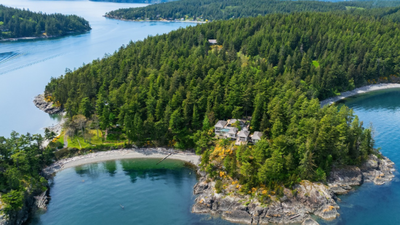
In 1905, doctors told Seattle shipbuilder and former mayor Robert Moran that he had only six months to live because of severe exhaustion. The next year, he sold his shipbuilding company for a reported $3.5 million, moved to Orcas Island, and lived for another 37 years. That major change not only gave Moran a quieter life but also changed the landscape of Washington state. Fifteen years after moving to the San Juan Islands, Moran gave more than 2,700 acres of his private estate to the state government. The gift became what is now Moran State Park. Historical records from HistoryLink, the online encyclopedia of Washington state history, and the Washington State Parks Field Guide blog document Moran’s role in creating the park.
Rise of a Seattle industrialist
Born in New York City in 1857, Robert Moran arrived in Seattle in 1875 with just 10 cents in his pocket. He found work as a ship’s engineer before starting a marine repair shop with his brothers along the Seattle waterfront. That small workshop grew into Moran Brothers Company, which became one of the largest shipbuilding yards in the Pacific Northwest. The company gained national attention after winning a federal contract to build the USS Nebraska, a Virginia-class battleship for the United States Navy. HistoryLink identifies the Nebraska as the only battleship built in Washington state. HistoryLink records that Moran also served two terms as mayor of Seattle. He took office after the Great Seattle Fire of 1889 and helped rebuild the city’s central business district and modernize its public water system. The pressure of running a major shipyard and overseeing work on the battleship damaged Moran’s health. In 1905, his doctors told him he had organic heart disease and might have no more than six months to live. Moran later described his condition as the result of a highly nervous state caused by an overworked physical and mental life.
Building Rosario on Orcas Island
Moran followed the doctors’ warning. In 1906, he sold Moran Brothers Company to the New York firm Berton-Griscom and Company for a reported $3.5 million. He used his wealth to acquire thousands of acres on Orcas Island, the largest island in the San Juan archipelago. Between 1906 and 1909, Moran built Rosario, a 54-room mansion overlooking Cascade Bay. HistoryLink describes Rosario as a maritime-inspired Arts and Crafts mansion. According to the Washington State Parks Field Guide blog, Moran brought the same careful approach to his home that he had used in shipbuilding. Rosario included strong construction and systems designed for the remote island setting. The estate also had its own hydroelectric power system and water system. The property became the center of Moran’s large private estate. He eventually acquired about 7,800 acres that included forests, lakes, shoreline and Mount Constitution, the highest point in the San Juan Islands.
Gift of land to Washington state
While living at Rosario, Moran acquired a large amount of wilderness land around Mount Constitution. By 1921, Moran had decided that the forests, lakes and mountain areas around his home should be protected rather than developed. He formally gave 2,731 acres to the State of Washington for use as a public park. The state accepted the donation in April 1921, and Moran State Park was established. Moran had first tried to give land to the state several years earlier. HistoryLink reports that he offered 3,000 acres in 1911, but the state did not yet have the organization or funding needed to manage such a large park. After Moran removed the conditions on his offer and reduced the proposed donation to 2,731 acres, the state finally accepted it in 1921. During the Great Depression in the 1930s, the Civilian Conservation Corps built major facilities in the park. Its work included trails, roads, bridges, stone shelters and the landmark 53-foot stone observation tower that still stands on Mount Constitution. The tower was completed in 1936.
Legacy of conservation in the San Juans
Today, Moran State Park covers more than 5,000 acres after expanding through additional land purchases and donations. HistoryLink describes it as one of Washington’s most popular park destinations. The park includes five freshwater lakes, miles of forest trails and wide views across the San Juan Islands, Vancouver Island, the Olympic Peninsula, Mount Baker and the Cascade Range. The park’s trail system covers about 38 miles. Moran lived at Rosario until 1938, when he sold the estate and moved to a smaller house on Orcas Island. He died in 1943 at age 86, nearly four decades after doctors had warned that he had only months to live. Rosario was later converted into a resort and was added to the National Register of Historic Places in 1977. Moran’s hydroelectric plant still supplies the property with power. Much of the land he gave to Washington remains protected as Moran State Park and is open for public recreation.