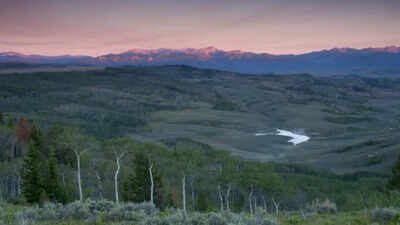
Tim Delaney had no family history of ranching when he bought Rolling Thunder Ranch in Wyoming in 2010. He and his wife had spent years visiting Colorado, but they wanted a property of their own where they could combine recreation with agriculture. Today, Delaney manages thousands of acres for wildlife, recreation and livestock.Delaney, who lives in upstate New York, is also a principal in a heavy highway construction firm that builds large commercial wind farms and infrastructure such as roads and bridges, according to US Deprtament of Agriculture. His family had raised draft horses and some cattle on a small scale, but Rolling Thunder Ranch was his first major ranching experience.The Wyoming property sits at about 8,500 feet and covers a landscape that Delaney describes as a large bowl surrounded by mountain ranges. The ranch provides habitat for a wide range of wildlife, including moose, grizzly bears, elk, deer, pronghorn, black bears, sage grouse, mountain lions and wolves.Since buying the property, Delaney has also worked on conservation projects. With help from The Conservation Fund and the US Department of Agriculture’s Natural Resources Conservation Service (NRCS), he has used conservation easements to protect the land. He has also regenerated aspen stands and replaced 20 miles of conventional fencing with wildlife-friendly fencing.
Bying the Delaney Wyoming ranch
Delaney said he and his family had been spending time in Colorado since the late 1990s. Over the years, the property they visited was gradually being sold in pieces, reducing their opportunities for hiking, hunting and fishing.That led them to look for a property that could provide both recreational and agricultural uses. In late 2009, they found Rolling Thunder Ranch and decided to buy it. They completed the purchase in spring 2010.The family spends about 10 to 12 weeks at the ranch each year. From November to mid-May, however, the property is usually covered by snow. A neighbouring rancher leases summer grazing rights on the land, and 600 head of yearlings grazed there in the year described in the Farmers.gov report.For Delaney, the ranch stood out because of its landscape and wildlife habitat. He said the property offers views of three mountain ranges and allows visitors to see almost the entire perimeter from its higher areas.
Deciding to conserve the area
Delaney said owning the ranch gave him an opportunity to become involved in conservation, even though his professional background is in construction.“As I said, I am in the construction business, so when you own a bulldozer for a living, you are not considered necessarily to be conservation minded,” he said.He said he approached improvements on the ranch with the same planning mindset he uses in construction. That approach also led him to undertake wider conservation planning for the property.According to Delaney, the conservation work made economic sense as well as supporting the land. He said it could benefit both the future value of the ranch and its agricultural operation.“Our experience has been that conservation can certainly go hand-in-hand with ranching- they are mutually beneficial,” Delaney said.His work with The Conservation Fund began after Luke Lynch, then the organisation’s Wyoming state director, contacted him. Lynch explained how conservation easements could help landowners protect working properties.Lynch also connected Delaney with funding from the NRCS. The funding was used for conservation easements that helped protect working land on the ranch.
More than 7,900 acres covered
Delaney and his partners eventually completed three bargain sales of conservation easements covering several connected pieces of land.The first covered the original 3,600 acres of Rolling Thunder Ranch. A few years later, Delaney purchased another 4,000 acres at Rim Ranch, which was also included in the conservation work. A further 340-acre former subdivision lot, called Rolling Thunder II, was also protected. Together, the three properties cover 7,940 acres.The 340-acre Rolling Thunder II property has particular importance for migrating mule deer and pronghorn. Delaney said the land lies entirely within a stop-over area on the mule deer migration route.Hundreds of mule deer have been seen moving through the property during their spring and autumn migrations. The ranch properties are also located within habitat areas designated by the Wyoming Game and Fish Department for sage grouse.