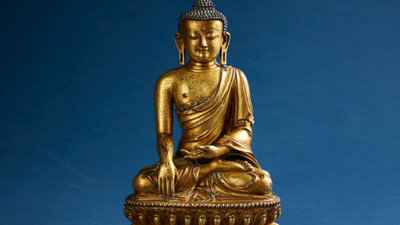
A tiny Buddha statue bought for just over SEK 20 at a Swedish flea market in the 1980s has turned into a multimillion-kronor discovery after experts identified it as a rare work from China’s Ming dynasty. The gilt-bronze statue of Shakyamuni Buddha, which had spent decades in a private Swedish home, fetched a final price of SEK 2,437,500 at Stockholms Auktionsverk’s Asian Fine Art Sale on December 11, 2025. The amount is more than 120,000 times the original purchase price of just over SEK 20.The sculpture was bought at a flea market in Uppsala by the eventual seller, who purchased it for its appearance without initially knowing its historical or artistic significance. According to Stockholms Auktionsverk, the statue remained largely unnoticed in the private home for decades before its importance was recognised.The auction house identified the piece as a rare Buddha figure from the Yongle period, which lasted from 1403 to 1424 during the Ming dynasty. The period is associated with some of the finest examples of early Ming Buddhist sculpture.
From flea-market find to Ming-era artwork
The statue stands just over 18 centimetres tall and is cast in gilt bronze. It depicts Shakyamuni Buddha, the historical Buddha, in a traditional Buddhist iconographic form. Its small size, however, does not reflect the level of craftsmanship that experts found in the piece.Stockholms Auktionsverk said the sculpture features refined folds in the Buddha’s robes, finely chiselled details and unusually rich gilding. These characteristics helped place it among a small group of highly accomplished sculptures associated with the imperial Ming workshops. The auction house described the statue as an example of early Ming aesthetics and noted that works of the same type can be found in major international collections.For decades, the Buddha had effectively been living an anonymous life in Sweden. Its eventual identification transformed an ordinary-looking flea-market purchase into the headline piece of the Asian Fine Art Sale.“It is absolutely extraordinary—and highly unusual—for a work of this quality to appear in private hands in Sweden,” Elisabet Fellbom, specialist in Asian art and craft at Stockholms Auktionsverk, said in the auction house’s announcement. She described the sculpture as an outstanding example of 15th-century Buddhist metalwork and said it was significant to see it return to wider attention after its long period in private ownership.
Why the Yongle period matters
The statue dates to the reign of the Yongle Emperor, whose rule covered the years 1403 to 1424. This places the sculpture at more than six centuries old. The period falls within the Ming dynasty, which ruled China from 1368 to 1644. The Yongle era is particularly associated with major artistic and cultural production, including Buddhist sculpture.The auction house said the Buddha’s combination of detailed drapery, precise carving and gilding was consistent with the quality expected from imperial Ming workshops. Rather than being a later decorative reproduction, it was presented as a genuine 15th-century work of Buddhist metalwork.Stockholms Auktionsverk also pointed to comparable sculptures that have appeared at major auction houses and said examples of the same type are represented in institutions including the British Museum.
Intense international bidding
Once the statue was recognised and prepared for auction, its story attracted attention beyond Sweden. The auction house said the unexpected provenance and quality of the sculpture generated strong international interest during the sale. After competitive bidding, it eventually sold for SEK 2,437,500.That final figure works out to more than SEK 2.4 million, making the small Buddha one of the notable highlights of the Asian Fine Art Sale.For the original buyer, however, the story began much more modestly. The statue had been picked up at a flea market in Uppsala for only slightly more than SEK 20 sometime in the 1980s. The auction house’s account does not state exactly why the buyer chose the object beyond noting that it was purchased for its beauty. The buyer apparently had no idea at the time that the small bronze figure was connected to the Ming imperial tradition.Nearly four decades later, the difference between the purchase price and auction result became extraordinary.A little-known decorative object that had spent years inside a Swedish home was suddenly being examined as a historically important Chinese sculpture. Its final auction price of SEK 2.4375 million also illustrates how dramatically the value of an artwork can change once its age, origin, rarity and artistic significance are established.