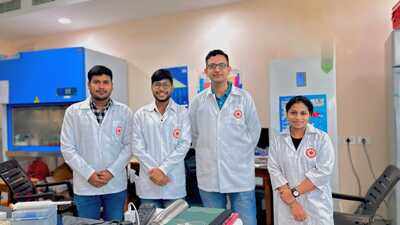
Berhampur: A team of researchers from Indian Institute of Science Education and Research (IISER), Berhampur, has developed a nanotechnology-based fluorescent sensor which will enable faster detection and stratification of diabetic kidney disease (DKD) using urine samples.Differentiating diabetic kidney disease from other kidney disorders can be challenging due to overlapping clinical features, highlighting the need for faster and more specific approaches. The new nanotechnology sensor will offer potential for rapid, minimally invasive biomarker-based assessment with further validation, the researchers said.“The study demonstrates a proof-of-concept for using a COF-based fluorescent immunosensor to detect NGAL, which is a protein and distinguishes diabetic kidney disease samples from other clinical groups,” said Satyabrata Senapati, research scholar and one of the authors of the article published in the ‘Royal Society of Chemistry’.“The technology is not intended to replace established diagnostic methods at this stage, but provides a promising platform for further optimisation and clinical validation,” said Parikshit Moitra, assistant professor, Department of Chemical Sciences, who led the study.