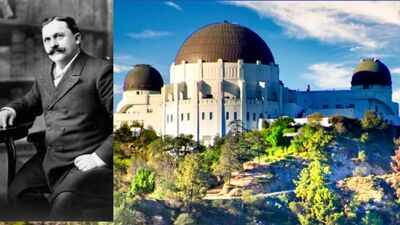
In 1882, mining millionaire Griffith J. Griffith paid $50,000 for 4,071 acres of ranchland in the Santa Monica Mountains, a purchase that would reshape Los Angeles for generations. Fourteen years later, in 1896, he donated 3,015 acres of that land to the city, creating what is now Griffith Park and setting aside the hillside that would later hold the Griffith Observatory. The gift transformed a private cattle ranch into one of the largest urban parks in the United States, providing open space, recreation and cultural institutions for a rapidly growing city, according to the Los Angeles Department of Recreation and Parks and the Los Angeles Times.A ranch in the hills above Los AngelesThe land Griffith purchased was part of the Rancho Los Feliz, a sprawling Mexican-era grant that covered much of what is now central Los Angeles. At the time, the area was still largely rural, with oak woodlands, chaparral and grasslands covering the hills. Cattle grazed on the slopes, and the landscape bore little resemblance to the dense urban neighbourhoods that would later surround it.Griffith, a Welsh-born mining engineer who had made his fortune in Nevada silver mines, saw potential in the property beyond its immediate agricultural use. He envisioned a park that would offer city residents access to nature, fresh air and recreation at a time when Los Angeles was expanding rapidly. His purchase was an early bet on the city’s future growth and the value of preserving large tracts of open space within its boundaries.The 4,071-acre acquisition gave Griffith control of a significant portion of the eastern Santa Monica Mountains. That land included the hills that rise above the Los Feliz and Los Angeles River valleys, as well as the prominent peak that would later bear his name. By holding such a large, contiguous parcel, he positioned himself to make a gift that would be impossible to replicate once the area was subdivided and developed.The 1896 donation that created a parkIn December 1896, Griffith donated 3,015 acres of his ranch to the city of Los Angeles. The deed specified that the land be used as a public park and that it remain open and free for the people of the city. That condition helped ensure that the property would not be sold off or developed for private gain, preserving it as a permanent public resource.The donation came at a time when Los Angeles was still a relatively small city by modern standards, but one that was growing quickly. Rail lines, streetcars and new neighbourhoods were pushing outward, and civic leaders were beginning to think about parks and public spaces as essential infrastructure. Griffith’s gift provided a massive green space that could serve residents across the region for generations.Not all of Griffith’s original 4,071 acres were included in the 1896 donation. He retained some land for personal use and later development, but the 3,015-acre core became the foundation of Griffith Park. Over time, additional acquisitions and transfers would expand the park to more than 4,300 acres, making it one of the largest municipal parks in the country, as per reports.A vision for science and the starsGriffith’s plans for the park went beyond trails and picnic areas. He was fascinated by astronomy and believed that a public observatory could educate and inspire residents about science and the universe. In 1896, he wrote that he wanted to make the hills around the park a place where people could look up at the stars and learn about the heavens.That vision took decades to realise. Griffith died in 1919, but his will included a bequest to build an observatory on the land he had donated. The Griffith Observatory was constructed in the 1930s and opened to the public in 1935, perched on the southern slope of Mount Hollywood with sweeping views of the city and the Pacific. It quickly became one of Los Angeles’ most iconic landmarks.The observatory’s location within the park was no accident. Griffith had designated the hillside as an ideal site, offering elevation, visibility and accessibility. His original donation set aside that ground, so the observatory would be a part of a larger public landscape and not an isolated attraction. Today, the building and its telescopes attract millions of visitors each year and fulfilll his dream of bringing astronomy to the public, the reports say. A park for recreation and culture Today, Griffith Park has grown into a multifaceted urban resource that supports recreation, culture and conservation. It includes miles of hiking and equestrian trails, sports fields, golf courses, picnic areas and the Los Angeles Zoo. The park also houses cultural institutions such as the Autry Museum of the American West, the Greek Theatre and the Travel Town railroad museum.Those amenities reflect Griffith’s original idea of a park that would serve many purposes. He imagined a space for exercise and gathering, education and nature appreciation, all within the city’s borders. Over the years, the park has hosted everything from family picnics and school field trips to major concerts and film productions, becoming a center of Los Angeles’ civic life. The park’s size and location also make it an important ecological resource. Its hills and canyons provide habitat for native flora and fauna, including coyotes, bobcats and many species of birds. Conservation efforts within the park aim to preserve those ecosystems while allowing for public access, balancing recreation with responsibility for the environment.A complicated legacyGriffith’s gift is celebrated as one of the most important in Los Angeles history, but his legacy is also complicated. In 1897, he shot and seriously wounded his wife in a domestic violence incident, for which he was convicted and served time in San Quentin. That part of his story has prompted ongoing discussion about how cities remember donors whose personal conduct conflicts with contemporary values.Despite that history, the park and observatory continue to bear his name. City officials and historians have debated whether to rename the park or add context to its history, but as of now the Griffith name remains. The debate reflects broader questions about how to honour transformative gifts while acknowledging the flaws of the people behind them.For many Angelenos, the park itself is the most important part of the legacy. Whether or not they know the details of Griffith’s life, millions of residents benefit from the open space, trails and institutions he helped create. The park has become a shared resource that belongs to the city as much as to any individual.From ranchland to city icon The transformation of Griffith’s ranch into one of the nation’s largest urban parks is a tale of vision and civic largesse. His 1882 purchase and 1896 donation came at a time when Los Angeles was still small enough that such a gift could shape its future. As the city grew around the park, the land became increasingly valuable, both ecologically and culturally.Today, Griffith Park is a defining feature of Los Angeles, visible from freeways, neighbourhoods and the downtown skyline. The observatory, in particular, has become a symbol of the city’s relationship with science, entertainment and the night sky. Films, television shows and photographs have spread its image around the world, making it one of the most recognisable landmarks in Southern California.Griffith’s original $50,000 investment and subsequent donation created a foundation for recreation, education and conservation that continues to serve millions. “It’s a reminder that gifts of land on a grand scale can have a legacy beyond the donors, and that can shape cities in ways that are hard to predict but impossible to ignore.”