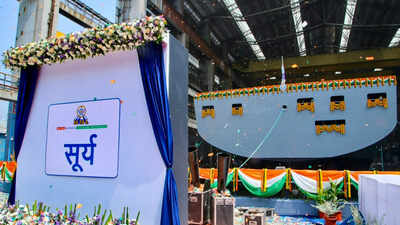
In a big boost for India’s maritime capabilities, defence minister Rajnath Singh on Tuesday launched ‘Surya’, the country’s first indigenously-built fleet support ship (FSS-1), laid the keel for the fifth ship in the series (FSS-5), and inaugurated the upgraded Slipway-4 and 300-tonne Goliath crane at Hindustan Shipyard Limited (HSL) in Visakhapatnam.Thereafter, he went to Odisha’s Koraput to witness the delivery of the 2,000th aero-engine by Hindustan Aeronautics Limited (HAL).Fleet support ships will act as floating logistics hubs that will keep Indian Navy’s warships and carrier battle groups operational at sea for extended periods by providing fuel, fresh water, ammunition and dry provisions to frontline ships and even act as on-board maintenance workshops.Describing the “three milestones” as symbols of India’s growing maritime capability, Rajnath said, “The launch of FSS1 is a symbol of achievement, keel laying of FSS-5 is a symbol of resolve and the new Slipway is a symbol of our growing capability,” he said,Rajnath said the vessels would enhance Indian Navy’s reach, endurance and operational effectiveness in the Indian Ocean region. “Fleet support ships provide this critical capability by enabling at-sea replenishment and supporting naval operations over prolonged periods, thereby enhancing the fleet’s operational endurance,” he said.The defence minister had recently announced that a record 18 warships would be commissioned or inducted in 2026, marking the largest single-year force expansion in its history. Currently, around 45 active warship construction projects are under way, with orders for additional vessels and submarines approved or in the pipeline. With the Rajnath-led defence ministry pushing for self-reliance in naval shipbuilding, more than 75% of the content on these newly-built warships is now made in India.The upgraded Slipway-4 has been extended and strengthened to enable HSL to build and launch ships of up to 45,000 DWT. The 300-tonne Goliath Crane spanning Slipways 3 and 4 has been designed and manufactured by L&T Geostructure with Konecranes under Make in India. The new infrastructure will strengthen HSL’s ability to undertake larger and more complex shipbuilding programmes and support modern block construction.“Self-reliance is an important milestone, but global competitiveness is the next big leap,” Rajnath said while stressing that Indian shipyards should be able to compete on quality, cost, technology, delivery and reliability with the world’s leading shipyards.Calling for Visakhapatnam to be developed as a maritime industrial hub, Rajnath said the presence of Eastern Naval Command, Naval Dockyard, HSL, and Visakhapatnam Port provides the city with the “foundation for an integrated maritime ecosystem”.Recalling the launch of the first ship built in independent India ‘Jala Usha’ at Visakhapatnam in 1948, the minister highlighted India’s long-standing maritime heritage, noting that the country’s relationship with the sea dates back to ancient times.He described HSL as a custodian of India’s national maritime capability and lauded its contribution to the country’s maritime and defence requirements for more than eight decades. He highlighted HSL’s attainment of Miniratna Category-I status in 2025 after it came under the defence ministry as an important milestone reflecting its transformation and sustained efforts.“Our goal should be simple and clear — Design better, build faster, deliver on time. Operate efficiently and do maintenance effectively,” Rajnath said.At Koraput, Rajnath announced the establishment of a second production line for Shakti engines. Describing the milestone delivery of 2,000th aero-engine by HAL as a significant achievement in India’s aerospace journey, he called for strengthening indigenous capabilities in the design, development, testing, manufacturing and maintenance of advanced aero-engines, stressing that mastery of propulsion technology is essential for self-reliance in the aerospace and defence sector.“Today is a historic day for HAL Koraput. The division has today delivered its 2000th engine. This is more than a production milestone. It is a symbol of six decades of engineering capability, skilled manpower and commitment to strengthening India’s defence preparedness. I am extremely pleased to be part of this remarkable journey. HAL Koraput has also crossed another significant milestone. It has overhauled more than 9,000 engines. Behind these numbers is the skill and dedication of the engineers and technicians who keep India’s critical platforms mission-ready,” Rajnath later posted on X.He highlighted HAL Koraput’s contribution to military aviation, noting that its engines have powered frontline aircraft, including MiG-21, MiG-27, MiG-29 and Su-30MKI. He stated that while production provides new capability, overhaul extends service life, making both critical for military preparedness. The production of AL-31FP engines for the Su-30MKI is an important step in strengthening India’s indigenous engine manufacturing capability.The minister further said on X, “Despite global supply-chain disruptions and raw-material challenges, the Koraput team delivered its first engine ahead of schedule. 63 engines have now been delivered. I would like to acknowledge the commitment demonstrated by the team here in its production. HAL is also enhancing annual production capacity from 30 to 50 engines. These capabilities directly contribute to the sustained operational readiness of the IAF’s Su-30MKI fleet.”On increasing helicopter engine capacity, Rajnath said, “India’s growing fleet of indigenous helicopters requires a strong and reliable indigenous engine ecosystem. HAL is establishing a second production line for Shakti engines at Koraput, adding to the existing capability at Engine Division, Bengaluru. Together, these facilities will strengthen our capacity to support platforms such as the ALH and LCH and meet the evolving requirements of the armed forces. A stronger engine ecosystem is essential to a stronger self-reliant defence capability.”