Romal Shetty is betting that AI will give Deloitte so much more work that it will need thousands of additional employees. The opportunity, he says, lies in reaching customers that the firm, one of the world’s largest professional services networks, could never afford to serve before. We met the CEO of Deloitte South Asia in his Bengaluru office, overlooking the city’s racecourse and one of its biggest golf courses.He’s a cricket fan, and there’s signed memorabilia around his office. Shetty has little time to play these days. And the conversation quickly turns from cricket to the future of consulting.Deloitte’s India practice plans to add about 50,000 people by 2030, on top of the current humongous workforce of 1.5 lakh (30% of worldwide strength), of which 1 lakh serve global markets in areas like consulting, tech services, analytics, audit and tax services. That’s a level of optimism you just wouldn’t expect if you were looking at share prices of services and software companies over the past year.But listen to Shetty, and you might wonder: what’s wrong with investors! Deloitte has traditionally worked with large corporations. Smaller businesses often assumed they could not afford it, while Deloitte questioned whether serving them would be profitable.Al changes that calculation. If machines handle most routine work, then tax advice, compliance and other services can reach smaller companies at prices they can manage. I never had this market before,” Shetty says.Deloitte is piloting a platform called E-Vardhan with about 100 companies. The idea is something like an app store for business services. Customers could pick GST compliance, inventory management or working capital tools, paying a subscription instead of commissioning an expensive consulting assignment.Shetty illustrates the potential with a hypothetical Rs 10,000 monthly subscription and a target of one million small businesses. At that scale, even a modest subscription becomes a sizable business. For customers, it could mean access to expertise previously out of reach.
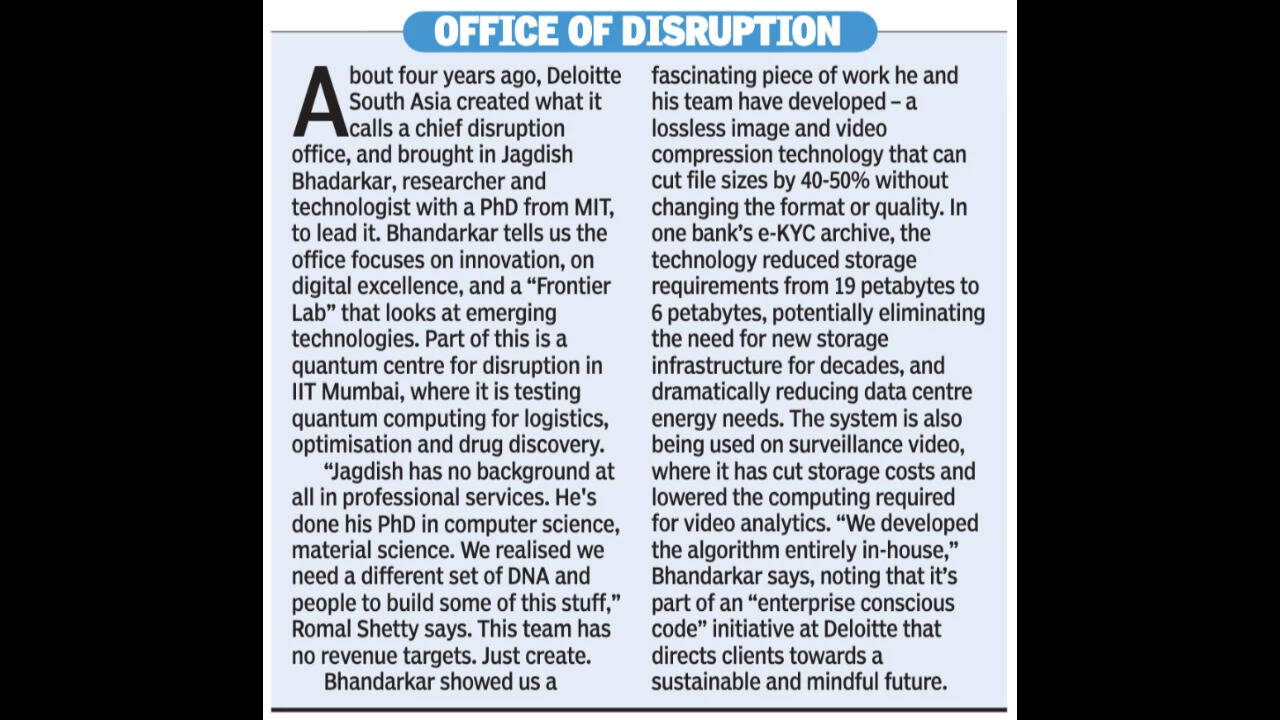
Office of disruption
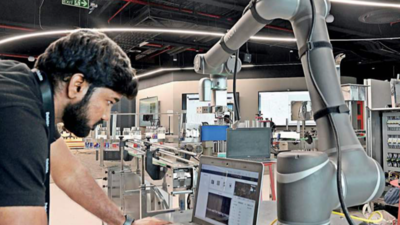
It also changes consulting’s staffing arithmetic. Instead of roughly 10 professionals serving one client, Shetty envisages one professional overseeing 10 clients, with machines doing most of the work. Even at that ratio, serving a million businesses would require 100,000 people.Five new areasThis platform approach is one of five areas Deloitte is developing. Others include increasingly autonomous services; tech products with professional support built in; helping companies improve not just their profitability but also their market value through stronger fundamentals; and investments in emerging businesses such as space and defence technology. Together, these areas account for less than 5% of revenue today. Shetty wants that to reach 45% by 2030.A lot of what’s newly possible is showcased in what Deloitte calls Centre for Innovation and Technology, a 12,500 sqft space that opened two years ago, covering everything from customer experience through to factory operations. Clients can attend tailored sessions in this space, from a few hours to multi-day workshops, try out solutions, see them at work. We took a tour of it, and were reminded of the equally extensive EY.ai Centre for Reimagination that was launched in Bengaluru four months ago by EY’s CEO Janet Truncale, the first such centre for the firm.Clearly, India is becoming central to global professional services companies’ AI strategy.In autonomous services, Shetty points out a project to make the implementation of SAP on public cloud autonomous. Deloitte in India developed a framework of rapid configurations that cut such implementations from 6-8 months to 6-8 weeks. That gets clients running sooner and lowers their overall cost. “It’s the first time anything like this has been done in the world. We had SAP’s global R&D lead and Gartner analysts from Germany coming over to see it,” he says.Products is another emerging space, but in association with and connected to services that Deloitte already is strong in. Shetty notes that previous attempts at products failed because implementation was left to clients.That model’s changing.Aditya Kaithan, partner for technology and transformation, demonstrated an Al content generation platform that allows advertisements and marketing campaigns to be created and launched very quickly. The platform creates a brand-specific Al profile that learns preferences such as people, settings, language, tone and visual style, making content generation progressively faster. Once a campaign brief is entered, Al agents act as the copywriter, designer and brand team, developing a master brief and creative, with humans able to review and refine the direction. It can then generate and distribute content across formats such as social, email and kiosk advertising. “No shoot location, no models, no shooting team. Video is created in minutes or hours. So what was a $100,000 budget, crashes into nothing,” Kaithan says.Shetty notes how suddenly all of these now become viable tor, say, a small property broker in Jaipur.“We do it for top companies in the world, but we also want to do it now for small businesses,” he says.Deloitte’s teams in India are also building technology for global use. For a Japanese car manufacturer, they used Nvidia’s Omniverse platform to simulate a factory and identify bottlenecks before construction.“If they have to make 2 lakh cars a year, a car must be manufactured every 2 minutes and 32 seconds. We’ve been able to digitally simulate and say that these are the obstructions in, say, robotics or kinetics or physics or raw material flow that could prevent that speed of manufacturing. And then show them clearly the way out. If they had already built the factory, they would have had to spend millions of dollars to make the changesi,” Shetty says. Similar solutions can be used to address, for instance, hospital flows.Across existing services, Shetty wants delivery to become at least 30% faster. But getting there requires people who understand businesses, can connect different systems and know which questions to ask. “Because you can’t code without understanding the business,” he says. Coding alone will not be enough.That does not mean shutting out fresh graduates. Shetty recalls two young women studying computer engineering solving an augmented and virtual reality problem in three days after an experienced team estimated weeks. Youngsters bring alterent ways of thinking, he says. Removing junior roles also risks breaking the apprenticeship through which future experts learn.“If you haven’t gone through the apprenticeship, how will you learn?”Shetty’s own career has crossed plenty of borders. A banker’s son whose family comes from Kundapur in Karnataka, he moved cities frequently while growing up. He built much of his career in telecom, including as a sector head at KPMG, and says he has worked in about 40 countries. Saudi Arabia taught him about the latest network technologies; Africa showed him how inventive companies could be with limited resources. He is now looking for that same willingness to rethink familiar problems as AI changes Deloitte’s business.
Enterprise technology environments are too complex. There is no way that the oroader Al technology can get into the enterprise without the services industry. People can’t just go and buy an LLM and expect their problems to be solved… For IT services, there are at least two big opportunities – given their decades of experience with enterprise systems. One, they can use Al to help enterprises modernise their legacy systems substantially faster, and probably at on fifth the traditional cost. The bigger opportunity is going and having a conversation with the customer saying we’re going to leverage Al to change the way you do business – look at new markets, look at new sets of customers, or completely reimagine the supply chain.
Rajesh Nambiar | PRESIDENT, NASSCOM
As Al moves from research to real-world business applications, India’s strengths become much more important. The country has decades of expertise in enterprise software, implementation and business processes. That knowledge will be critical in training and deploying the next generation of Al agents.
Christian Klein | CEO, SAP