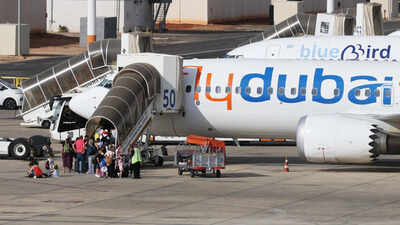
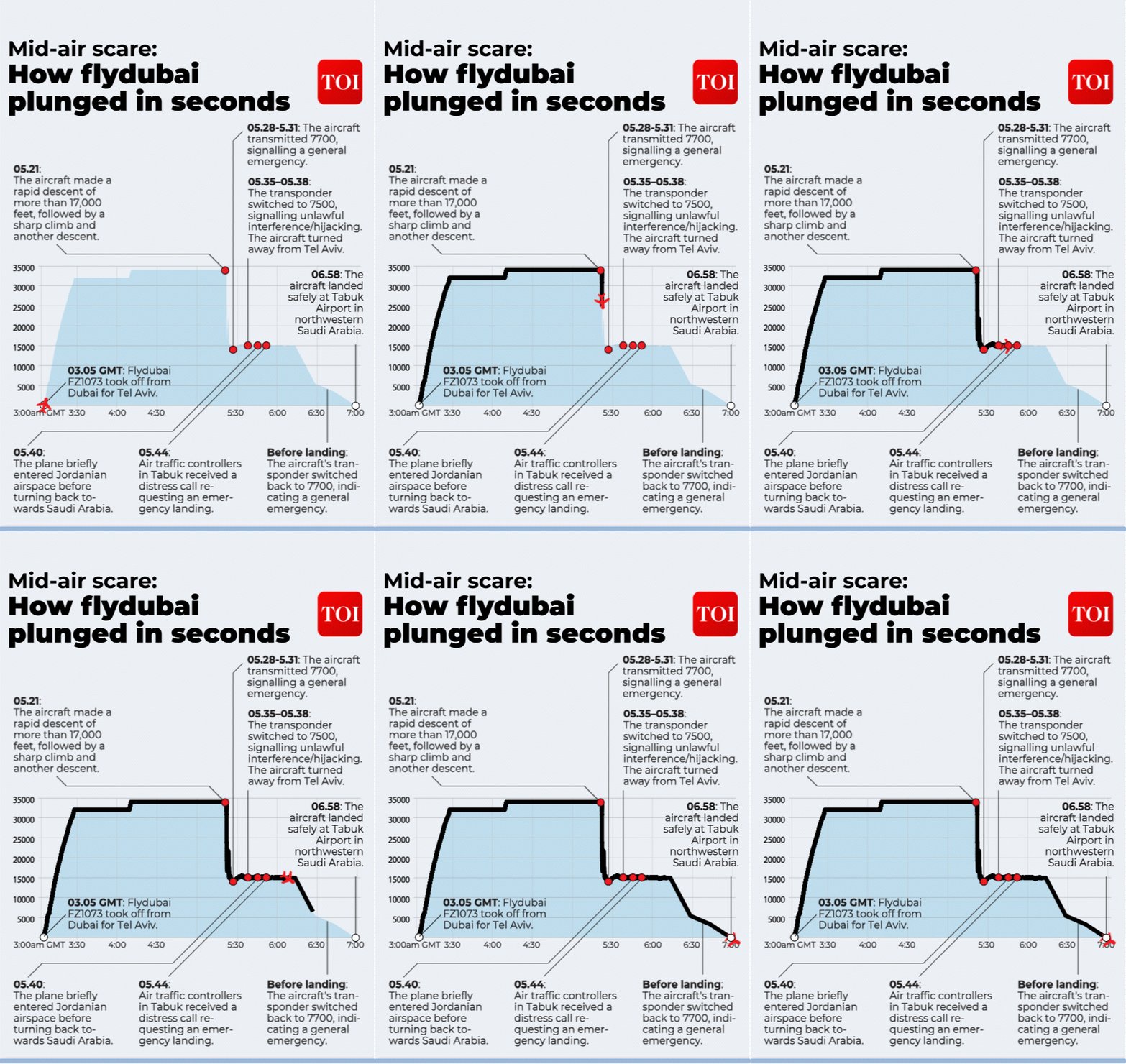
NEW DELHI: The attack by a Flydubai co-pilot on the captain during a flight from Dubai to Tel Aviv has renewed questions about whether aviation security needs another overhaul, 25 years after the September 11 attacks transformed how airlines protect their aircraft.The September 30 incident saw the aircraft plunge around 16,000 feet in 30 seconds after the co-pilot allegedly attacked the captain with an emergency crash axe. The aircraft was eventually brought under control and landed safely in Tabuk, Saudi Arabia, after the injured captain managed to open the cockpit door, allowing passengers to overpower the attacker. Another pilot travelling on board and a standby crew member helped regain control of the aircraft.
–
All 182 people on board, including eight crew members, survived the incident.The incident has brought renewed attention to a question that aviation security measures introduced after 9/11 were not primarily designed to address: what happens when the threat comes from a member of the flight crew?
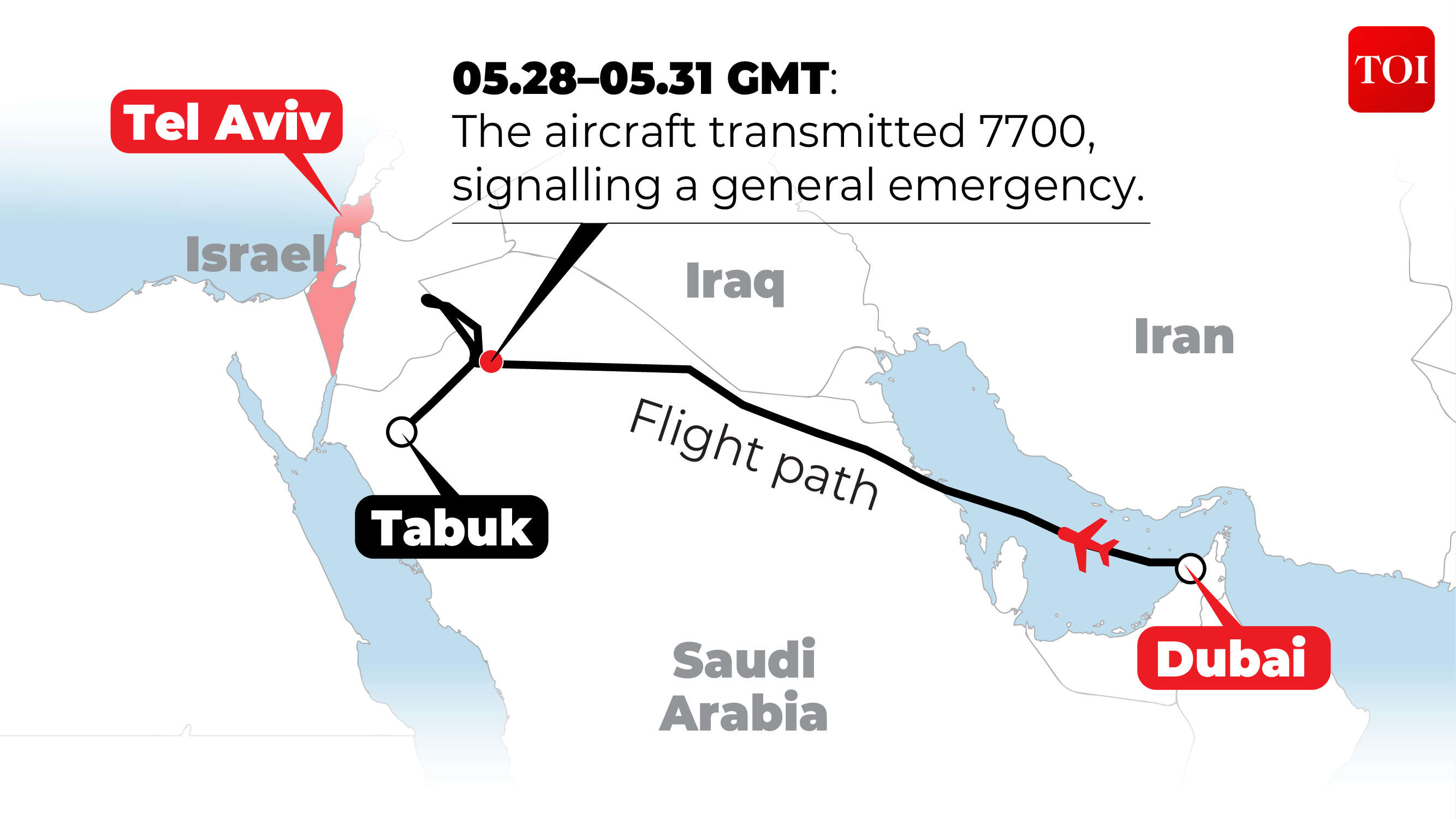
Flight path of the aircraft involved in the Tel Aviv-bound flight incident
Airlines have spent decades strengthening cockpit doors, tightening airport security and introducing procedures to prevent unauthorised access to aircraft. However, the Flydubai incident has raised concerns about pilot screening, the sharing of background information between countries, cockpit access and the industry’s ability to respond when a member of the flight crew becomes violent.On October 8, airline executives acknowledged that preventing every such incident would be difficult, even as they defended existing safety standards. The incident is being investigated by authorities in the United Arab Emirates and Saudi Arabia, while Israel has indicated that it will review security arrangements for flights entering the country.
How 9/11 changed aviation security
The September 11, 2001, attacks fundamentally changed commercial aviation. Nineteen al-Qaeda hijackers took control of four passenger aircraft in the United States, crashing two into the World Trade Center in New York and one into the Pentagon. The fourth aircraft crashed in Pennsylvania after passengers resisted the hijackers. Nearly 3,000 people were killed.Before the attacks, airport security in the United States was largely handled by private contractors, cockpit access was less restrictive and passengers could carry certain items that would later be prohibited. The hijackers exploited these vulnerabilities to take control of the aircraft.
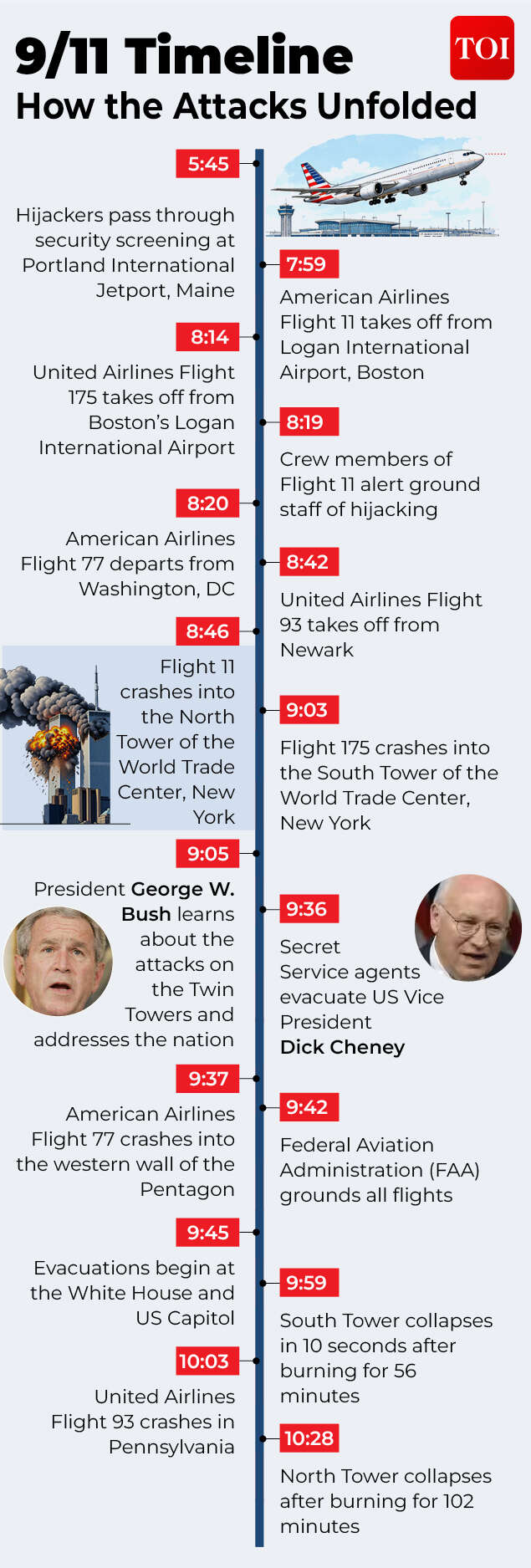
Timeline of the September 11 terrorist attacks on the Twin Towers
The US government responded by creating the Transportation Security Administration in November 2001, tightening passenger and baggage screening, strengthening identity checks and expanding the federal air marshal programme.The most consequential change aboard aircraft was the introduction of reinforced, lockable cockpit doors designed to resist forced entry and firearms. US airlines were required to install reinforced doors by April 2003, with international aviation standards subsequently extending cockpit protection worldwide.Security procedures also expanded beyond passengers to include airport employees, restricted areas, baggage and cargo. Airlines and regulators developed additional safeguards to prevent aircraft from being seized by unauthorised individuals.These measures were designed primarily to prevent an external attacker from entering the flight deck and taking control of an aircraft. The Flydubai incident presents a different challenge: the alleged attacker was an authorised member of the flight crew who already had access to the cockpit.
What happened aboard Flydubai flight FZ1073?
On September 30, Flydubai flight FZ1073 was travelling from Dubai to Tel Aviv with 182 people on board when the co-pilot allegedly attacked the captain.The aircraft experienced a steep descent, losing around 16,000 feet in approximately 30 seconds. Flight-tracking data also showed the aircraft transmitting emergency signals during the incident.The injured captain reportedly managed to open the cockpit door, enabling passengers and crew members to overpower the co-pilot. Another pilot who was travelling on board subsequently helped regain control of the aircraft, which was diverted to Tabuk in northwestern Saudi Arabia and landed safely.
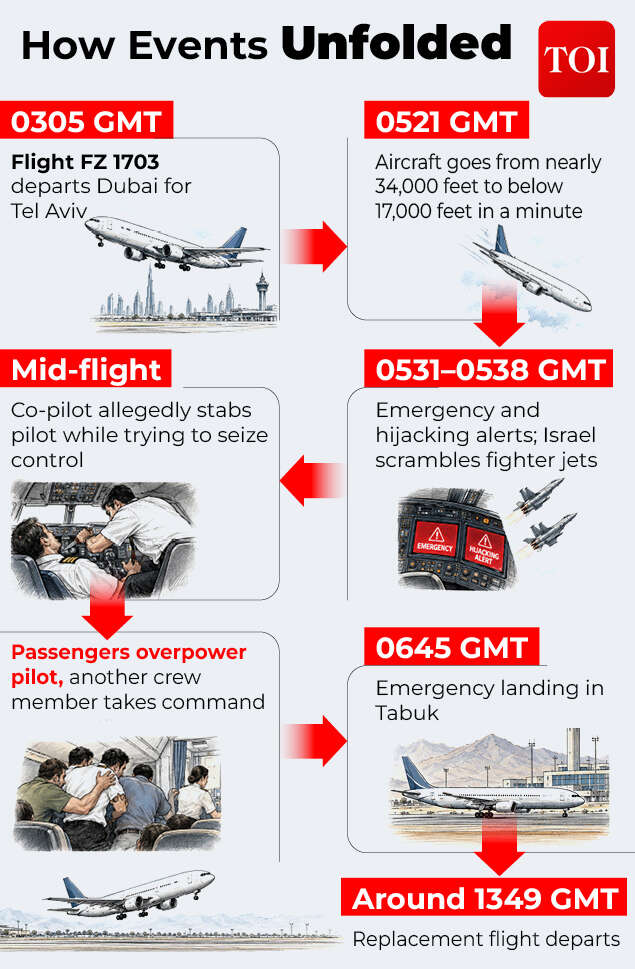
Reuters reported, citing Israeli officials familiar with the investigation, that the co-pilot had told interrogators in the UAE that he planned the attack before joining the airline. The allegation has not been established through a publicly announced court finding, and the UAE had not announced formal charges against him, according to Reuters’ October 8 report.Israeli authorities have described the incident as a terrorist attack and an alleged attempt to crash the aircraft. Investigators are also examining how the suspect was cleared to serve on a flight bound for Israel.The incident’s outcome has prompted questions about how much the response depended on circumstances that may not be present during another emergency.Saj Ahmad, chief analyst at aviation consultancy StrategicAero Research, told Al Jazeera that the presence of additional pilots aboard the aircraft was crucial.“It is frightening to think of what the outcome would have been if those additional pilots were not there to take control.”
How secure is a cockpit door?
Reinforced cockpit doors remain one of the central security measures introduced after 9/11. On modern commercial aircraft, the flight deck is protected by a reinforced door and an access-control system designed to prevent unauthorised entry.Under normal operating procedures, the door remains locked during flight. Cabin crew can request access, while an emergency-entry system provides a mechanism for authorised personnel to seek entry if a pilot does not respond. The system includes safeguards intended to prevent an attacker from simply entering the cockpit.However, these protections primarily address the threat of someone attempting to break into the flight deck from the cabin. They cannot, by themselves, prevent a violent confrontation between people already inside.
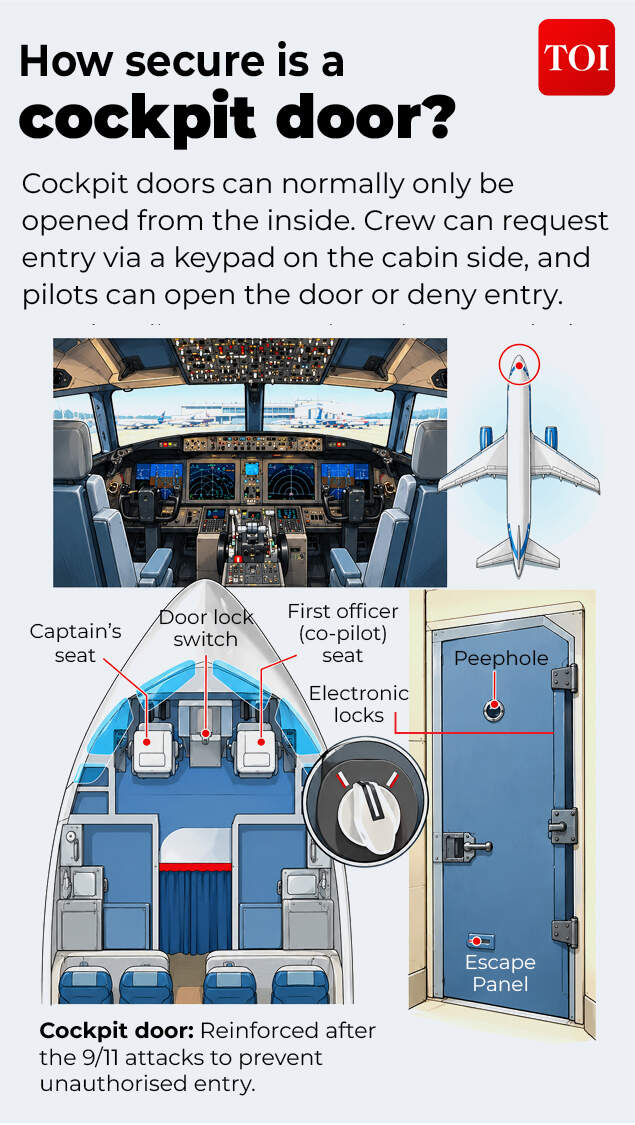
Abhinav Singh, a pilot with a leading airline, told TOI that cockpit doors remain an essential security measure but cannot address every possible threat.“Reinforced cockpit doors and access-control systems were primarily strengthened after the September 11 attacks to prevent unauthorised access to the flight deck. They are an essential layer of aviation security, but no single security measure can address every possible threat, including one originating inside the cockpit itself,” he said.“If a pilot becomes violent, the situation is fundamentally different from an external intrusion because the person already has authorised access to the flight deck and may have control of the aircraft. The door can protect the cockpit from outside interference, but it cannot resolve a threat involving a person already inside,” he added.“Access-control procedures must therefore balance cockpit security with the need to manage emergencies. Any procedure for dealing with a violent crew member must account for the possibility that restricting access or delaying assistance could create additional risks. The broader objective should be to combine physical security with crew training, clear emergency procedures and effective coordination between the flight deck and cabin crew,” Singh said.The 2015 Germanwings crash exposed another dimension of the problem. Co-pilot Andreas Lubitz locked the captain out of the cockpit and deliberately flew the Airbus A320 into the French Alps, killing all 150 people on board.Following the crash, European aviation authorities recommended that two authorised people remain in the cockpit at all times. The recommendation was subsequently replaced by a more flexible, risk-based approach, allowing airlines to adopt safeguards suited to their operations.The Flydubai incident has renewed debate about whether existing access procedures adequately address situations in which one pilot attacks another, or whether additional measures could help the remaining crew regain control.
Could pilot screening become stricter?
The incident has also renewed scrutiny of how airlines recruit pilots and verify their professional and personal backgrounds.Pilots undergo licensing checks, medical assessments and background screening, but the process involves airlines, training institutions and regulators operating across different jurisdictions. A pilot may train in one country, obtain a licence in another and subsequently work for airlines based elsewhere.This can make it difficult to build a complete picture of an individual’s professional history and identify relevant concerns when pilots move between employers.Abhinav Singh, a pilot with a leading airline, told TOI that airlines assess pilots through licensing checks, medical fitness assessments, training records and technical evaluations. However, verifying their complete employment and disciplinary histories across borders can be more complicated.“Pilot recruitment involves several layers of checks, including licence verification, medical fitness, training records, simulator assessments and technical evaluations. Airlines also examine a candidate’s flying experience and operational competence before allowing them to fly commercially. However, the depth of employment and background checks can vary depending on the airline, the regulatory framework and the country in which the pilot previously worked,” he said.“Verifying a pilot’s licence is relatively straightforward when the issuing authority and records are accessible. The more complicated part is establishing a complete picture of their previous employment, training history, performance and any disciplinary concerns across different jurisdictions. Records may be maintained by different regulators and operators, and information-sharing practices are not always uniform internationally,” he added.“This is why stronger cooperation between aviation regulators and standardised systems for verifying a pilot’s professional history are important. A licence establishes that a person meets specified requirements, but recruitment should also establish their professional record and continued fitness to operate safely,” Singh said.Following the Flydubai incident, Israel said it would strengthen security checks for pilots flying into the country. The investigation is expected to examine whether any concerns about the co-pilot had previously been raised and whether relevant information was shared with the authorities responsible for screening him.Investigators will need to establish whether existing safeguards were followed, whether relevant information was available to the airline and whether additional screening could realistically have prevented the incident.
What happens if violence erupts in the cockpit?
A violent confrontation between pilots creates a particularly difficult emergency because the people responsible for controlling the aircraft may themselves be involved.Singh told TOI that cabin crew can help manage security incidents and communicate with the flight deck, but their training and authority differ from those of a qualified pilot operating the aircraft.“The immediate priority in such a situation is to preserve control of the aircraft and prevent the confrontation from escalating. Commercial aviation procedures are designed around clear responsibilities, communication and the management of abnormal situations. However, a violent confrontation inside the cockpit creates an exceptionally difficult scenario because the people responsible for flying the aircraft may themselves be involved in the emergency,” he said.“Cabin crew are trained to manage security incidents and communicate with the flight deck, but their training and authority are not equivalent to those of a qualified pilot operating the aircraft. Their role would depend on the circumstances, the aircraft’s procedures and the extent to which communication with the flight deck remains possible,” he added.“An appropriately qualified pilot travelling as a passenger could potentially provide assistance, depending on the circumstances and airline procedures. However, it would be unsafe to assume that any available person could simply take over. This is why emergency preparedness, crew resource management and clear escalation procedures matter. Airlines and regulators need to examine whether existing training adequately addresses situations involving violence between flight crew members, rather than focusing exclusively on external security threats,” Singh said.The presence of another pilot aboard the Flydubai flight may have helped avert a worse outcome, but the incident has raised questions about how airlines prepare crews for emergencies involving a member of the flight deck team.
Does aviation need another security overhaul?
The Flydubai incident does not, by itself, establish that the aviation industry’s existing safeguards are inadequate. Nor does it demonstrate that any single additional screening measure would have prevented the attack.It does, however, expose a vulnerability that differs from the one aviation authorities sought to address after 9/11. The earlier reforms focused on preventing unauthorised individuals from entering the cockpit and using aircraft as weapons. The latest incident raises questions about how to respond when a person with legitimate access becomes the threat.Singh told TOI that the International Civil Aviation Organization (ICAO) and national regulators should examine cross-border employment verification, confidential reporting of safety concerns, crew conflict management and recurrent training.“Incidents involving violence or deliberate actions by flight crew highlight the need to continuously reassess aviation safety measures. The Germanwings crash demonstrated the catastrophic consequences of a pilot deliberately causing an aircraft to crash, while reports of violence involving crew members raise questions about how airlines identify, prevent and respond to threats originating within the operating crew.“The International Civil Aviation Organization (ICAO) and national regulators should examine whether existing standards provide sufficient guidance on cross-border employment verification, confidential reporting of safety concerns, crew conflict management and responses to deliberate acts of violence. There should also be greater consistency in how airlines assess previous employment records and verify qualifications across jurisdictions.“Another area for review is recurrent training. Pilots and cabin crew should be prepared to recognise and respond to serious onboard security incidents, including scenarios involving a member of the flight crew. Such training must be realistic, proportionate and designed around preserving aircraft control.“However, additional security restrictions alone will not solve the problem. Regulators need to strike a balance between safeguarding cockpit security, protecting the wellbeing and rights of aviation professionals, and ensuring that credible safety concerns can be reported without fear of retaliation. The ultimate objective should be a system that identifies risks early, responds effectively when incidents occur and learns from every serious event.”Airline executives have also cautioned that no safety system can eliminate every risk posed by an individual acting deliberately.Ryanair Group chief executive Michael O’Leary, speaking at an Airlines for Europe press conference in Brussels on October 8, said: “If you have somebody who is a mad person in a cockpit, it’s very difficult to legislate for it,”Lufthansa chief executive Carsten Spohr also stressed the limits of preventive measures while defending the industry’s safety standards.“We have to face the fact that there is no absolute safety and security in this industry,” Spohr said.The remarks reflect the challenge facing airlines and regulators: strengthening safeguards without creating procedures that introduce new vulnerabilities or discourage pilots from reporting health and personal difficulties.The Germanwings crash prompted greater attention to pilots’ mental health, including psychological assessments and support systems. However, mental health screening and security screening address different risks. Experiencing depression, anxiety or stress does not, by itself, indicate that someone poses a security threat. A system that makes pilots reluctant to disclose health problems could undermine safety by discouraging them from seeking help.Possible areas for review include the exchange of pilot background information across national borders, verification of professional histories when pilots change employers, crew security checks and procedures for responding to violence in the flight deck. Authorities may also examine cockpit access arrangements, emergency communications and recurrent crew training.Any changes will need to be based on evidence gathered during the investigation rather than a reaction to an extraordinary incident. Aviation safety depends on multiple layers of protection, from recruitment and training to cockpit procedures and emergency response.The challenge for regulators is to identify where those layers failed, if they did, and determine whether existing rules were properly implemented before introducing new requirements.Twenty-five years after 9/11 transformed aviation security, the Flydubai incident has raised a different question for the industry: how can it protect an aircraft when the person posing the threat is already inside the cockpit?