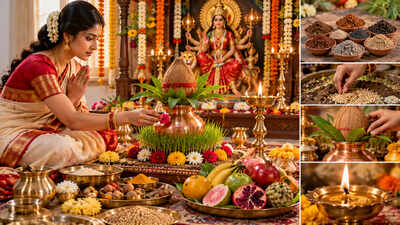
Before you buy the coconut, prepare the soil. The Kalash, the sacred pot, rests on a bed of earth, and that bed must be ready before the muhurat, or auspicious time, arrives. This year, the window comes early. On Sunday, 11 October 2026, Pratipada, the first lunar day of Ashvin Shukla, falls on the day of Ghatasthapana. In Delhi, the Ghatasthapana muhurat is approximately 6:19 AM to 10:12 AM. If you miss it, the Abhijit muhurat, from about 11:44 AM to 12:31 PM, is an alternative. Timings vary by city, so check your local panchang.Pratipada is also known by names such as Pratham Sthapana and Pariva. Whatever you call it, this is the day that lays the foundation for everything that follows. It matters more than usual in 2026 because Navratri spans ten calendar days this year. Saptami, the seventh lunar day, is present at sunrise on both 17 and 18 October, so no tithi is omitted from the observance. The lamp you light today, therefore, has to burn a little longer.
Why the pot needs seven kinds of earth
The Kalash is installed to invoke the seven energies of the Saptamatrikas, the seven mother goddesses associated with nourishment. That idea of nourishment is central to the ritual. This is worship that nourishes something within you throughout the nine nights, not merely a display for the living room.Collect seven types of soil from different places and prepare a clean spot in the north-east corner of your home, known as the Ishanya direction. Sprinkle water on the soil and mix in seven types of grains, or simply use jau (barley). Barley is the traditional choice partly because it sprouts quickly. A green shoot appearing in the later days of Navratri is considered a favourable sign.Place the Kalash on the moist soil. Clay is traditionally preferred, although brass, bronze, and other metals may also be used. Avoid aluminium and iron. Fill the pot with water and add:
- A betel nut (supari)
- Durva grass
- Five coins
- Unbroken rice grains
- A pinch of turmeric
Place five mango leaves around the rim, followed by a coconut on top. Mango leaves are generally available even in October, making them a practical choice for the ritual.Together, the pot and coconut symbolise the garbha, or womb. Worshipping the Divine Mother, in this interpretation, celebrates every form of creative potential, whether you are writing a poem, painting a wall, or building a business. Because the arrangement is meant to remain alive throughout the observance, check it daily and replenish the water if necessary.
The flame that goes in the south-east
The next step is lighting the Akhand Deepak, the continuously burning lamp. It represents nine nights of steadfastness: your devotion does not depend on your mood.Use pure desi ghee. If it is unavailable, mustard oil, sesame oil, or another suitable natural oil may be used, depending on your family’s tradition. Avoid refined oils and vanaspati, a hydrogenated vegetable-fat product. Place the lamp in the south-east, known as the Agneya disha, the direction associated with fire.With the Kalash in the north-east and the lamp in the south-east, your Navratri observance is underway. One symbolises the promise of creation; the other, the promise of continuity.If you keep an Akhand Deepak burning continuously, place it on a stable, heat-resistant surface, well away from curtains, flowers, and other flammable materials. Never leave an open flame unattended, and follow appropriate fire-safety precautions.
What Counts as Fruit on a Navratri Plate?
Many people get this wrong, treating anything sold as a “fasting food” as suitable for a fast. But real fruit means actual fruit. October offers plenty of choices:
- Guava
- Pomegranate
- Apple
- Custard apple
- Papaya
- Banana
- Sweet lime
These fruits are widely available during the post-monsoon season. If you are observing a fast, avoid relying on fried foods simply because they carry a “fasting” label. They may not align with the simpler approach to eating that many devotees prefer.If fruit alone is not enough to sustain you through the day, singhara (water chestnut flour) and sabudana (tapioca pearls) are commonly accepted fasting foods. Keep fried dishes to a minimum, and make that choice consciously each morning rather than slipping into the habit. A simpler plate also reflects the broader idea of purity in food, accompanied by gentler speech and quieter thoughts.Tomorrow morning, before anything else, lift the Kalash cover and check the water.