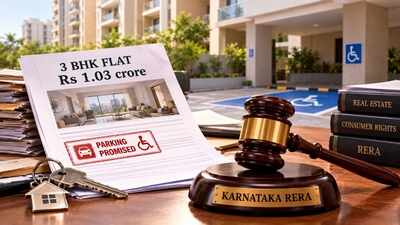
You buy an apartment with the builder promising some special parking provisions. But the builder fails to deliver and collects steep maintenance charges from residents. What do you do?In one such case, a woman and her family bought a 3BHK ( 3 Bedrooms, Hall, Kitchen) from a builder in Bengaluru for Rs 1.03 crore. The builder promised two specially enabled parking spaces, and it was supposedly one of the property’s key attractions.
What the case is about
The builder’s brochure and terms clearly referred to these parking facilities. However, he failed to deliver on that commitment.However, the problems did not end there. Although the family executed the sale deed in August 2024, the builder has still not formed an apartment association.Also Read | Sisters sought share in parents’ properties under Hindu Succession law; Madras HC rules for brother over mother’s land on ouster, father’s estate over missing partiesNot only that, he has allegedly been collecting steep maintenance charges from residents without offering a proper explanation or producing audited accounts to justify the amounts.Frustrated by the builder’s conduct, the woman approached the Karnataka Real Estate Regulatory Authority (K-RERA) to seek legal action.On September 7, 2026, the Karnataka RERA tribunal ruled in her favour and also strongly criticised the builder for undermining homebuyers’ expectations.Also Read | She worked as a teacher till 62 years of age instead of retiring at 60, but was denied gratuity because of extended service; Allahabad HC orders payment with 6% interest
Why did the homebuyer win the case?
Subrata Mukherjee, Partner at SNG & Partners, Advocates & Solicitors, told ET that the homebuyer succeeded because Karnataka-RERA concluded that the builder was obligated to provide a separate car parking space for a physically challenged person.This took into account the specific regulatory requirements governing the project and the evidence submitted before the Authority.The homebuyers purchased the apartment under a Sale Deed dated August 6, 2024, for a total consideration of Rs 1,03,28,979.In December 2023, the builder sent an email to the homebuyer, assuring her that a specially enabled parking space would be provided. However, the promised facility was not made available.The woman then wrote to the builder, reminding about the applicable guidelines requiring the provision of specially enabled parking.She relied on the environmental clearance issued by the Karnataka government. Clause 32 of the clearance specifies that facilities such as ramps and separate parking spaces must be provided for physically challenged persons.Considering these exchanges alongside the specific conditions in the project’s Environmental Clearance, the Authority concluded that the builder was obligated to provide the required facility.After examining this provision, the Karnataka RERA tribunal observed that the guidelines clearly required the builder to make arrangements for facilities, including ramps and dedicated parking spaces, for persons with disabilities.RERA said: “Hence, viewed from any angle, the respondent (builder) is bound to provide separate car parking for physically challenged.”On this basis, the tribunal directed the builder to provide parking spaces for specially enabled persons in the housing project within 60 days from the date of the order.Karnataka-RERA also held that the builder was required to establish an association of allottees in accordance with the applicable law once the project had been completed in all respects and the occupancy certificate or completion certificate had been obtained.Following the formation of the association, the builder would have to execute the deed of declaration and provide audited accounts along with details of the maintenance charges.Accordingly, the tribunal directed the builder to furnish audited accounts and revised maintenance charges while executing the Deed of Declaration. This was to be done after the project was fully completed, the Occupancy Certificate or Completion Certificate was obtained, and an Association of Allottees was formed in accordance with the law in force.Also Read | Housing society wanted to label Mumbai doctor a defaulter over Rs 1.42 lakh maintenance dues and 18% interest; why Maharashtra court has granted him interim protection