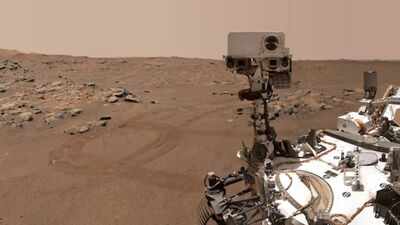
Nasa’s Perseverance rover has driven farther than any vehicle on the surface of another world, covering a record 45.22 km on Mars in just five and a half years and surpassing a mark that took its predecessor nearly 15 years to set.According to Nasa, Perseverance broke the record on October 11, when its odometer crossed the 45.16-km distance covered by the Opportunity rover between 2004 and 2018. The milestone came on the 2,006th Martian day of Perseverance’s mission.The six-wheeled rover landed in Jezero Crater on February 18, 2021. In just five and a half years, it has covered more ground than Opportunity did during nearly 15 years on Mars.“Perseverance’s engineering hardware and instruments are in excellent shape with all redundant systems still available,” Steven Lee, project manager for Nasa’s Perseverance and Curiosity rovers at the Jet Propulsion Laboratory in California, told Reuters.Lee further added that, “A recent assessment of all systems concluded that they are capable of operating well into the 2030s, likely beyond.”Perseverance’s achievement has been driven in part by advances in autonomous navigation, which allow the rover to analyse terrain, identify obstacles and select suitable routes without waiting for instructions for every manoeuvre.Nasa’s AutoNav system uses images to construct three-dimensional maps of the surrounding terrain, helping the rover navigate rocky surfaces and other hazards. More than 90 per cent of Perseverance’s total driving distance has involved autonomous navigation, according to Nasa.Beyond the record, what Perseverance has discovered on MarsPerseverance has found potential signs of ancient microbial activity in a rock nicknamed Cheyava Falls, collected in July 2024 from the Bright Angel formation in Jezero Crater.The rock contained organic compounds and distinctive mineral patterns known as “leopard spots”, which include minerals that can form through biological processes on Earth.The rover has also investigated evidence of an ancient lake and river delta in Jezero Crater, where water once flowed and deposited sediments that could have preserved traces of microbial life.Its observations have revealed evidence of changing water conditions and powerful floods that carried large boulders into the crater. In December 2024, Perseverance began exploring the crater’s western rim, examining ancient rocks that could provide clues about Mars’ geological evolution more than 3.9 billion years ago.Alongside its scientific investigations, Perseverance has drilled and stored rock cores and regolith samples for potential retrieval and detailed analysis on Earth.It has also tested technologies for future exploration, including Nasa’s MOXIE experiment, which successfully produced oxygen from carbon dioxide in the Martian atmosphere.