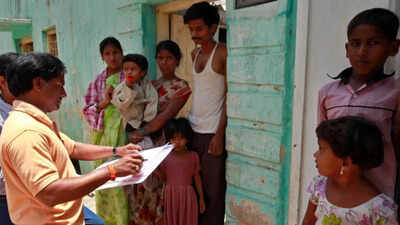
NEW DELHI: The home ministry Friday expanded the pool of enumerators for the Census exercise, making teachers of not just govt schools but also that of aided or unaided private bodies, societies and trusts; and clerks or officials employed not just by central and state govts but also by public sector undertakings, banks etc, eligible for the assignment.Amending Census Rules 1990, the ministry, in a notification issued Friday, expanded the description of staff who can be hired as enumerators for Census 2027, the second phase of which is due to start in five poll-bound states in Nov, followed by the remaining states (barring the snow-bound UT of Ladakh and parts of Uttarakhand, Himachal Pradesh and J&K where it is already over) in Feb next year.The description of those who can be hired as enumerators — encapsulated in Rule 3 of the Census Rules — has been revised from “teachers, clerks or any official or any person” to three distinct categories.Among teachers, those employed in any educational institution of govt, local authority, aided or unaided private bodies, societies or trusts will be eligible to be hired as enumerators. Also, clerks or any official of central govt, state govt, local authority or establishment, including PSUs, statutory bodies, banks, companies, institutions, societies and trusts may be assigned the job of census enumerator.
Share your thoughts in the comments
Be respectful · TOI community guidelines
This pool will now also include any person that the state govt or Union territory administration may consider suitable for performing the duties as an enumerator.The amended rules — to be called the Census (Amendment) Rules, 2026 — will offer more clarity to what classes of officials and staff may be hired to carry out the job of census enumerators, apart from expanding the talent pool. Given that the second phase of census — involving population enumeration — will, in a first since 1931, also record caste, the availability of a wide range of suitably qualified officials for engagement as enumerators is expected to help in correctly capturing the responses to the Phase 2 questionnaire.