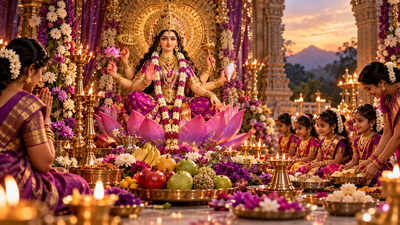
Red and blue make purple, and that simple bit of colour arithmetic is one reason devotees reach for purple on Maa Siddhidatri’s day.
Which night and which morning?
Navami Tithi, the lunar day, begins late in the morning on Monday, 19 October, making that night the Navami Tantra Puja night. This observance is followed by practitioners of specific Tantric traditions and is not required of every household.Some calendars also list Maha Navami on 19 October. On Tuesday, 20 October, Navami prevails at sunrise, and Maa Siddhidatri is worshipped until the Tithi ends around 12:50 PM in Delhi. Check your local Panchang (Hindu almanac) for the exact timings. Dashami and Dussehra follow.
Offerings for a farewell
In popular devotional belief, the Mother Goddess is said to depart after Navami, even as the inner interpretation holds that she merges within the devotee. This is why some traditions emphasise abundant offerings and a sense of completeness during the puja.Offer nine types of items, allowing the number to guide your devotion. Bring nine kinds of flowers and nine kinds of fruit, and make your offerings with generosity. In October, your fruit selection could include:
- Pomegranate
- Guava
- Apple
- Banana
- Sweet lime
- Custard apple
Kanya Puja, also called Kanjak—the worship of young girls as manifestations of the Goddess—is closely associated with this day. If your family tradition does not involve feeding nine girls on Ashtami, you may invite and feed them on Navami instead. Some families perform the ritual on 20 October itself.It is not about rushing through the ritual. It is about observing it properly, according to your family’s tradition.
Why purple, and what the lists say
The Mother Goddess is said to favour purple. Red represents the Devi, while blue is associated with Shiva. Where these two energies meet and merge within you, purple emerges. The colour, therefore, is not merely decorative; it symbolises a union.Published Navratri colour lists vary, so it is worth distinguishing the colour associated with the day from the colour associated with the Goddess herself. Many lists assign peacock green to 19 October and no specific colour to 20 October. Purple is traditionally associated with Siddhidatri herself, so wearing it on Navami does not conflict with these lists.
Ketu and the remedy
In astrology, Maa Siddhidatri is associated with Ketu. If you are experiencing difficulties attributed to Ketu, praying to her is considered a devotional remedy. Her worship is also believed to support success in endeavours associated with Ketu.These are matters of faith, not guaranteed outcomes. If Ketu is your concern, the devotional path leads to her.
The mantras and her form
Chant the following mantras to seek the blessings of Maa Siddhidatri.1. The Beej Mantra (seed mantra)ॐ ह्रीं क्लीं सिद्धिदात्र्यै नमः॥Om Hreem Kleem Siddhidatryai Namah.Meaning: I bow to Maa Siddhidatri, the embodiment of divine energy (Hreem) and attraction or Siddhi-giving energy (Kleem), who bestows spiritual accomplishments.2. The Mool Mantra (root mantra)ॐ देवी सिद्धिदात्र्यै नमः॥Om Devi Siddhidatryai Namah.Meaning: O Goddess Siddhidatri, I bow to you. Please bless me with accomplishment and success.3. The Stuti Mantra (hymn of praise)या देवी सर्वभूतेषु सिद्धिदात्री रूपेण संस्थिता।नमस्तस्यै नमस्तस्यै नमस्तस्यै नमो नमः॥Ya Devi Sarvabhuteshu Siddhidatri Rupena Samsthita, Namastasyai Namastasyai Namastasyai Namo Namah.Meaning: Salutations again and again to the Goddess who dwells in all living beings in the form of Siddhidatri.4. The mantra describing her formसिद्धगन्धर्वयक्षाद्यैरसुरैरमरैरपि।सेव्यमाना सदा भूयात् सिद्धिदा सिद्धिदायिनी॥Siddhagandharvayakshadyairasurairamarairapi, Sevyamana Sada Bhuyat Siddhida Siddhidayini.Meaning: Siddhas, Gandharvas, Yakshas, Devas, and Asuras all worship the Mother Goddess. She is the bestower of Siddhis. May Maa Siddhidatri always bless us.When the final mantra ends, the plate holds nine flowers, nine fruits, and a patch of purple. The lamp has burned lower than it did at sunrise.