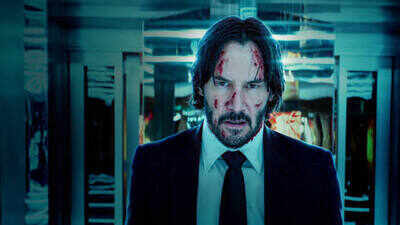
When John Wick hit theaters on October 24, 2014, most of us expected the film to be another slick, gun-heavy action movie, albeit with the star power of Keanu Reeves – an actor whose credentials as an action star was already established. Twelve years later, it’s a global blockbuster phenomenon. We still can’t get enough of John Wick.But is it the action sequences that draw us into theatre halls? Or, is it that the movie stirred something so deep and visceral in us that we didn’t see coming. Released as an action film with “gun-fu” stunts ( hybrid action style that blends close-quarters firearm use with traditional martial arts, acrobatics, and choreographed melee combat), John Wick tapped something far deeper – the unbearable pain of loss, death.And the void we find ourselves in even as we try to get by because the world has gotten too comfortable with the adage: Move on. John Wick did something no one was expecting. It got grief better than most Hollywood tearjerkers.While traditional action movies use a personal tragedy as a quick excuse for revenge, this film turns loss into the whole emotional engine of the story. It hits home with audiences far beyond hardcore action fans because it captures a raw truth: grief isn’t a neat, step-by-step process toward closure. It’s a relentless, crushing force that changes your life forever.
A cold world and relentless sorrow
It is a particularly important lesson in our times as our preparedness or ability to grapple with difficult emotions have diminished over the past decade and a half or so. To that extent this Keanu-Reeves starrer was well ahead of its time. As most art is. It came at a time when technology was developing so rapidly that in a few years it would completely take hold over our minds and even control our emotions (read rage-bait).Neurologists and psychologists, backed by research, have been telling us for the past few years that social media and addiction to smartphones and gadgets have made us more vulnerable than we ever knew. Each and everyone of us is struggling to deal with the smallest of infractions to the biggest mistakes – because our reaction to everything is too loud, too angry and too out of our control.Hence John Wick—whicever chapter—we are watching is a special kind of catharsis we are looking for. Wick’s action and the attacks on him all seem a bit too much. Why is everyone against a grieving man, who just wanted to be left alone? Does that seem familiar?It’s because for a second it felt it was you. It could be me. It is, actually, everyone.Then there is the matter of a lovely little puppy.
“It wasn’t just a dog”
The setup for the first film—a bad guy killing an adorable Beagle puppy, Daisy, almost didn’t happen. Studio executives panicked, warning directors Chad Stahelski and David Leitch that killing a puppy would alienate the audience. But lead actor Keanu Reeves fought hard to keep the scene, knowing the entire heart of the movie rested on it. Maybe Reeves is a canny businessman. A good storyteller. A great actor whose face can portray rage and grief in the same frame like very few others. Or, maybe he knew something about the coming decade. Or, is just just understanding human fallibility?In the first film, released today 12 years ago, when John later tells a criminal boss, “it wasn’t just a dog,” he sums up the whole franchise.Before she died of a terminal illness, John’s wife Helen knew her husband—a former hitman used to total control—would lock himself away in silent despair. So, she arranged for Daisy to be delivered to him after her death as a final gift. The puppy was a lifeline, a gentle way for John to heal without destroying himself.So when a degenerate mobster breaks into John’s house and slaughters Daisy, he isn’t just stealing a car or hurting a pet; he’s ripping away John’s only safe outlet for mourning. With his quiet healing stolen, John’s buried pain erupts. The return of his deadly assassin persona, ‘Baba Yaga,’ isn’t a cool victory — it’s a painful relapse. The explosion of violence is his way of screaming against an unbearable void.Throughout the series, John’s grief reshapes how he fits into his world. The secret assassin underworld—with its High Table rules, gold coins, and neutral Continental hotels—acts like a mirror for a cold society that only cares about deals and rules.
John Wick’s grief seems familiar because we have all lost the ability to deal with pain
The High Table demands order. But grief is unpredictable and absolute. When a mob boss tries to bribe and/or reason with John, he fails to realize that money and power mean nothing to a man who has lost his reason to live.John sledgehammers everything — from his basement to his enemies because emotional pain cannot be bought off or negotiated.Revenge gives grief a direction for John. It turns helplessness into action. Sorrow into purpose. John knows how to kill; he does not know how to live with the absence of the person who made his life worth living. The first film’s tragedy is that the world he escaped offers him a familiar language for his pain, and it is the only language he knows how to speak.
When grief becomes a way of life
What makes the subsequent films so compelling is that they refuse to treat revenge as a clean emotional transaction. Killing the people responsible does not restore Helen, nor does it return John to the life he had before her death. Instead, every act of violence draws him deeper into the world he had abandoned. In John Wick: Chapter 2, the consequences of his return become impossible to contain; in John Wick: Chapter 3 – Parabellum, survival itself becomes an exhausting, almost mechanical exercise. The action expands, but the emotional possibilities contract.This is where the franchise’s relentlessness becomes more than a stylistic signature. John rarely has the luxury of stopping long enough to consider what his actions mean. Enemies arrive before he can recover from the last fight, obligations accumulate, and the machinery of violence keeps moving.It resembles the way grief can overwhelm a person’s inner life, occupying so much mental and emotional space that ordinary existence begins to feel remote. Kind of what our lives look like since 2020. Post Covid. We are talking of mass PTSD – undeclared medically but feels real enough.The comparison is not literal, of course, but the films capture something recognisable about the experience of being unable to put down an emotion that has become the organising principle of one’s life.There is also a darker suggestion here: that grief and anger contain an enormous, often destructive potential when they are given no other outlet. John’s extraordinary abilities make him almost superhuman, but they do not make him emotionally invulnerable. If anything, his competence is part of the problem. He can turn pain into action with terrifying efficiency, yet he cannot make the pain disappear. The world sees a legendary assassin; we see a man who has never quite found a way back from loss.The fourth film brings this preoccupation with mortality to the foreground. Reeves has explained that death and the possibility of peace became central to the story they wanted to tell, giving John’s journey a destination beyond another cycle of revenge.The question is no longer simply whether John can defeat his enemies, but whether there is any way for him to escape the life that grief has helped set in motion.In the end that is the paradox at the heart of the film. John Wick keeps going because stopping would mean facing the silence left behind by Helen. And that silence, more than any army of assassins, is the one adversary he has never quite learned to defeat.That is too familiar an emotion for all of us, especially, in the times we live in.