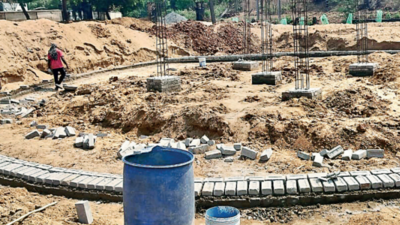
A recent illegal park construction in Udayagiri has brought the focus back on the larger challenge facing Odisha’s bid to secure Unesco World Heritage status for its famed Buddhist triangle. TOI examines the situationThe Archaeological Survey of India (ASI) in Sept stopped the construction of a proposed park, Buddha Vihar Park, by a private entity in the regulated area of the protected Buddhist complex at Udayagiri in Jajpur district and lodged a police complaint. Both the National Monuments Authority (NMA) and ASI have begun an inquiry, while the Jajpur administration has recently approached the NMA seeking statutory clearance to resume the remaining work.The construction of the park may have been stopped, but the episode has drawn attention to construction and encroachment around Lalitgiri, Udayagiri and Ratnagiri — the three Buddhist sites that India has put forward as a single cultural property for Unesco World Heritage recognition.The three sites in the Assia hill range — Lalitgiri in Cuttack district, and Udayagiri and Ratnagiri in Jajpur — were included in Unesco’s Tentative List after the ASI, India’s nodal agency for the World Heritage Convention, submitted the serial nomination last Dec. The Centre is likely to take up the nomination of the Udayagiri-Lalitgiri-Ratnagiri complex around 2029-30.The nomination describes them not simply as three archaeological sites, but as an “interconnected Buddhist landscape”. Buddhist researcher Sunil Patnaik said Lalitgiri is among the earliest Buddhist centres in the region, dating from the 2nd-3rd century BCE onwards.Udayagiri emerged as a Mahayana centre and later developed Vajrayana associations, while Ratnagiri became a major Vajrayana centre, particularly during the Bhaumakara period.The significance of the three sites extends beyond the surviving monuments. Their hillocks, water bodies and wider setting form part of the cultural landscape presented in the Unesco nomination. All three are centrally protected under the AMASR Act, 1958, and managed by the ASI.According to govt reports, over the years, modern buildings and a temple have come up inside the protected/prohibited zone at Lalitgiri. At Ratnagiri, modern buildings were recorded within the protected, prohibited and regulated areas. The ASI’s recorded action included writing to the district collector in the case of Lalitgiri and issuing a stop notice at Ratnagiri.“At Udayagiri, land within the regulated area was excavated for construction of the superstructure of a proposed park by a private entity, despite repeated reminders from locals and the ASI about the violations,” said Godabari Shyanti, sarpanch of Gopalpur panchayat under Badachana block.“This issue of encroachment is significant for the state’s bid to secure World Heritage status for its Buddhist Triangle, not because Unesco requires a candidate site to be completely encroachment-free, but because integrity, protection and effective management are central to the assessment,” said Buddhist scholar Prakash Chandra Nayak.“Unesco’s World Heritage framework requires a nominated property to retain the integrity needed to express its Outstanding Universal Value. That is particularly relevant to the Buddhist Triangle because the nomination identifies the surrounding hillocks and water bodies as part of the landscape necessary to express its heritage value,” Nayak said, adding, “Construction that damages archaeological remains, alters the historic setting or disrupts the relationship between the monuments and their surroundings can, therefore, raise questions about the effectiveness of protection.”ASI’s superintending archaeologist Milan Kumar Chauley said it is taking steps to prevent further violations.“The ASI has so far conserved the three sites in their original form by not allowing any modern constructions in the prohibited and regulated areas,” Chauley added. Wherever encroachments are coming to notice, ‘stop notices’ are being served and local police being informed about it.Meanwhile, the Centre has begun strengthening boundary management around centrally protected monuments. In Aug, the culture ministry stated that ASI had completed surveying, geo-referencing and digitisation of the boundaries of protected monuments and sites, with the information uploaded on the Bhuvan portal.Joint surveys with revenue authorities are also being undertaken to establish and safeguard monument boundaries, including those of Odisha’s Buddhist sites.