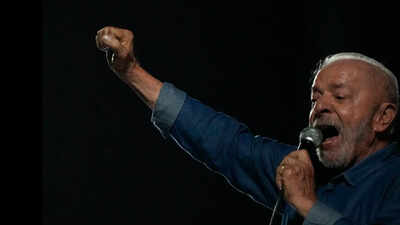
Brazilian voters have denied Latin America’s resurgent right its ultimate prize, snapping a streak of seven straight conservative presidential victories in 18 months. The stunning triumph of President Luiz Inácio Lula da Silva over Flávio Bolsonaro on Sunday, two days before his 81st birthday, with 51.8% of the vote to 48.2%, limits US President Donald Trump’s drive to tighten his grip on the Western Hemisphere and cements Latin America’s most populous country and largest economy as a counterweight to Washington.A Bolsonaro victory would have left Mexico’s Claudia Sheinbaum as the only progressive president among the region’s powerhouses.By Monday morning, with his ally Flávio Bolsonaro, following his father’s lead, refusing to concede and calling for the result to be annulled, Trump had yet to publicly acknowledge Lula’s re-election, even as congratulations poured in from around the world. PM Modi congratulated Lula on his “remarkable re-election victory” and said he is looking forward to working closely with him.For US, which has wielded tariffs, sanctions and military force to reassert its dominance in the region, Lula’s victory complicates its campaign to enlist Brazil in its military coalition against cartels.
Result shows Brazil doesn’t accept to be anyone’s backyard: Lula
More broadly, Brazil’s vote opened a stretch of high-stakes elections that could reshape global politics, with Israel Tuesday holding its first national election since the Oct 7, 2023 Hamas attack and the US midterms on Nov 3.Yet both sides see reasons to cooperate. Washington wants access to Brazil’s vast trove of rare earths to reduce its defence industry’s reliance on China. Lula wants foreign investment and tariff relief for Brazilian exporters. “Lula is pragmatic enough to work out some kind of modus operandi with the Trump administration,” said Will Freeman, a fellow for Latin America studies at Council on Foreign Relations, adding that the Bolsonaros’ allies in Washington would likely lose sway after the family’s second electoral defeat. Flávio’s father, former President Jair Bolsonaro, lost to Lula in 2022.“I’m not sure anyone in the Trump administration, beyond a few individuals, will want to keep making the Bolsonaros the central issue in the US-Brazil relationship,” he said. Across much of Latin America, voters fed up with rising crime have rewarded presidential candidates promising to restore order. From Peru’s Keiko Fujimori to Colombia’s Abelardo de la Espriella and Chile’s José Antonio Kast, newly elected conservatives have courted Trump while taking their cues from El Salvador’s President Nayib Bukele, whose sweeping gang crackdown has sharply reduced homicides at the cost of suspended civil liberties.Trump has reinforced that shift with electoral endorsements, financial bailouts and pledges of military aid. “US is certainly putting its finger on the scale to try to help the more hardline right-wing elements in the region,” said Kenneth Roberts, a professor of govt at Cornell University.Brazil would have been Washington’s most consequential addition. Bolsonaro had promised to join the US-led security coalition “with great enthusiasm and great honour”, making his alliance with Trump part of his pitch to voters.Lula, by contrast, has championed Brazil’s long tradition of non-alignment, cultivating ties with competing powers. His govt deepened trade ties with China and sought greater global influence through Brics. Trump’s heavy-handed support for the Bolsonaros played into that message. The double-digit tariffs he imposed on a range of Brazilian goods to punish Brazil for prosecuting former President Jair Bolsonaro over a coup plot to oust Lula stirred a nationalist backlash that the leftist leader channelled into the rallying cry “Brazil belongs to Brazilians”.In his victory speech late Sunday, Lula described the outcome as “a demonstration that this country does not accept being anyone’s backyard”. Lula made a dramatic return to office in 2022 elections after a corruption scandal saw him jailed for over 18 months before the charges were annulled on procedural grounds. Lula oversaw a drop in inflation and unemployment in his third term, and lifted millions out of hunger, but many voters felt gloomy about the high cost of living and crime.Flavio Bolsonaro (45) pitched himself as more moderate and jovial than his father and galvanised conservatives, as well as less ideological voters wanting something new. “We’re in a deep hole. People can barely afford to eat,” said 68-year-old retiree Tereza Cristina Ramos. Lula, already one of the world’s oldest leaders, will be 85 by the end of his new term in 2030. He also faces a hostile Congress dominated by the right.