
By Vedika NarvekarEvery Diwali, Indian investors ask us one question: Is it the right time to buy gold? And our answer? Absolutely! However, this year, the answer isn’t so simple. Gold has fallen more than 26% from its January record high, yet in rupee terms, it is still 11.6% higher than last Diwali.There is considerable uncertainty in global markets, which would normally boost gold’s safe-haven appeal. However, the yellow metal is currently responding more to elevated bond yields and interest rate expectations.Meanwhile, in India, mutual funds have closed one door, jewellers are reporting strong sales, and global investors have started buying again. So, let’s understand what’s driving the gold market and whether this Diwali presents the right opportunity to invest.
The Diwali-to-Diwali scorecard
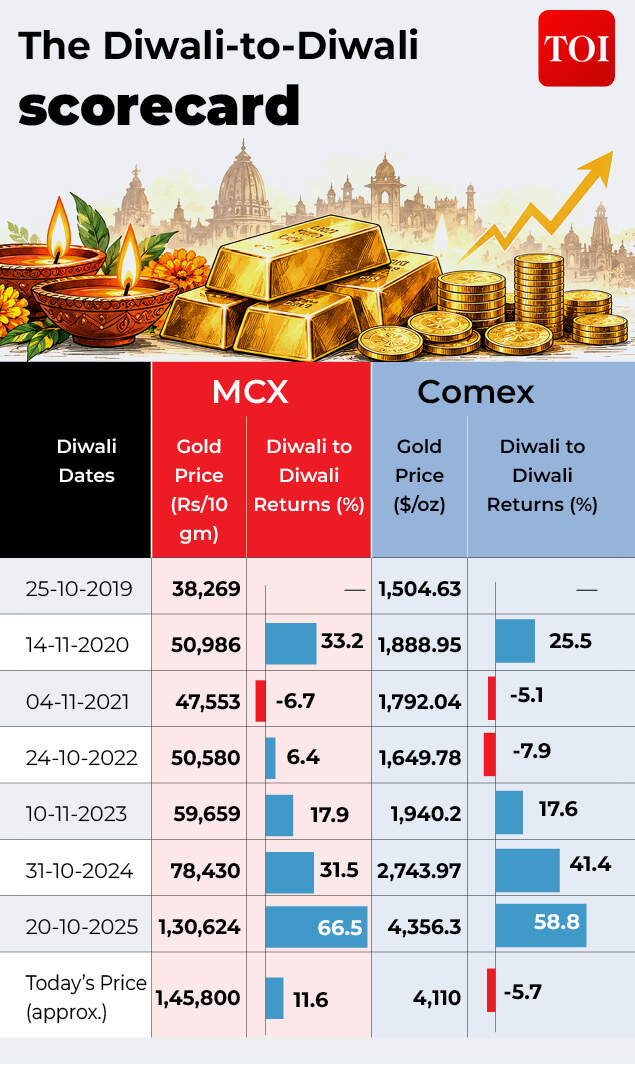
If we look at gold from one Diwali to the next and it has rewarded patient buyers. On the MCX, gold has risen from Rs 50,986 per 10 gm in November 2020 to about Rs 1,45,800 now. That is almost 3 times the price.It has fallen in only one of the seven Diwali-to-Diwali periods (down 6.7% in 2021). The best run was last year, when it jumped 66.5%.
Gold’s Diwali to Diwali scorecard
International gold (Comex) tells a quieter story. It has gone from $1,888 to about $4,110 per ounce, but it is down 5.7% this year, and it also fell in 2021 and 2022.Why is gold down in dollars but up in rupees? Because of the weaker rupee and the import duty hike in May, from 6% to 15%. Both have cushioned Indian buyers from the global fall.
Lets understand why gold fell globally
Higher rates and a stronger dollar did most of the damage. The US 10-year yield is above 5%, its highest since 2002, and the dollar index is near 102, close to an 18-month high. Gold fell 8.5% in September to $4,176 as the Fed raised rates by 25 basis points, its first hike since 2023, and a December hike is priced at about 90%. US inflation is 3.7%, and Brent is up over 75% this year to about $108 since the US-Iran war began in late February.Buyer support has also weakened. China’s central bank bought 23t in September and 103t this year, and central banks bought 170t in January-August. But Russia sold 56t, Turkey net sold 82t, and Kazakhstan plans to cut gold to 75% of reserves from 78%.Physical demand is soft too: China’s wholesale demand fell 21% y/y to 234t in July-September, and India’s gold imports were $1.8 billion in September, down 81% y/y.
What buyers are doing
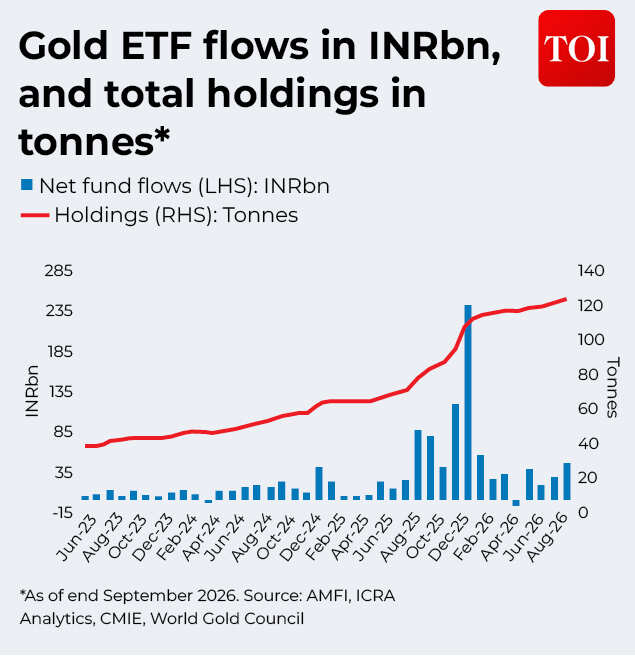
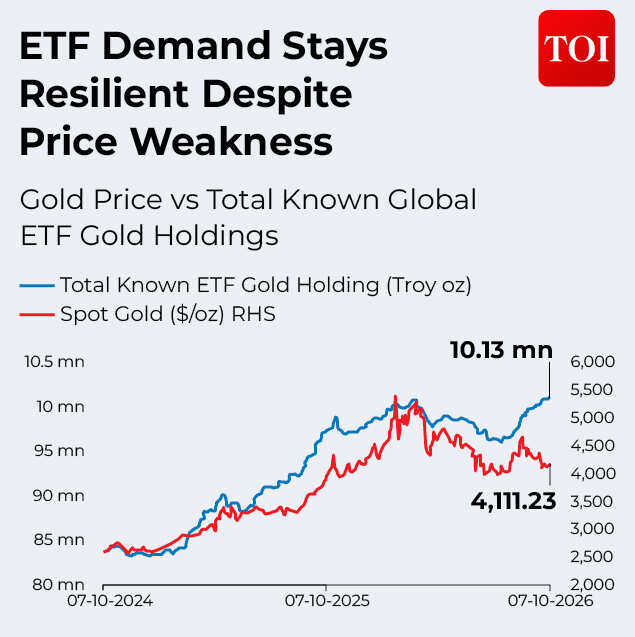
Global ETFs are back. After dipping in the April-July period, following the war’s outbreak, global gold ETF demand has risen steadily: $18 billion in August, $10 billion (67.3t) in September, and a record $31 billion for the July-September quarter. Total holdings are at a record 4,256t, and North American funds had their first quarterly inflow of 2026.
Gold ETF flows
India’s ETFs follow the trend. Indian gold ETFs took in Rs 4,450 crore in September, a seven-month high, adding about 3t to reach 124t. Another Rs 1,722 crore came in the first half of October. About 140,000 new accounts were opened in September, against around 4,000 in August. Digital gold also rose, with 1.7t bought in September, 83% more by value than a year ago.Jewellery is resilient, coins are cooling. Listed jewellers grew revenue 20-30% in July-September even though key festivals fall in the next quarter this year, and same-store sales rose about 20%. Buyers are choosing lighter pieces, average bills are up by double digits, and old-gold exchange makes up over half of sales at some retailers.
ETF Demand Stays Resilient Despite Price Weakness
Coin and bar demand, however, has cooled from a strong base as price momentum eased. The discount on domestic gold has narrowed from $66 an ounce in September to $8, a sign that festive demand is returning.
Different avenues and their pros and cons
Gold can be bought through jewellery, coins and bars, Gold ETFs, gold FoFs, digital gold and MCX gold derivatives. Jewellery suits wearing and gifting but involves making charges and GST, while coins and bars have lower making charges but require safe storage. Gold ETFs offer exchange-traded exposure without storage concerns but require a demat account.Gold FoFs allow easy SIPs without a demat account, though fresh investments may be restricted by some fund houses. Digital gold starts at Rs 1 but carries 3% GST, a 2.5-5% buy-sell spread and lacks SEBI regulation.MCX gold derivatives allow investors to gain exposure to gold price movements with relatively low upfront margin and no physical storage, but involve leverage, high volatility, margin calls and the risk of substantial losses. The simple rule is buy jewellery to wear and ETFs for long-term investment and allocate 10-12% of a portfolio to gold.
The outlook until next Diwali
The next trigger is the US Fed meeting on 27-28 October. Markets see about an 82% chance of no change, but a December hike is largely priced in. In the short term (1 month), we expect Spot gold to stay in the range of $3,950-4,320 and on the MCX Rs 1,39,500- Rs 1,53,000. Beyond that, there are three scenarios:• Cautious: The Fed keeps tightening and oil stays high. In such a scenario, Spot Gold could dip below $3,900 towards $3,800 level, which is about Rs 1,34,500 per 10 gm on the MCX.• Base case: Gold moves sideways, then recovers as festive and wedding demand, ETF flows and central bank buying offset higher rates. That is about $4,000-4,550, or Rs 1,41,000-1,61,000.• Positive: The hiking cycle ends and fears of currency debasement return. In such cases, Gold may rebound sharply towards $4,800-$4,850, or about Rs 1.72 lakh.Overall, any major geopolitical escalation, a surge in oil prices, or further Fed tightening could trigger a decline in MCX gold prices towards Rs 1,40,000 and below. However, in the absence of such developments, prices may consolidate around current levels of Rs 1,44,500-Rs 1,54,000, with limited downside.For prices to move beyond this range, the interest rate-hiking cycle would need to come to an end, potentially paving the way for a strong upside in MCX gold prices towards Rs 1,60,000-Rs 1,70,000. Considering these scenarios, the smart approach is to wait for a dip and buy gold in installments rather than all at once. Use ETFs for investment, and keep gold to around 10-12% of your portfolio. Avoid borrowing to buy gold.While gold may have lost some of its shine this year, it continues to hold a special place in Indian homes. This Diwali, the key is to buy wisely, plan ahead and invest within your means.(The author is Research Analyst – Commodities & Currencies, Anand Rathi Shares and Stock Broker)(Disclaimer: Recommendations and views on the stock market, or any other asset classes or personal finance management tips given by experts and analysts are their own. These opinions do not represent the views of The Times of India.)