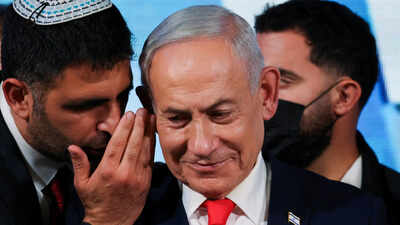
Israel’s election has produced an uncertain political picture, with exit polls initially projecting a close contest between prime minister Benjamin Netanyahu’s Likud-led bloc and the opposition led by former military chief Gadi Eisenkot. Neither camp was projected to secure the 61 seats needed for a majority in the 120-member Knesset.As counting progressed, partial results published by the Central Elections Committee showed Netanyahu’s bloc with 57 seats and the anti-Netanyahu bloc with 47, with 41.9% of ballot boxes counted as of 5:58 am (local time). The predominantly Arab Joint List and Ra’am factions together held the remaining 16 seats. The figures remain provisional and could change as counting continues.Likud had received 28% of the votes counted, while Eisenkot’s Yashar party had secured 21%. These vote shares do not directly establish the final number of seats each party will win.
Arab-led parties could hold the key
Exit polls projected Arab-led parties to win around 18-19 seats, potentially giving them leverage in negotiations. However, both Netanyahu and Eisenkot have expressed reservations about relying on these parties to form a government.In his election-night speech, Netanyahu reiterated his opposition to a government dependent on Arab-led parties. Eisenkot has indicated he could work with them under certain conditions, a move that could complicate negotiations with other opposition partners.Israeli political analyst Asaf Ronel told news agency Al Jazeera, that the exit polls raised questions about whether opposition leaders would cooperate with Arab-led groups.“The question now is whether they can let go of their racist elections promise, otherwise the most likely scenarios is that we are back to another round of elections in the next few months,” he said.
October 7 and military service shape vote
The election was held against the backdrop of the Hamas-led October 7, 2023, attacks and the subsequent wars. Netanyahu’s opponents have demanded accountability for the security failures, while his supporters point to Israel’s military campaigns since the attacks.The exemption of ultra-Orthodox Jewish men from military service was another major campaign issue. Eisenkot has pledged to end the de facto exemptions, which have become increasingly contentious amid prolonged military mobilisation.Turnout reached 77.7%, according to Israel’s Central Elections Committee, the highest since 1999 and more than seven percentage points above the figure recorded at the same stage in the 2022 election.
What happens next?
Once final results are announced, President Isaac Herzog will consult party leaders before asking the candidate he believes has the best chance of forming a government to assemble a coalition.The designated candidate will initially have 28 days, with a possible 14-day extension.If negotiations fail, another candidate could be invited to try. If no government can be formed, the Knesset could be dissolved and fresh elections called within 90 days.Until then, Netanyahu’s government would remain in office in a caretaker capacity.
Has it happened before?
Israel has experienced repeated political deadlock in recent years. Between April 2019 and March 2020, the country held three elections as parties failed to secure a stable majority in the Knesset. The impasse ended with a power-sharing agreement between Benjamin Netanyahu and his then-rival Benny Gantz, under which the two were supposed to rotate as prime minister. However, the government collapsed after about a year when it failed to pass a state budget, triggering another election.